As organizations pivot toward the realities of 2027, learning and development (L&D) leaders find themselves confronting an uncomfortable truth. For years, the industry’s north star has been "access"—ensuring employees have the platforms, content, and digital infrastructure to upskill at will. Yet, as the pace of technological disruption accelerates, providing more content is no longer a viable strategy. The modern employee is not suffering from a lack of information; they are suffering from a deficit of bandwidth.
The central question for the coming year is no longer "How do we train our people faster?" but rather, "Where will the capacity to absorb this change come from?"
The Main Facts: The Collision of Change and Exhaustion
We are currently witnessing a historic collision between organizational necessity and human limitation. Employees are simultaneously being tasked with mastering artificial intelligence, pivoting to fluid workflows, navigating perpetual corporate restructuring, and maintaining, if not exceeding, existing performance benchmarks.
Individually, these expectations are manageable. Collectively, they are creating a crisis of capacity. Deloitte’s recent research highlights the gravity of this shift: the average employee now navigates 10 planned enterprise changes annually, a fivefold increase from just 2016. Furthermore, global surveys indicate that approximately two-thirds of the workforce feels overwhelmed by the velocity of change, with nearly half expressing a pervasive fear that the pace of evolution will eventually render their current skill sets obsolete.
The gap is not in the curriculum; it is in the time, energy, and cognitive overhead required to turn training into genuine performance. When organizations respond to a performance gap by simply layering on more "learning," they risk creating a cycle of professional burnout that ultimately diminishes the very agility they seek to build.
Chronology of a Crisis: From Skill Gaps to Capacity Constraints
To understand how we reached this inflection point, we must look at the evolution of the workplace over the last decade:
- 2016–2019: The Content Era. Organizations focused on democratizing learning. The goal was to provide "Netflix-style" access to libraries of content. The metric of success was participation and course completion.
- 2020–2023: The Digital Acceleration. The pandemic forced a rapid transition to remote work, and L&D teams responded by digitizing everything. The focus shifted to "learning in the flow of work" and building robust LMS platforms.
- 2024–2025: The AI Inflection. The rise of generative AI began to rewrite job descriptions. The "skills gap" became the primary concern for CEOs, leading to an aggressive push for continuous reskilling.
- 2026–2027: The Capacity Ceiling. Organizations have realized that while AI can create infinite training materials, it cannot manufacture more hours in a day. We are now in a phase where the "learning load" has surpassed the "human capacity to absorb."
Supporting Data: The Quantitative Reality
The data underscores that this is a systemic issue rather than a localized training failure. According to PwC’s 2026 Global AI Jobs Barometer, the skills required for roles most exposed to AI are evolving at a rate more than twice as fast as those in roles less influenced by technology. This rapid obsolescence creates a treadmill effect: workers are forced to run faster just to stay in the same place.
LinkedIn’s 2025 Workplace Learning Report reveals the business motivation behind this: 49 percent of L&D professionals report that their executives are actively anxious about the workforce’s inability to execute current business strategies due to skill deficiencies. However, the data also reveals that these same executives are inadvertently contributing to the problem by mandating constant learning interventions that compete with, rather than complement, daily productivity.
The Implications: Redefining the Role of L&D
The realization that capacity is the primary constraint forces a fundamental shift in the L&D mandate. Moving into 2027, the role of the learning leader must evolve from "content provider" to "capacity architect."
H3: The Distinction Between Capability and Capacity
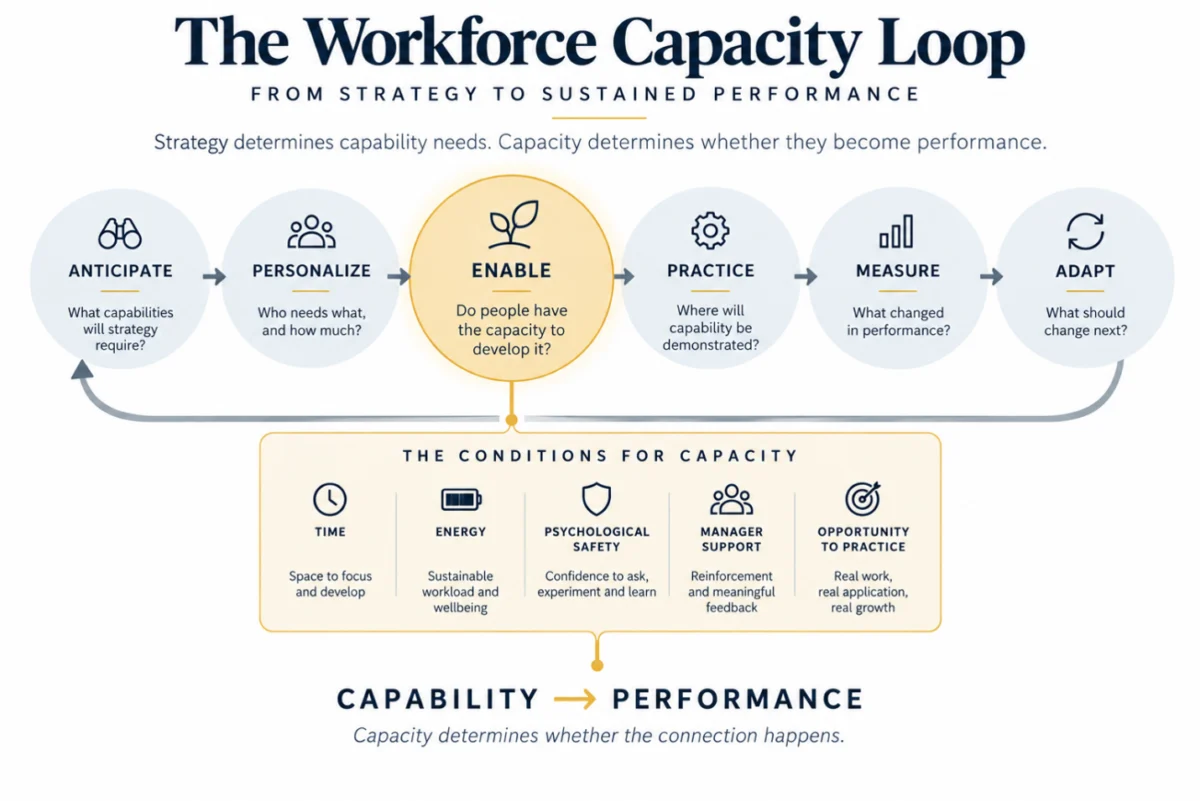
Capability is the potential to perform a task; capacity is the condition that allows that potential to be realized. An employee might have the capability to use a new AI coding tool (the knowledge), but if they are back-to-back in meetings and managing three different project management workflows, they lack the capacity (the time and energy) to integrate that tool into their routine.

H3: Personalization as a Friction-Reduction Tool
For too long, personalization has been viewed through the lens of curriculum—creating a unique path for every learner. In 2027, personalization must shift toward "friction reduction." The goal is not to give the employee more to learn, but to find the shortest credible path between their current state and the required performance.
This means identifying when the solution is not a course, but a performance support tool, a change in workflow, or a clarification of expectations. Sometimes, the most effective "learning intervention" is the removal of a redundant process that is stealing time from the employee’s day.
Conditions for Capability: The Human Element
The conversation around learning in 2027 must expand to include resilience and psychological safety. These are not merely "wellness" topics; they are functional requirements for organizational adaptability.
H3: Psychological Safety as a Learning Metric
If an employee fears that admitting they don’t know how to use a new AI tool will be perceived as a performance failure, they will hide their knowledge gap. Psychological safety is the bedrock of reskilling. Without it, the organization remains blind to the very capability gaps it needs to fill.
H3: The Cost of Cumulative Change
Deloitte’s data on the 10-change-per-year threshold is a warning. Every new initiative competes for the same finite pool of attention. When a learning initiative fails, we must stop blaming the content and start auditing the environment. Did the employees have the psychological space to experiment? Was the management culture supportive of the "mistakes" inherent in learning something new?
Official Perspectives: The 2027 Learning Agenda
Industry leaders and analysts are increasingly aligning on the idea that "continuous reskilling" cannot mean "continuous training." The paradox of the current moment is that AI, while responsible for much of the skill disruption, also provides the tools to solve the capacity crisis.
AI-embedded performance support—guidance provided directly within the workflow—can eliminate the need for traditional, long-form training for many tasks. If an AI agent can guide a user through an infrequent technical process in real-time, the employee no longer needs to spend hours memorizing information that will likely be outdated in six months.
Conclusion: A New Philosophy for the Future
As we look toward the remainder of 2027, the most successful organizations will not be those with the largest libraries of training content. They will be the ones that recognize the precious nature of human attention.
The new "Workforce Capacity Loop" requires that leaders ask five diagnostic questions before launching any new initiative:
- Is this a learning problem, or a process/tool problem?
- Does the employee have the time and energy to absorb this right now?
- What is the least burdensome intervention that will yield the required performance?
- How will we measure the actual change in performance, rather than just completion rates?
- What current initiative can be sunset or simplified to make room for this new requirement?
Learning is abundant; human capacity is not. By moving away from the "more is better" mindset and focusing on creating the conditions for performance, learning leaders can finally move from being a cost center of endless programs to being the architects of sustainable organizational agility. The future belongs to those who protect their people’s capacity as fiercely as they protect their bottom line.