By Industry Analysis Desk
Updated: September 16, 2026
In the rapidly shifting landscape of enterprise technology, the concept of "data sovereignty" has undergone a radical transformation. Once relegated to the dusty corners of legal compliance departments and IT risk assessments, it has emerged as a cornerstone of modern business strategy. According to the latest findings from BARC’s comprehensive 2026 survey, which polled 320 organizations globally, data sovereignty is no longer just about adhering to regional regulations—it is now a critical prerequisite for the safe and effective deployment of AI-driven processes.
The Paradigm Shift: Defining the New Sovereignty
For many years, the term "data sovereignty" was synonymous with data residency—the simple requirement that data generated within a specific jurisdiction, such as the European Union, remains stored on servers located within that region. However, as organizations accelerate their adoption of generative AI, large language models (LLMs), and cloud-native analytics, the definition has expanded.

Today, data sovereignty encompasses the ability of an organization to retain complete control over its data assets, even when that data is processed by third-party AI service providers. It is the bridge between operational agility and risk mitigation. As firms rush to automate decision-making processes, the failure to maintain sovereignty—whether through loss of intellectual property or breach of privacy mandates—poses an existential threat to business continuity.
Chronology of a Transformation: How We Reached 2026
The trajectory of data sovereignty over the last five years has been defined by three distinct phases:
Phase 1: The Regulatory Wake-Up Call (2021–2022)
Following the implementation of the GDPR and the subsequent tightening of digital privacy laws worldwide, businesses were primarily reactive. The focus was on "check-the-box" compliance. Organizations spent millions on legal audits, focusing on where their data lived rather than how it was being utilized.

Phase 2: The Cloud-First Friction (2023–2024)
As corporations migrated wholesale to public cloud environments, they encountered a fundamental conflict: the convenience of centralized cloud platforms versus the necessity of localized data governance. During this period, "sovereignty-by-design" became a buzzword, though practical implementation remained inconsistent.
Phase 3: The AI Imperative (2025–2026)
With the explosion of generative AI, the stakes changed. Companies realized that feeding proprietary data into foundational models without strict sovereignty controls risked leaking trade secrets or infringing upon user privacy. By 2026, sovereignty moved from the legal office to the boardroom, becoming a strategic condition for competitive survival.
Supporting Data: Insights from the 2026 Survey
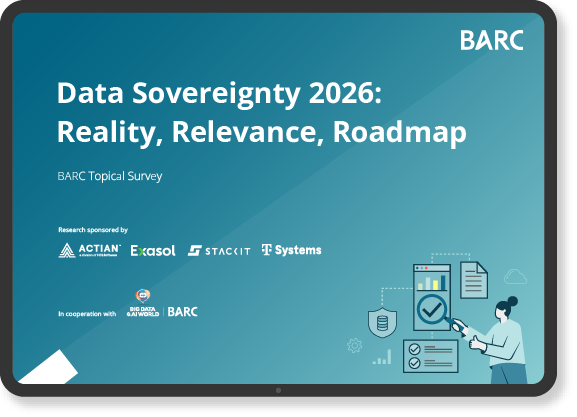
The BARC "Data Sovereignty 2026: Reality, Relevance, Roadmap" study reveals several striking trends among the 320 organizations surveyed:

- Strategic Prioritization: Over 70% of respondents now classify data sovereignty as a "top three" priority for their IT and data architecture teams.
- AI Integration Risks: 64% of companies report that they have slowed or halted AI projects due to concerns regarding the sovereign control of data used for model training or fine-tuning.
- Economic Impact: Organizations that have successfully implemented mature sovereignty frameworks report a 25% increase in speed-to-market for new data products, as they spend less time navigating legal roadblocks during the development phase.
- Vendor Choice: Sovereignty is now a major procurement factor. Software vendors that provide "sovereign cloud" options or localized, air-gapped AI environments are seeing a 40% higher adoption rate among enterprise clients compared to those who do not.
The Expert Perspective: Insights from Timm Grosser and Dr. Carsten Bange
Timm Grosser, Senior Analyst for Data & Analytics at BARC, emphasizes that the technological aspect of sovereignty is only half the battle. "The technical implementation—such as using confidential computing or localized encryption—is the foundation," Grosser explains. "However, the true challenge is organizational. It’s about creating a culture where data governance is viewed as an enabler of innovation rather than a bottleneck."
Dr. Carsten Bange, founder and CEO of BARC, adds that the shift represents a maturing of the digital economy. "Over the past 25 years, we have seen businesses move from basic data storage to complex analytics, and now to autonomous AI systems. Sovereignty is the guardrail that makes this evolution possible. Without it, companies are essentially driving at high speeds without brakes. Our research shows that the most successful firms in 2026 are those that have integrated sovereignty into their core business model, ensuring that they—and not their vendors—maintain the master key to their data assets."
Implications for the Future: What Companies Must Do
The implications of this shift are profound for leadership teams. To remain relevant in 2026 and beyond, organizations must adopt a three-pillar strategy:
1. Architectural Sovereignty
Companies must audit their current cloud architectures. Are they relying on providers that offer transparent data processing? Are they leveraging "sovereign clouds" that allow for local encryption and data isolation? The goal is to ensure that even in a distributed environment, the company retains the right to withdraw or relocate its data at any moment without service degradation.
2. Organizational Alignment
Data sovereignty is not a technical problem; it is a business one. Chief Data Officers (CDOs) and Chief Information Security Officers (CISOs) must work in tandem with the legal department. By treating sovereignty as a product requirement rather than a compliance hurdle, teams can build trust with customers and regulators alike.
3. Vendor Agnosticism
A key takeaway from the 2026 research is the danger of vendor lock-in. As AI capabilities evolve rapidly, businesses must ensure their data architecture remains modular. Relying on a single provider for both infrastructure and AI models creates a single point of failure that is fundamentally incompatible with the principles of data sovereignty.
Navigating the Road Ahead
The "Data Sovereignty 2026" report serves as a roadmap for organizations attempting to navigate this complex terrain. It highlights that while the legal landscape will continue to evolve, the underlying principle remains constant: the value of a business in the AI era is directly tied to the security and control of its proprietary data.
For those lagging behind, the path forward is clear: start by assessing the risk profile of current AI initiatives. Identify where sensitive data flows and ensure that technical controls are in place to govern that flow. As the global economy becomes increasingly data-driven, those who master the art of sovereign control will not only mitigate risk—they will secure a significant competitive advantage.
Conclusion
The findings from the 2026 BARC survey underscore a pivotal moment in the history of enterprise data management. We have transitioned from an era of unchecked data collection to an era of controlled, strategic data utilization. For organizations looking to lead in this environment, sovereignty is the new standard of excellence. It is the mechanism by which companies can harness the power of AI while protecting the intellectual capital that defines their market position.

As Dr. Bange and Timm Grosser suggest, the transformation is ongoing. The businesses that thrive in the coming decade will be those that view data sovereignty not as a constraint, but as a catalyst—a way to build robust, resilient, and high-performing data ecosystems that stand the test of time.
For more in-depth analysis and to access the full findings of the "Data Sovereignty 2026" report, visit the BARC research portal. Access to this and other exclusive content is available through a BARC+ subscription, providing comprehensive insights into the trends shaping the data and analytics world.