For over a decade, the primary objective of any brand’s social media strategy was simple: grow the follower count. The logic was linear and comforting—more followers meant higher reach, which fueled engagement, ultimately driving sales and justifying marketing budgets. It was a cycle of accumulation that defined the "social media manager" job description.
However, in 2026, this playbook is not just outdated; it is fundamentally broken. We have entered the era of the algorithmic feed, a paradigm shift where content is surfaced based on relevance, intent, and engagement metrics rather than the size of a static audience. For brands, the mission has pivoted from audience building to discoverability.
The Algorithmic Shift: Why Follower Count No Longer Matters
Modern social media platforms like TikTok, Instagram, and YouTube are no longer "social graphs" where users see content exclusively from accounts they follow. They have transitioned into "interest graphs." On platforms like TikTok’s "For You" page or Instagram’s Reels tab, the vast majority of viewers have no prior relationship with the creator.
Data from Sprout Social’s 2026 insights confirms this: more than 70% of views on top-performing content originate from non-followers at least 60% of the time. This shift effectively decouples reach from the follower count. Furthermore, consumer behavior has followed suit; only 17% of users report checking an influencer’s follower count before deciding to engage with their content or follow them. In this landscape, follower counts are no longer a "trust signal"—they are a vanity metric that obscures the true drivers of performance: topic relevance, content quality, and authentic engagement.
The Rise of Niche Authority
If follower counts are declining in importance, what has replaced them? The answer is niche authority. Data indicates that buyers are significantly more likely to act on a recommendation from a niche creator (21%) than a mega-influencer (15%).
This preference is rooted in the "authenticity economy." Smaller creators often foster tight-knit communities where their recommendations carry the weight of personal endorsement. Consumers are increasingly discerning, with 80% stating that influencers must actually use the products they promote, and 44% demanding that creators be long-term users of a brand before entering a partnership. These requirements are far easier to meet with micro-influencers whose content feels like a genuine reflection of their lifestyle, rather than a polished, broadcast-style advertisement.
The Human Element: Frontline Employees as Brand Advocates
While external influencers have long dominated the conversation, a new, more powerful force is emerging from within: the frontline employee.
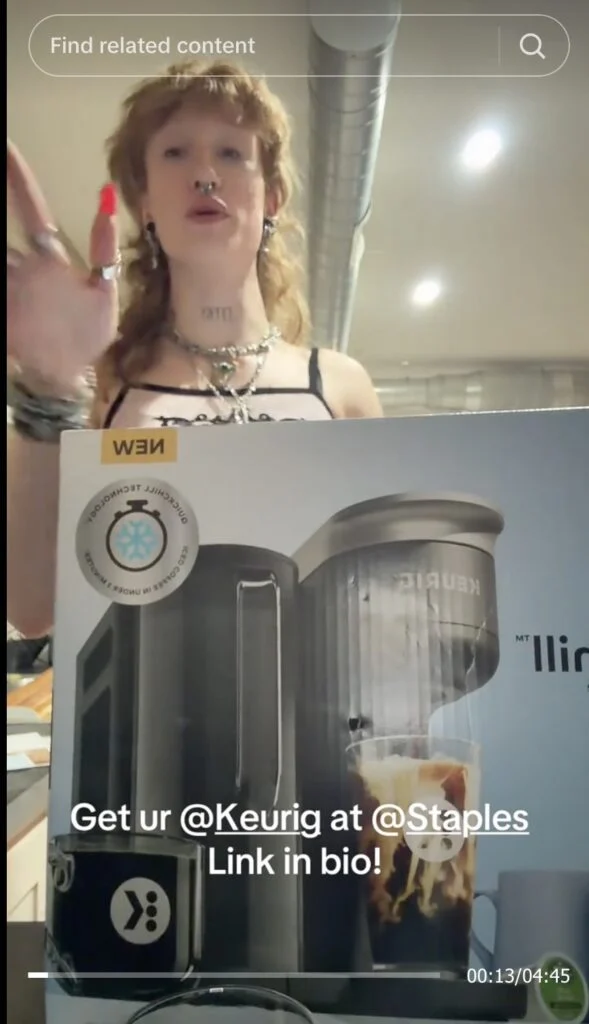
The phenomenon of the "Staples Baddie"—an employee whose unfiltered, humorous, and relatable content about daily office-supply store life went viral—perfectly encapsulates this trend. This isn’t just a trend; it is a fundamental shift in how consumers discover products. 40% of consumers (and 62% of Gen Z) report that employee-generated content influences their product discovery at least monthly.
The Authenticity Gap
Consumers are suffering from "corporate fatigue." They have grown wary of perfectly curated marketing campaigns delivered by the C-suite or polished brand pages. Instead, they want to hear from the barista, the warehouse clerk, or the customer service rep.
This creates an opportunity for brands to leverage their internal talent, but it must be approached with ethical rigor. 61% of consumers believe that employees should be compensated for their content creation work if it falls outside their standard job description. Forward-thinking companies like Gap and Starbucks are already establishing formal employee-advocacy programs. These initiatives provide the necessary guardrails—ensuring brand alignment—while granting employees the creative freedom to remain authentic.
Chronology of the Social Search Evolution
To understand how we arrived at this point, one must look at the evolution of social platforms:

- 2010–2015 (The Follower Era): Social media was a broadcast medium. Growth was measured by the size of the audience "owned" by the brand.
- 2016–2020 (The Engagement Era): Platforms began experimenting with algorithmic sorting, prioritizing high-engagement posts in the feed to keep users on the app longer.
- 2021–2024 (The Recommendation Era): The rise of TikTok-style short-form video shifted the focus entirely to content discovery. The algorithm began deciding what users saw based on interest rather than social connections.
- 2025–2026 (The Search and AI Era): Social media has become a primary search engine. Content is now indexed, searchable, and integrated into AI-driven answer engines, effectively giving social posts a "long-tail" shelf life that can last for years.
Tactical Implementation: Mastering Social Search (SOSEO)
If discoverability is the new goal, then Social Media Search Engine Optimization (SOSEO) is the primary tactic. Social media is now the second most common search destination across all demographics, frequently outperforming traditional search for younger users.
To succeed in this new environment, brands must treat their video content like blog posts. The algorithm "reads" content in ways it never did before:
- Audio Analysis: Algorithms transcribe spoken audio to understand the topic of a video.
- On-Screen Text: OCR (Optical Character Recognition) parses text overlays to index content.
- Captions and Metadata: Every caption must be optimized with the exact keywords your audience uses to find solutions to their problems.
When a brand creates a video that is perfectly optimized for search, it isn’t just competing for space in a follower’s feed; it is competing for permanent space in the platform’s search results.
The Long-Tail Effect: Beyond the Social Network
The implications of these changes extend far beyond the apps themselves. Because Google now features a "Short Videos" tab in search results, and AI answer engines like ChatGPT and Claude scrape social content to synthesize information, a single piece of social content can now drive traffic and brand awareness for months, or even years, after its original posting.
This has transformed social media from a "disposable" medium—where content dies in 24 hours—into a "searchable" medium that builds evergreen equity. Brands that prioritize high-quality, keyword-aligned, and authentic content are no longer just posting; they are building a searchable library of assets that contributes to their broader SEO strategy.
Implications for Future Strategy
The transition to a post-follower era requires a total overhaul of the marketing department’s KPIs.
1. Shift from Audience Size to Reach Efficiency: Stop measuring the success of an influencer by their follower count. Measure it by the relevance of their audience and the engagement rates they generate.
2. Invest in Searchable Content: Every piece of video content should be optimized for discoverability. If the algorithm cannot "read" your video, it cannot recommend it.
3. Formalize Employee Programs: Leverage your internal experts. Create programs that reward employees for sharing their daily professional lives in a way that aligns with brand values, ensuring they are compensated fairly.
4. Audit Your Partnerships: When scouting for talent, prioritize credibility over reach. A creator with 5,000 highly engaged followers in a specific niche is significantly more valuable than a creator with 500,000 followers who lack trust or topic relevance.
Conclusion: The New Path Forward
The "rinse and repeat" cycle of chasing followers is over. We have entered a, more meritocratic era of social media where the best content wins regardless of who produced it or how many people "liked" their account yesterday.
For brands, the message is clear: stop building a walled garden of followers and start building a bridge to the entire internet. By focusing on discoverability, optimizing for social search, and empowering authentic human voices, brands can move beyond the vanity of the follower count and achieve something far more valuable: a permanent place in the consumer’s search journey.
Data Source: Unless otherwise noted, all insights are derived from a Q3 2026 Pulse Survey of 2,286 consumers in the US, UK, and Australia, conducted by Panoplai on behalf of Sprout Social.