Sales and marketing misalignment rarely presents itself as a catastrophic, overnight collapse. Instead, it manifests as a subtle, toxic friction: "qualified" leads that sales representatives refuse to call, marketing campaigns that remain a mystery to the people selling the product, and a pipeline that looks deceptively healthy on a dashboard while actual closed-won revenue begins to stagnate.
According to a comprehensive new study by Unbounce, which surveyed over 500 small-to-medium business (SMB) go-to-market (GTM) professionals, the disparity between perceived and actual alignment has reached a critical juncture. While 87% of teams believe that better synergy between sales and marketing would directly boost performance, only 56% describe their organizations as "highly aligned."
This article unpacks the structural breakdown of GTM teams, the hidden costs of departmental silos, and the specific operating model shifts that separate high-performing companies from those stuck in a cycle of blame.
The Anatomy of the Misalignment Gap
To understand why so many teams struggle, one must first look at what "alignment" actually means. For many, it is a surface-level exercise. It involves a recurring Monday morning Zoom call, a shared Slack channel, and a vague agreement on what a "good" lead looks like. However, the data suggests that these teams are merely building a meeting cadence without fixing the underlying operating model.
The Illusion of Agreement
The 56% of professionals who claim their teams are "highly aligned" are often describing a state of cooperation, not integration. They share information, but they do not share a single source of truth. In these organizations, marketing counts the leads, sales counts the closed deals, and the two sets of numbers refuse to reconcile.

True alignment requires a shared architecture: unified lead data, standardized handoff rules, and, most importantly, success metrics that hold both departments accountable to the same revenue outcomes. When these elements are missing, the team is merely performing the motions of alignment while the system continues to produce conflicting data.
The Executive Perception Gap
One of the most striking findings in the report is the "view from the top." There is a significant disconnect between leadership and the boots-on-the-ground staff:
- 69% of executives report strong alignment.
- Only 47% of non-executives agree with that assessment.
This is a structural information lag. Executives often view alignment through the lens of strategy decks and organizational charts. Non-executives, however, experience it through the daily barriers of data inconsistencies, limited communication, and entrenched silos. When the people executing the strategy feel the process is broken but lack the authority to fix it, the organization suffers from a compounding decay in morale and efficiency.
The True Cost of Siloed Operations
Misalignment is often categorized as a "culture problem," but it is, at its core, a massive operational expense. When the gears of a GTM engine don’t mesh, the friction burns through budget and time.
The Direct Revenue Impact
The consequences of poor alignment follow a predictable, destructive path. First, employee frustration peaks, leading to turnover. Second, operational inefficiencies emerge, characterized by:

- Delayed Follow-up: Marketing generates demand, but sales—distrustful of the lead quality—waits too long to engage, effectively killing the lead’s momentum.
- Duplicated Work: Both teams often spend hours manually cleaning data or vetting leads, draining resources that should be spent on conversion.
- Messaging Mismatch: Prospects are promised a specific solution in a marketing asset, only to be met with a completely different value proposition during a sales call, eroding trust.
Why "Lead Quality" is a Symptom, Not a Root Cause
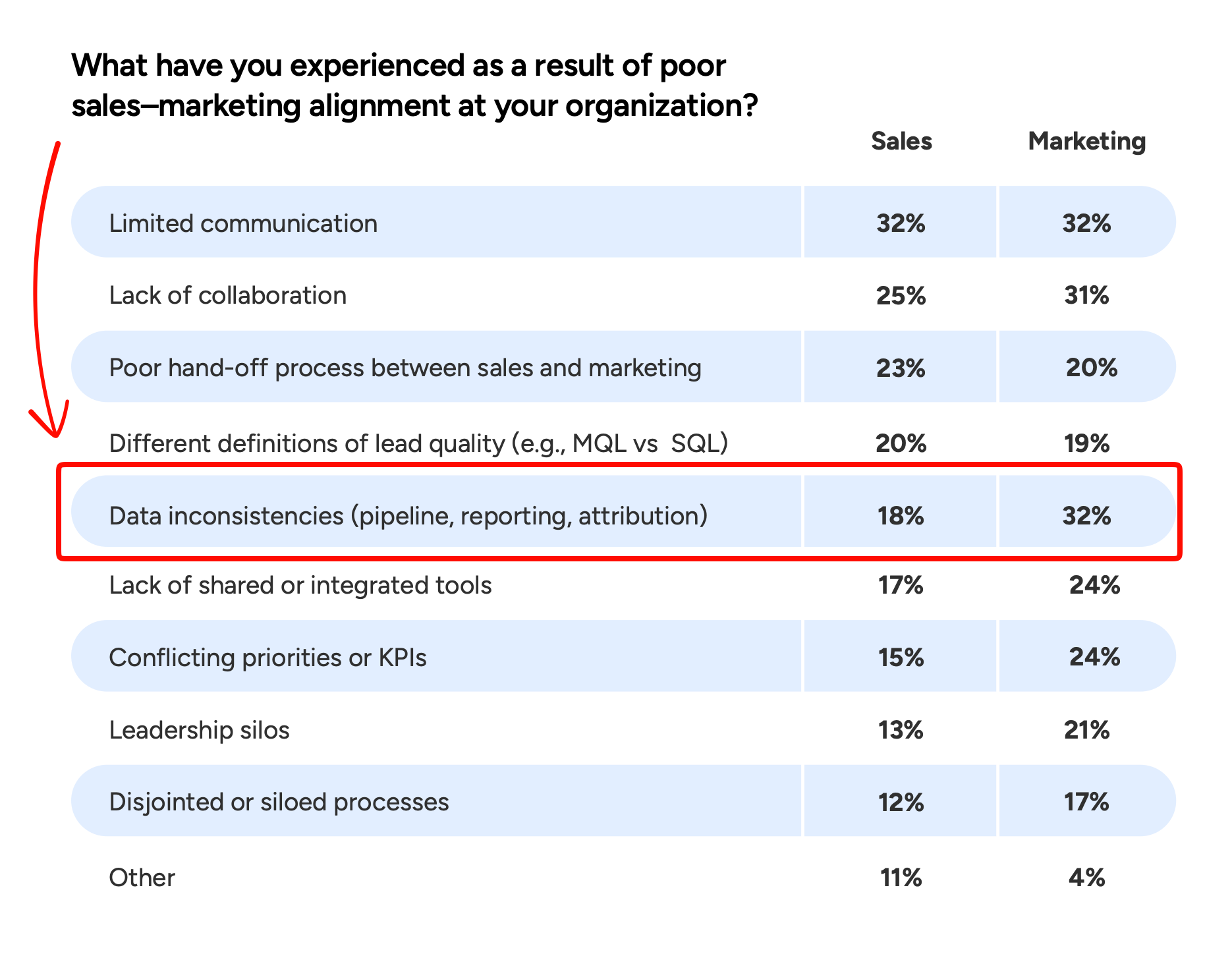
When revenue dips, the standard knee-jerk reaction is to blame the "quality" of leads. Marketing points to the sales process, and sales points to the marketing funnel. However, 23% of sales professionals identify the handoff process—not the lead itself—as the primary barrier. If the handoff is not codified with an agreed-upon Service Level Agreement (SLA), leads will inevitably slip through the cracks. The quality definition is a symptom; the broken process is the disease.
Why Communication Frequency is Not the Solution
A common trap for GTM leaders is the belief that "more communication" will solve the problem. In reality, 54% of teams prioritize meeting frequency as their primary alignment strategy. But as the data shows, you cannot talk your way out of a broken operating model.
Moving Beyond the Meeting Room
High-performing teams focus on the "operating layer." They don’t just talk more; they integrate their systems. They prioritize:
- Integrated Workflows: Utilizing CRM and marketing automation tools that talk to each other in real-time.
- Shared KPIs: Aligning compensation and performance incentives so that marketing isn’t rewarded for volume while sales is rewarded for quality.
- Coordinated Lead Qualification: Establishing firm, data-driven criteria for what constitutes a Sales Qualified Lead (SQL).
Account-Based Marketing (ABM) serves as a gold-standard example of this. In a true ABM model, the account targeting is coordinated by design from the beginning of the campaign, rather than being "stitched together" after a lead has already entered the funnel.
Root Causes: Data, Tools, and Incentives
The Unbounce report identifies four primary root causes for misalignment: operational (53%), goal/incentive-based (43%), cultural (40%), and structural (34%).
The Data Paradox
While 40% of GTM teams report "excellent" cross-functional data sharing, 68% still encounter regular data inconsistencies. This indicates a confidence gap; teams think they are sharing data, but because they are using different systems or definitions, the data itself is fragmented. Marketing looks at attribution dashboards, while sales looks at spreadsheets. These two versions of reality cannot coexist in a high-growth environment.
The "Tool Bloat" Trap
Perhaps the most counterintuitive finding is the impact of software. Many teams believe that buying more tools will solve their alignment issues. However, the data confirms the opposite:
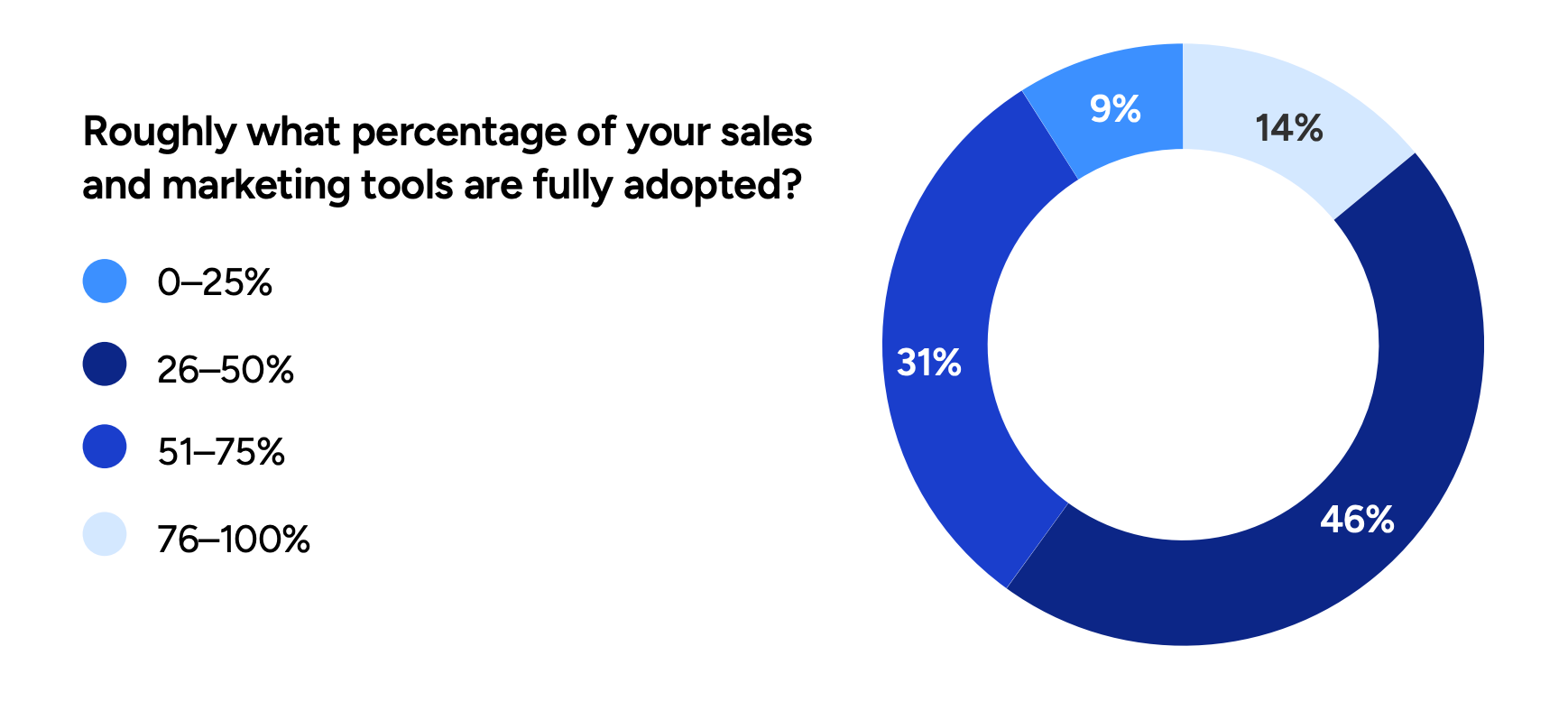
- 56% of GTM professionals struggle with tool bloat.
- 60% of organizations use less than half of the tools they pay for.
The most successful teams are those that consolidate their tech stacks. Leaner stacks with higher adoption rates consistently outperform bloated, complex ecosystems. When tools are rarely used, they become data graveyards, reinforcing silos rather than breaking them down.
The Path Forward: Three Essential Operating Moves
To transition from a siloed organization to an aligned powerhouse, leadership must take three concrete actions.
1. Co-create the Buyer Persona
Buyer personas should not be a "marketing deliverable" that gets handed over to sales. They should be a joint artifact. When sales and marketing sit down to define the ideal customer profile, they create a shared language. This ensures that marketing’s lead generation efforts are targeting the exact pain points that sales hears about on discovery calls.
2. Standardize the Handoff SLA
A functional handoff requires three things: clear documentation of the buyer’s journey, a set timeframe for follow-up, and a feedback loop where sales informs marketing of why a lead was rejected or accepted. This SLA transforms the handoff from a "toss over the wall" into a structured, professional transition.
3. Unify the Reporting Infrastructure
If you cannot measure it together, you cannot improve it together. Teams must move toward a single dashboard that tracks the same KPIs for both departments. When both marketing and sales are measured against the same Customer Acquisition Cost (CAC) and conversion rates, the incentive to collaborate becomes structural rather than optional.
Conclusion: Alignment as a Competitive Advantage
In the current SMB landscape, growth is harder to come by than it was a decade ago. Efficiency is the new revenue. The teams that stop treating alignment as a "soft" cultural goal and start treating it as a rigorous operating model will be the ones that capture market share.
As the industry moves into 2026 and beyond, the focus must shift from how often we meet to how we operate. By unifying data, cleaning up the tech stack, and aligning incentives, organizations can finally turn the "Great Divide" into a unified, high-performing revenue machine. The goal is not just to talk more; it is to ensure that when the sales and marketing teams speak, they are speaking the same language, working from the same data, and chasing the same finish line.