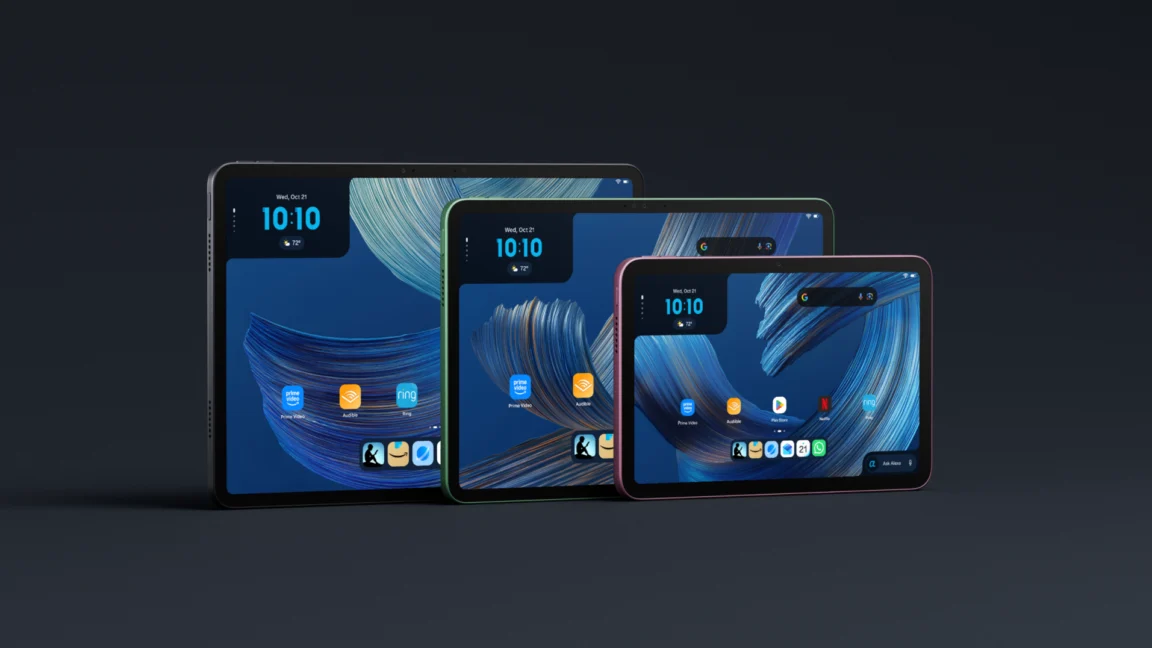
For over a decade and a half, the Amazon tablet experience was defined by a singular, immutable philosophy: extreme affordability paired with a walled garden. Since the launch of the original Kindle Fire in 2011, the company’s hardware strategy relied on Fire OS—a heavily forked, restrictive version of Android that funneled users exclusively toward Amazon’s own ecosystem. Today, that era has officially ended.
In a move that marks the most significant strategic pivot in the company’s hardware history, Amazon has retired the "Fire" branding entirely. In its place, the retail giant has introduced the "Alexa Tablet" lineup, a series of devices that represents a total reconciliation with the broader Android ecosystem. For the first time in the company’s history, Amazon’s tablets are Google-certified, providing full access to the Google Play Store and the millions of applications that once remained out of reach for Fire users.
Main Facts: A Total Architectural Overhaul
The launch of the new Alexa Tablet lineup is not merely a cosmetic rebranding; it is a structural revolution. By shifting from the proprietary Fire OS to a standard, Google-certified version of Android, Amazon has effectively conceded that its attempt to bifurcate the mobile operating system market was ultimately unsustainable.
The new lineup consists of three distinct models, all featuring a premium shift toward unibody aluminum housings, moving away from the utilitarian plastic designs of the previous generation.
- Alexa Tablet 8: The entry-level model, starting at $230.
- Alexa Tablet 11: The mid-range offering, priced at $330.
- Alexa Tablet 12 Pro: The flagship productivity device, starting at $500.
Under the hood, the base models are powered by the MediaTek 8189 processor. While this is categorized as a budget-tier chipset, internal benchmarks indicate a significant performance leap over the aging hardware found in the final iterations of the Fire HD 8 and 10. The flagship 12 Pro, however, pushes into a new performance tier, utilizing the MediaTek Dimensity 8400 processor paired with 8GB of RAM and 128GB of internal storage.
A Chronology of the Fire OS Experiment
To understand why this change is so seismic, one must look back at the trajectory of Amazon’s hardware division.
2011: The Kindle Fire Debut
Amazon introduced the Kindle Fire as a $199 gateway to the Amazon ecosystem. It was a loss-leader, designed to make digital content consumption—books, movies, and music—as frictionless as possible. At the time, it was revolutionary, yet it was clear from the start that Amazon had "de-Googled" the Android base to ensure that every search, purchase, and stream benefited Amazon directly.
2012–2020: The "Good Enough" Years
Throughout the 2010s, Amazon settled into a cycle of incremental updates. The Fire tablets became synonymous with budget tablets—perfect for children, casual video streaming, and basic web browsing. Because the hardware was inexpensive, consumers overlooked the lack of Google services, despite the frustration of the limited Amazon Appstore.
2024: The Strategic Pivot
The writing on the wall appeared last year when Amazon made the quiet, yet definitive, decision to shutter its proprietary Appstore. The move signaled that Amazon had finally realized the maintenance of a parallel mobile ecosystem was a drain on resources and a hindrance to user adoption. By killing the Appstore, Amazon essentially surrendered its sovereignty over the platform in exchange for the vast, thriving ecosystem of the Google Play Store.
2025: The Birth of the Alexa Tablet
Today, the transition is complete. By adopting "Alexa Tablet" as the primary moniker, Amazon is leaning into its most successful brand—Alexa—while admitting that its tablets function best when they play by the rules of the wider Android community.
Supporting Data and Hardware Specifications
The shift in hardware philosophy is perhaps most evident in the flagship Alexa Tablet 12 Pro. Amazon is clearly aiming to capture the market segment currently occupied by mid-to-high-end Android tablets and the base-model iPad.
Display and Productivity
The 12 Pro features a 3:2 aspect ratio, a departure from the 16:10 ratio found on the Tablet 8 and 11. This choice is deliberate, favoring document editing, web browsing, and multi-window productivity over pure media consumption. The screen specs are aggressive: a resolution of 2800 x 1840, a 120 Hz refresh rate, and 500 nits of peak brightness. For an additional $50, users can opt for a matte display finish—a feature frequently requested by creative professionals and heavy readers.
Peripheral Ecosystem
For the first time, Amazon is positioning these tablets as viable productivity tools. The launch includes a $150 keyboard folio and a $90 stylus. This marks the first time Amazon has actively marketed a "Pro" device intended for tasks beyond mere entertainment.
Comparison Table: Old Fire vs. New Alexa Tablets
| Feature | Legacy Fire Tablet | New Alexa Tablet (Series) |
|---|---|---|
| OS | Fire OS (Forked Android) | Google-Certified Android |
| App Ecosystem | Amazon Appstore (Limited) | Google Play Store (Native) |
| Construction | Plastic | Unibody Aluminum |
| Flagship CPU | Custom MediaTek | Dimensity 8400 |
| Google Services | None (Sideloading required) | Full Integration |
Official Responses and Corporate Strategy
Amazon’s leadership has been notably measured in their descriptions of the change. In internal communications and press briefings, the company has framed this as a "reimagining of the connected home and work experience."
"We believe that the future of the tablet is defined by seamless integration," an Amazon spokesperson stated during the launch event. "By moving to a Google-certified Android foundation, we are providing our customers with the best of both worlds: the trusted convenience of Alexa and the vast power and compatibility of the Android software ecosystem."
Industry analysts suggest the shift was prompted by more than just consumer demand. As the tablet market has matured, the "budget" segment has become increasingly crowded by low-cost Chinese imports. By elevating the hardware quality to aluminum unibodies and embracing Google Play, Amazon is attempting to move upmarket, where profit margins are significantly higher than the razor-thin margins of the $99 Fire tablets of yesteryear.
Implications: A New Competitive Landscape
The launch of the Alexa Tablet lineup has profound implications for the tech industry, most notably regarding Amazon’s broader hardware roadmap.
The Divergence of Amazon Hardware
Curiously, while the tablets are moving toward Google’s version of Android, Amazon’s streaming devices—the Fire Sticks and Fire TV Cubes—are moving in the exact opposite direction. As noted in recent reports, these devices are abandoning Android entirely in favor of "Vega OS," a custom, Linux-based operating system. This suggests a bifurcation in Amazon’s strategy: tablets are for productivity and "open" app usage, while living room devices are for locked-down, high-performance media delivery.
The Impact on Competitors
The primary casualty of this move is likely the budget Android tablet market, dominated by brands like Samsung (the A-series) and Lenovo. By pricing the Alexa Tablet 8 at $230, Amazon is aggressively attacking the "mid-premium" space. Because Amazon can afford to subsidize hardware with their retail and Prime service infrastructure, they remain a formidable threat to any manufacturer trying to compete on price-to-performance ratios.
The Developer Perspective
For developers, the death of the Amazon Appstore is a massive relief. No longer must they build, test, and maintain separate packages for Fire OS. The new Alexa Tablets are standard Android devices, meaning that any app optimized for a Samsung or Pixel tablet will work perfectly on Amazon hardware out of the box. This is expected to drive a surge in app quality for the platform.
Conclusion: A Mature Pivot
For fifteen years, the Fire tablet was a peculiar experiment in digital isolationism. It was a device that lived in the Amazon ecosystem and nowhere else. While this served the company’s retail interests, it frustrated users who wanted a more versatile tool.
The transition to the Alexa Tablet lineup is a clear signal that Amazon has grown up. By shedding the limitations of the Fire branding and embracing the standard Android platform, the company is finally providing a tablet experience that can compete on its own merits rather than relying on a captive audience. Whether this will successfully challenge the dominance of the iPad remains to be seen, but one thing is certain: the era of the "Fire" is over, and the era of the "Alexa Tablet" has just begun. For the average consumer, this is a long-overdue, welcome change.