In the modern enterprise, the annual budget cycle is often a chaotic marathon of fragmented spreadsheets, version control nightmares, and manual data reconciliation. While the transition from manual tools like Excel to specialized planning software is frequently framed as a quest for cost reduction, industry leaders are finding that the true value lies elsewhere. According to The Planning Survey 26 by BARC, the most significant ROI for specialized planning tools is found not in headcount savings, but in the qualitative leaps in transparency, planning quality, and frequency.
To secure executive buy-in, finance leaders must move beyond the traditional "cost-savings" narrative. This article explores how to architect a robust, defensible business case that captures the operational and strategic benefits of modern planning platforms.
The Core Thesis: Why Short-Term Savings are a Misnomer
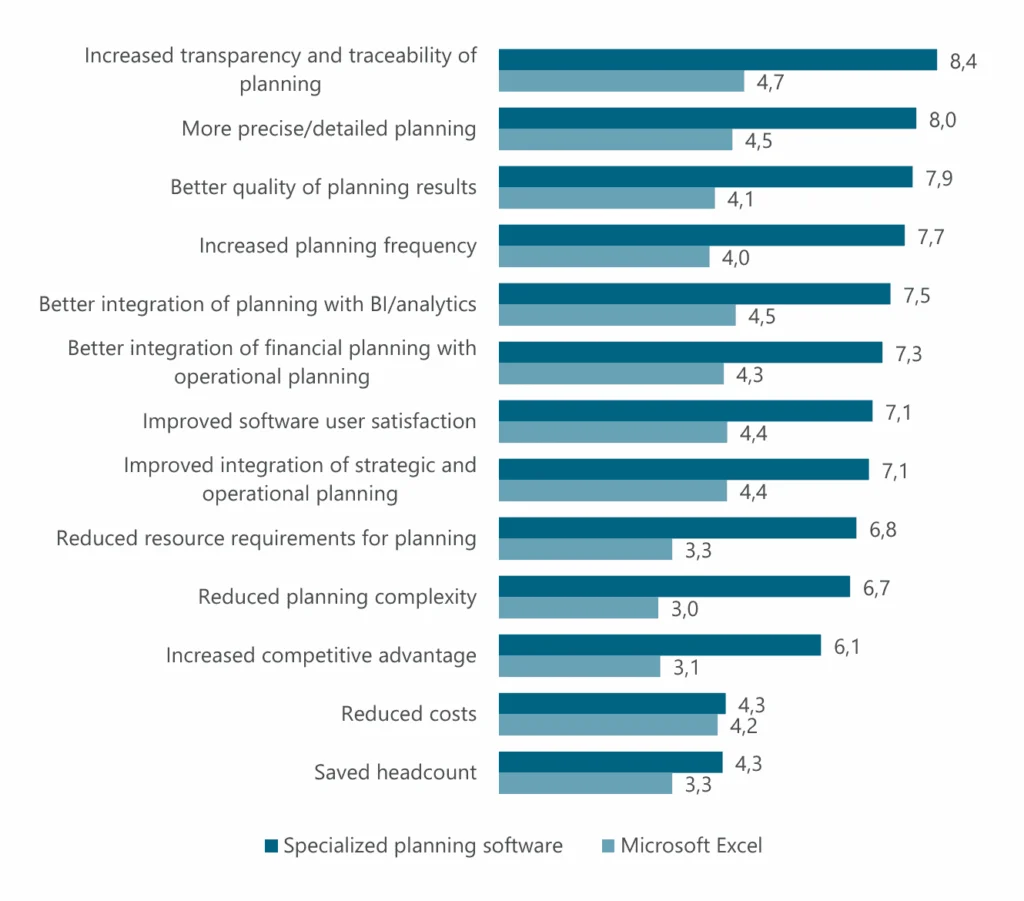
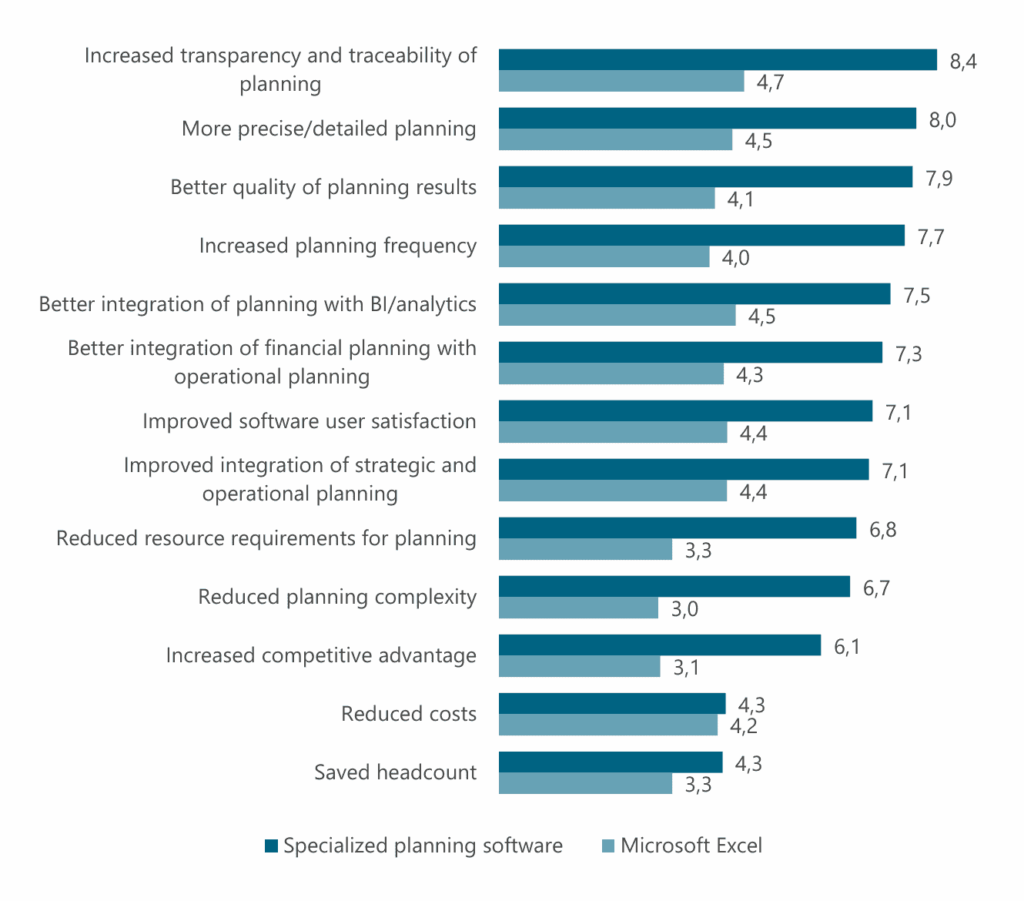
The prevailing myth in corporate finance is that new software should immediately pay for itself through staff reduction or reduced licensing overhead. However, data from The Planning Survey 26 paints a different picture. When analyzing the Business Benefits Index (BBI), specialized planning software consistently scores high on transparency (8.4/10), planning quality (7.7/10), and frequency (7.5/10). In stark contrast, Excel users report scores of 4.7, 4.1, and 4.0, respectively.
Crucially, cost reduction and headcount savings consistently rank at the bottom of the BBI. By focusing exclusively on these metrics, organizations risk ignoring the "hidden" value: the ability to make data-backed management decisions in real-time. A business case built solely on license fees or minor efficiency gains is incomplete; it fails to account for the competitive advantage gained when leadership can trace the logic behind a forecast or compare multi-variate scenarios in a matter of hours, not weeks.
Chronology of an Investment: From Concept to Realization
The journey to a successful planning transformation follows a logical, phased progression. Organizations that skip these steps often find themselves with powerful tools that fail to deliver expected results.
- The Diagnostic Phase: Before engaging vendors, the organization must perform a candid audit of the existing "status quo." This involves quantifying the time spent on manual data collation and identifying the specific "pain points"—such as broken formulas, version drift, or lack of audit trails.
- The Definition Phase: This is where the business case is drafted. It is not merely a request for funds; it is a roadmap. It must define specific KPIs for the five key benefit areas: process efficiency, decision quality, scalability, risk management, and strategic agility.
- The Selection Phase: The business case acts as the North Star for procurement. With a formal, competitive evaluation—a practice utilized by 76% of successful software adopters—the organization can test specific functionalities against the goals outlined in the business case.
- The Implementation & Post-Live Phase: The business case remains a living document. Post-implementation, the organization must measure performance against the original KPIs, creating a feedback loop that justifies the investment and guides future iterations.
Supporting Data: The Excel-to-Specialized Tool Gap
The statistical chasm between specialized tools and spreadsheets is the strongest evidence for the necessity of a dedicated planning platform. The Planning Survey 26 highlights that 87% of specialized software users would recommend their solution to a peer, whereas only 41% of Excel users would say the same for their primary planning tool.

The discrepancy in satisfaction is largely attributed to the central data model. Specialized software acts as a "single source of truth," where actuals, plans, and forecasts are integrated. This eliminates the "spreadsheet silos" where different departments operate on different sets of assumptions. When comparing these figures, it becomes evident that the value proposition is not just about doing the same work faster—it is about doing entirely new types of work, such as rolling forecasts and AI-assisted modeling, which are inherently fragile and error-prone in a flat-file environment.
Strategic Implications: Building the Five Pillars
A convincing business case is structured around five distinct pillars of value. Each requires measurable, verifiable targets.
1. Process Efficiency and "Low-Value" Elimination
The goal here is not to "fire staff," but to "free staff." By automating data loads and centralizing assumptions, the finance team shifts from manual labor to high-value analysis.
- KPIs: Hours spent on manual data consolidation per month, the duration of the budget cycle, and the number of manual interventions required for monthly variance reporting.
2. Decision Quality and Transparency
An integrated solution provides a clear audit trail. When management asks, "Why is the forecast lower for Q4?" a specialized system allows for immediate drill-down into the drivers.
- KPIs: Time-to-answer for management inquiries, consistency across departmental sub-plans, and the frequency of re-forecasting based on market volatility.
3. Scalability and Future-Proofing
As businesses grow through M&A or expansion, Excel-based models often collapse under the weight of new data entities. The business case should evaluate the cost of "breaking" a spreadsheet model versus the scalability of a cloud-native platform.
- KPIs: Effort required to add a new legal entity to the planning process and the time required to perform global model changes.
4. Risk Mitigation and Governance
The risks of spreadsheets—broken links, security leaks, and lack of version control—are often understated.
- KPIs: Number of reported data errors in final board reports, incident reports related to data security breaches in finance files, and the level of compliance with internal audit requirements.
5. Strategic Agility
This is the "advanced" stage. AI and scenario modeling require a high level of data maturity. The business case must outline the prerequisites (data cleaning, process standardization) needed to unlock these features.
- KPIs: Number of "what-if" scenarios evaluated per quarter and the accuracy of AI-assisted forecasts compared to manual projections.
Official Perspective: The Role of Independent Guidance
Industry experts and analysts at BARC consistently emphasize that the investment decision is only the beginning. The failure to treat the business case as a benchmark for selection is a common pitfall. As noted in the study, 72% of Excel users utilize the tool without any formal evaluation process. This lack of rigor is why many digital transformation projects in finance stall.
Independent advisory services, such as those offered by BARC, play a critical role in bridging this gap. By providing a neutral framework for requirements analysis and Proof of Concept (PoC) testing, these services ensure that the software selected is not just "market-leading," but specifically suited to the organization’s unique operational maturity and strategic objectives.
Conclusion: A Living Business Case
The ultimate takeaway for modern CFOs and finance leaders is clear: the business case for specialized planning software is not a one-time document designed to appease a budget committee. It is a strategic mandate. By focusing on the five pillars of benefit—efficiency, transparency, scalability, risk, and agility—finance departments can move away from being "spreadsheet clerks" and become true strategic partners to the business.
When the dust settles after an implementation, the most successful companies are those that look back at their business case not as a static budget request, but as a performance scorecard. By holding the new system accountable to these metrics, finance leaders ensure that the investment continues to deliver value long after the initial go-live, ultimately transforming the planning process from a reactive chore into a competitive weapon.
For those ready to embark on this transformation, the first step is to document the "pain" of the current state with absolute honesty. Only by measuring the cost of inefficiency can you truly justify the investment in the future of your organization’s planning intelligence.