In the modern digital economy, there is a prevailing dogma: growth is synonymous with headcount. Business owners are conditioned to believe that to scale revenue, one must expand the team, occupy a larger office, and increase the complexity of operations. However, a growing body of evidence—and the experience of high-performing e-commerce entrepreneurs—suggests that this "growth at all costs" mentality is often the primary driver of stagnant profitability and chronic founder burnout.
The Myth of Scale: A Case Study in Simplification
Consider the narrative of a store owner who managed a team of 35 employees. On the surface, the business appeared successful; revenue was robust and market position was strong. Yet, beneath the veneer of success, the owner was trapped in a cycle of diminishing returns. Profit margins were razor-thin, and the daily burden of managing 35 staff members had effectively become a full-time, high-stress occupation that left little room for strategic foresight.
Faced with mounting pressure, the owner initiated a radical restructuring. He transitioned the business to a fully remote model, outsourced logistics to a Third-Party Logistics (3PL) provider, and replaced a bloated full-time staff with a lean, specialized team of eight contractors and one dedicated employee.
The results were transformative. With the removal of heavy overhead and the simplification of the organizational structure, the company’s profitability reached historic highs. More importantly, the founder’s quality of life improved as the operational complexity plummeted. This anecdote serves as a microcosm for a broader trend: in many cases, scaling revenue is not the solution to a business’s problems—scaling efficiency is.

The Research: Operational Leanness vs. Marketing Cleverness
When analyzing data across hundreds of e-commerce businesses, a clear pattern emerges that defies conventional wisdom. Many founders assume that their struggles are rooted in marketing inefficiencies—that if they could just improve their Return on Ad Spend (ROAS) or refine their SEO strategy, profitability would follow.
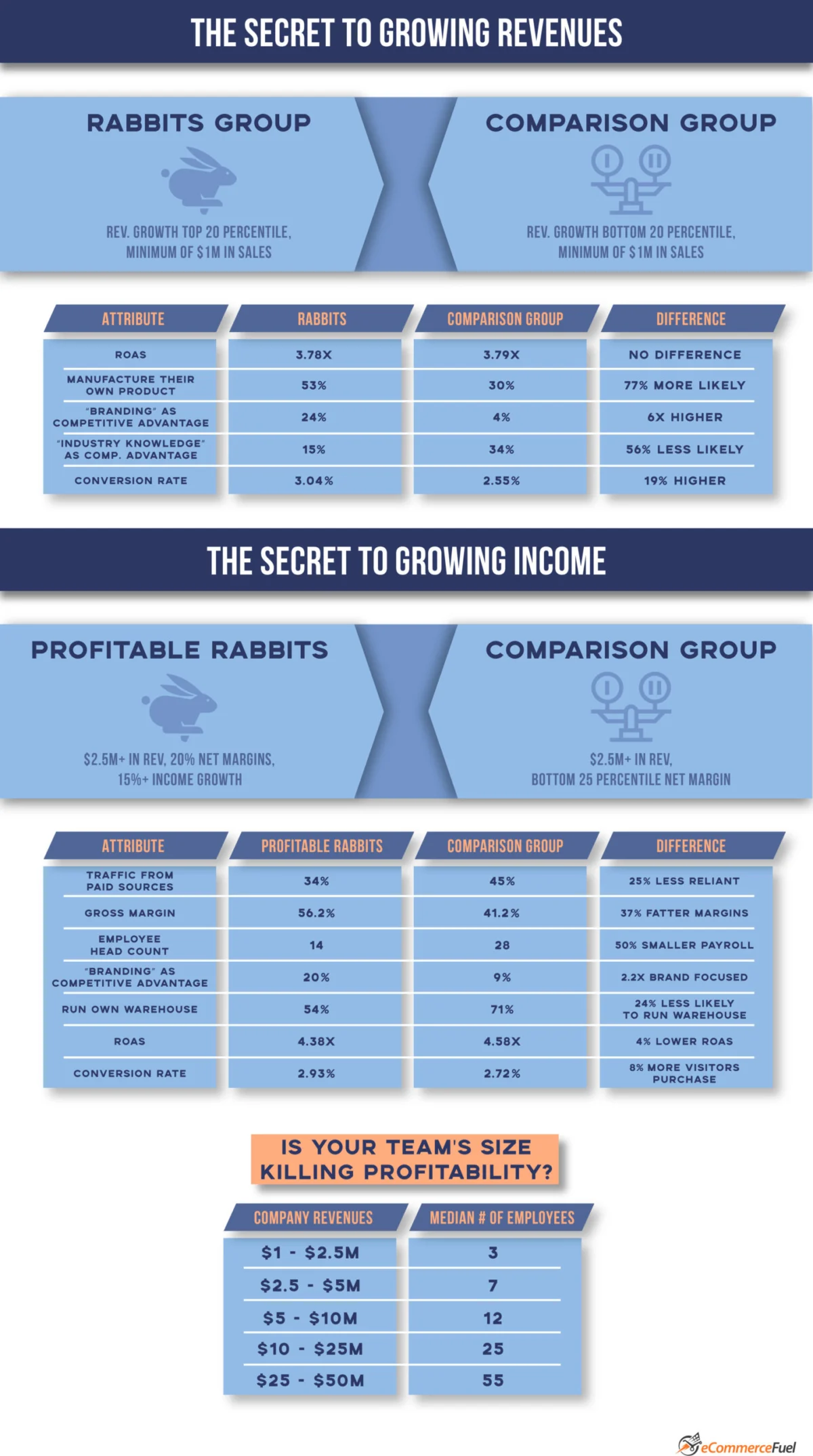
However, the data tells a different story. The variance in ROAS between top-tier performers and those struggling to break even is often negligible. The market leaders were not necessarily more adept at running Facebook ads or navigating Google’s algorithm updates. Instead, the primary differentiator was their structural approach to operations.
Key Performance Indicators (KPIs) of Top Performers:
- Lean Payroll: Top-performing stores typically operate with half the payroll of their peers.
- Strategic Outsourcing: They are 25% more likely to outsource warehousing and fulfillment, moving fixed costs to variable costs.
- Traffic Diversification: They are 25% less reliant on expensive, high-risk paid traffic, focusing instead on organic growth and customer retention.
The conclusion is inescapable: operational leanness beats marketing cleverness every time. A business that spends less on non-essential overhead and relies on efficient fulfillment systems creates a buffer that allows it to survive—and thrive—during market volatility.
Defining "Lean": Beyond Simple Headcount
When entrepreneurs hear the term "stay lean," they often immediately equate it to layoffs. While managing labor costs is a component, true operational leanness is a holistic philosophy that targets all forms of "bloat."

Overhead is often silent and incremental. It manifests in the commercial real estate lease that seemed necessary in 2019 but now hosts empty desks; it is the warehouse space maintained at a high cost when a 3PL could execute the same task with greater agility; it is the "SaaS creep"—the dozens of software subscriptions and automated services that silently drain thousands of dollars from the bottom line annually.
To achieve true leanness, owners must apply a rigorous filter: What is core to the brand’s value proposition? If high-end design is the company’s competitive advantage, keep the creative team in-house. If logistics and fulfillment are merely utility functions, there is no strategic reason to manage them internally. The most profitable businesses are not those that cut costs randomly; they are those that are ruthlessly intentional about where they allocate resources.
The Power of Proactive Hard Conversations
A fundamental truth of leadership is that success is often measured by the number of difficult, uncomfortable conversations a leader is willing to have. Most entrepreneurs, however, operate in a reactive state. They wait until a recession hits, until cash flow turns negative, or until a crisis makes change unavoidable.
The most successful owners are proactive. They initiate these hard conversations during periods of growth, not just during periods of distress. They ask the difficult questions:

- "Did we hire this person because the business truly needed the role, or because we felt busy?"
- "Are we paying for this tool because it drives revenue, or out of habit?"
- "If we were forced to cut 25% of our operating expenses tomorrow, what would we lose first?"
By answering these questions before they are forced to, these leaders build resilient organizations that are structured for profit rather than just "busyness."
The Second Unsexy Lever: Tax Architecture
Beyond operational efficiency, there exists a secondary, often ignored lever for profitability: tax optimization. Many business owners treat taxes as an unavoidable, fixed cost—a percentage of revenue that must be surrendered to the government. Consequently, they miss massive opportunities to retain wealth within the business and for their families.
A Tale of Two Owners
To illustrate the impact, consider two businesses with identical financials: $2.5 million in revenue and $250,000 in profit.
Owner A adopts a passive approach, treating taxes as a "set it and forget it" expense. They pay approximately $75,000 in annual taxes.

Owner B treats taxes as a strategic variable. By implementing a series of legal, deliberate, and proactive tax strategies, they reduce their annual tax burden to $21,000—a savings of $54,000 annually.
The Mechanics of Optimization:
- Profit Sharing: By utilizing advanced retirement vehicles rather than standard 401(k) plans, the owner shelters significantly more income while simultaneously building long-term wealth.
- Appreciated Stock Donations: Instead of donating cash to charity, the owner donates appreciated stock. This eliminates capital gains taxes while providing a full tax deduction for the fair market value.
- HSA Maximization: Leveraging the triple-tax-advantaged nature of Health Savings Accounts creates a powerful, tax-free vehicle for long-term health costs.
- Family Integration: By employing their children to perform legitimate, age-appropriate work, the owner shifts income into lower tax brackets and funds the children’s future through tax-advantaged Roth IRAs.
- Inventory Liquidation: Donating slow-moving inventory to charity rather than liquidating it at a loss allows for a deduction at fair market value, turning a dead-stock liability into a significant tax asset.
The Invisible Problem: Why We Miss These Levers
Why is the gap between Owner A and Owner B so wide? The answer lies in fragmentation. Financial information in a business is often scattered across personal tax returns, corporate filings, brokerage statements, and payroll reports. There is rarely a single dashboard that provides a holistic view of the owner’s total tax liability.
Furthermore, there is a fundamental misunderstanding regarding the role of a CPA. A "fine" accountant is one who ensures filings are accurate and compliant. However, a "fine" accountant rarely provides proactive tax strategy. They process the data provided to them; they do not typically engineer the financial architecture of the business.
The $54,000 difference is not the result of tax evasion; it is the result of intentionality. If a CPA is not initiating conversations about these strategies, the business owner is likely leaving significant capital on the table.

Conclusion: The Path to Sustainable Profitability
In the pursuit of business growth, it is easy to become distracted by the metrics that garner the most attention: CAC (Customer Acquisition Cost), LTV (Lifetime Value), and ROAS. While these are essential, they are not the only drivers of success.
The owners who win in the long term are those who recognize that profitability is a multi-front war. It is won by maintaining a lean, agile team, by being ruthless about removing operational bloat, and by managing the "unsexy" side of the balance sheet, such as tax architecture.
Better marketing may help you acquire customers, but operational efficiency and strategic tax planning ensure that you keep more of the profit those customers generate. For the entrepreneur looking to move from a high-revenue, high-stress cycle to a high-profit, sustainable future, the first step is often to stop looking for more customers and start looking at how much of the business is truly essential.