In the sprawling ecosystem of European e-commerce, few entities command as much gravity as Amazon. A comprehensive new study conducted by the Institut für Handelsforschung (IFH KÖLN) and General Evidence has laid bare the staggering extent of Amazon’s influence within Germany. The data paints a picture of a retailer that has evolved from a simple online bookstore into the central nervous system of German consumerism, dictating the flow of capital both online and, increasingly, within the physical retail sector.
With a market share that now commands 63 percent of Germany’s total online retail spending, Amazon is no longer just a participant in the market; it is the market. As the company continues to refine its logistics, expand its Prime subscriber base, and integrate its third-party marketplace, its footprint—both direct and indirect—has reached a level of saturation that presents profound questions for the future of European commerce.
Main Facts: The Numbers Behind the Giant
The report, titled "Neue Dynamik im Amazon-Markt" (New Dynamics in the Amazon Market), offers a forensic look at the platform’s performance over the last fiscal year. Amazon’s total sales volume in Germany hit a remarkable 69.1 billion euros, representing a year-on-year growth of 3.2 billion euros—or roughly 5 percent.
The Power of the Marketplace
Perhaps the most striking takeaway from the study is the distribution of this revenue. Amazon acts as both a retailer and a platform host. While Amazon’s own direct retail sales accounted for 17.2 percent of total online spending in Germany, its "selling partners"—the third-party merchants who rely on the platform’s infrastructure—accounted for a massive 46.1 percent. This symbiotic relationship between the platform and its independent sellers is the engine of Amazon’s dominance.
The Consumer Baseline
The saturation of the German market is near-total. According to the consumer survey, 97 percent of German online shoppers have purchased from Amazon. Perhaps more importantly, 59 percent of these shoppers are Prime members, a subscription status that effectively locks consumers into the Amazon ecosystem, creating a recurring revenue stream and reinforcing habitual shopping patterns.
A Chronological Evolution of Dominance
Amazon’s rise in Germany was not an overnight phenomenon, but rather the result of decades of strategic infrastructure investment and consumer behavior conditioning.
- The Early Years (Late 90s – Mid 2000s): Amazon entered the German market with a focus on books and media. During this period, it established the foundational trust required for online payments and logistics, setting the standard for customer service that traditional German retailers were slow to match.
- The Marketplace Pivot (2010s): The shift to a marketplace model allowed Amazon to scale horizontally. By inviting third-party sellers, Amazon removed the burden of inventory management while simultaneously increasing the diversity of its catalog, effectively turning the platform into a "one-stop-shop."
- The Prime Era (2015 – Present): The introduction of Prime transformed Amazon from a destination site into a utility. By bundling delivery speed, streaming services, and exclusive deals, Amazon changed the perception of "cost" in retail, making the convenience of the platform worth more than the potential savings of shopping around.
- The Current Competitive Landscape (2024 – 2025): We are currently witnessing a dual-front war. While Amazon maintains its lead, it is now contending with the "Asian influx" of Temu and Shein, which are challenging Amazon’s dominance in the price-sensitive segments of the market.
Supporting Data: The Retail Footprint
The study by IFH KÖLN is notable for its analysis of the "total retail" impact, moving beyond the silo of e-commerce.
The Offline Influence
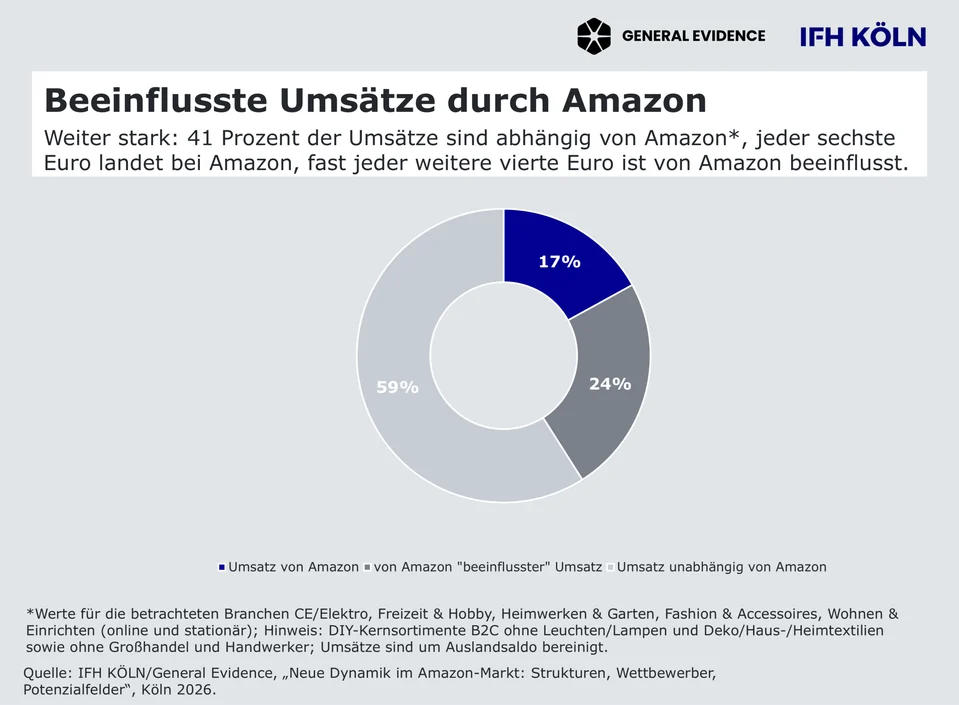
Amazon’s influence is not limited to the digital screen. When analyzing the product categories studied, Amazon accounts for 17 percent of all retail spending (combining both online and offline channels). Even more significantly, the study suggests that Amazon influences an additional 24 percent of spending. This "halo effect" occurs when consumers research products on Amazon—using it as a massive, real-time product database—before choosing to purchase the item elsewhere, or conversely, seeing an item in a physical store and checking Amazon for a better price or reviews.
The Competitive Landscape
While Amazon remains the clear leader, the study highlights shifting tides:
- The Domestic Competitors: Germany’s traditional retail giants, Otto and Zalando, saw a combined sales increase of 1.4 billion euros. This indicates that while they are losing the "all-encompassing" battle, they remain vital players in their respective niches.
- The Emerging Threat: Shein and Temu recorded a combined growth of 1 billion euros. While this figure is lower than Amazon’s 3.2 billion, the velocity of their growth is causing alarm among industry analysts. One in eight Amazon shoppers now admits to shifting some of their purchase behavior toward these Chinese platforms, primarily driven by extreme price sensitivity.
Official Responses and Industry Outlook
The report has sent ripples through the German business community. Representatives from retail associations have used these figures to reiterate their calls for stronger antitrust regulation, arguing that Amazon’s dual role as both a seller and a platform operator creates an inherent conflict of interest that tilts the playing field.
In official commentary, researchers from IFH KÖLN noted that while Amazon is facing competition, it remains the "gold standard" in the minds of the average German consumer. "On key performance indicators such as product range, ease of ordering, and delivery speed, Amazon still clearly performs best from the consumer’s perspective," the study states. This "convenience moat" is exactly what makes the giant so difficult to displace, even as price-focused competitors gain ground.
Amazon has responded by emphasizing its continued investment in the German logistics network. By pouring hundreds of millions of euros into distribution centers and local delivery partnerships, the company is effectively doubling down on the infrastructure that makes its dominance possible, signaling to competitors that it intends to defend its market share through operational superiority.
Implications: The Future of German Retail
The data presented by IFH KÖLN serves as a wake-up call for the European retail sector. There are three primary implications for the years ahead:
1. The Consolidation of Choice
As Amazon’s influence continues to permeate both online and offline retail, the risk of "platform bias" grows. When a single company controls the search engine for products, the logistics network for delivery, and the marketplace for competition, the neutrality of the marketplace is compromised. Smaller merchants may find that they have no choice but to sell through Amazon to survive, effectively turning themselves into "tenant farmers" on the platform’s digital land.
2. The Polarization of the Market
The emergence of Shein and Temu suggests that the German market is splitting. On one side, we have the "convenience-first" consumer, anchored by Amazon Prime and high service expectations. On the other, we have the "price-first" consumer, who is willing to sacrifice delivery speed and brand reliability for deep discounts. Traditional retailers like Otto and Zalando are caught in the middle, forced to compete on both quality and value.
3. Regulatory Challenges
With Amazon directly or indirectly influencing 41 percent of spending in the categories studied, the threshold for regulatory intervention has likely been crossed. The European Union’s Digital Markets Act (DMA) is designed to curb the power of such "gatekeepers," and the IFH KÖLN data provides the empirical evidence necessary for regulators to potentially impose stricter requirements on Amazon’s data-sharing practices and algorithmic transparency.
Conclusion
Amazon’s position in Germany is a testament to the power of logistics-led growth and consumer-centric innovation. However, as the retail landscape matures, the company’s dominance is facing a twofold challenge: the scrutiny of regulators concerned with market fairness and the rise of lean, price-aggressive competitors from abroad. While Amazon continues to grow in absolute terms, the "New Dynamics" identified in this study suggest that the era of uncontested, exponential dominance may be entering a new, more contested phase. For the German retail sector, the coming years will be defined by how local players adapt to a market where the platform is as important as the product itself.