For decades, the jingling of change and the crisp rustle of paper bills were the quintessential sounds of the American economy. Yet, as of 2026, those sounds are becoming increasingly rare. A profound shift in consumer behavior has taken root: the rapid, systematic abandonment of physical currency in favor of digital and card-based transactions. According to recent data from the Pew Research Center and the Federal Reserve Bank of Atlanta, the U.S. is marching toward a near-cashless society at an accelerated pace.
Main Facts: The Decline of Tangible Currency
The statistics are striking. Since 2015, the proportion of Americans who report using cash for all—or even most—of their weekly purchases has been sliced in half, plummeting from 24% to a mere 12%. Perhaps more telling is the rise of the "cash-free" consumer. Today, 42% of Americans say they do not use cash for a single purchase in a typical week, a significant jump from the 24% recorded just over a decade ago.
This isn’t merely a shift in convenience; it is a fundamental transformation of the transactional landscape. The ubiquity of the smartphone, the rise of tap-to-pay technology, and the aggressive expansion of digital wallets have made carrying a physical wallet feel, for many, like a relic of a bygone era.
While cash remains legal tender and continues to play a vital role for unbanked populations and those wary of digital tracking, its utility as a primary medium of exchange is waning. As Americans shed their paper money, they have migrated toward credit and debit cards, which now serve as the dominant backbone of the national economy.
A Chronology of the Cashless Transition
To understand how we arrived at this point, one must look at the trajectory of payment evolution over the last ten years.
The Pre-Digital Era (2015)
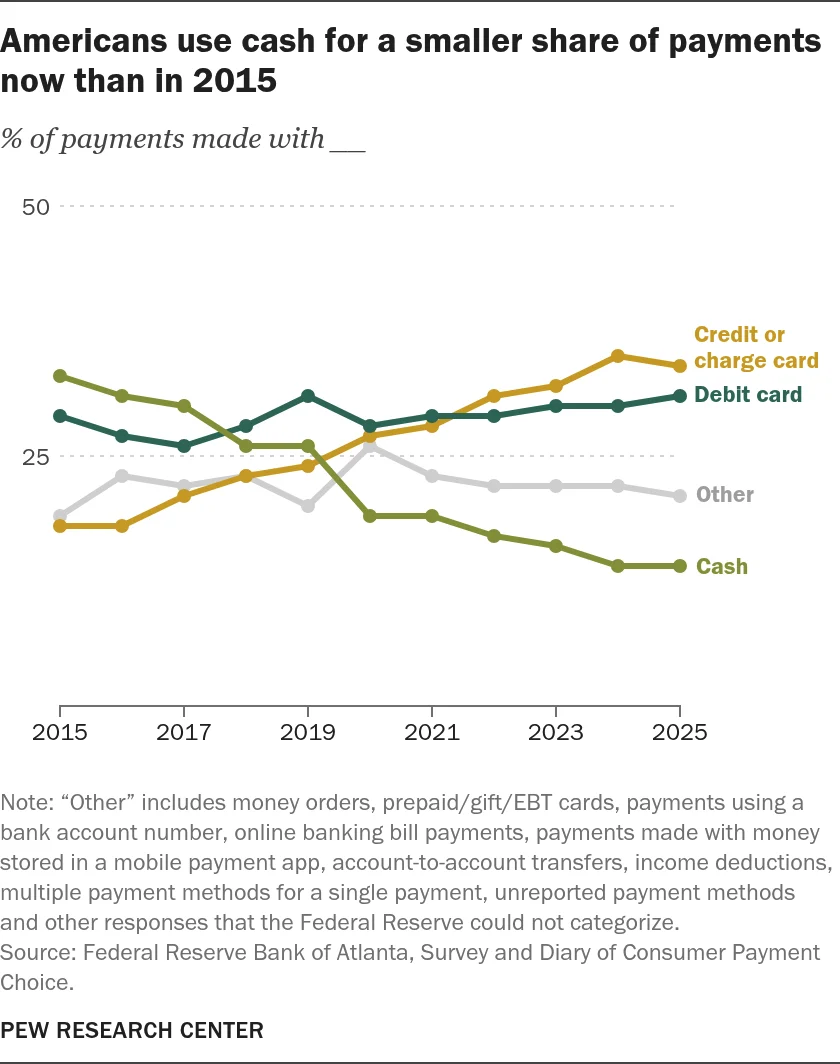
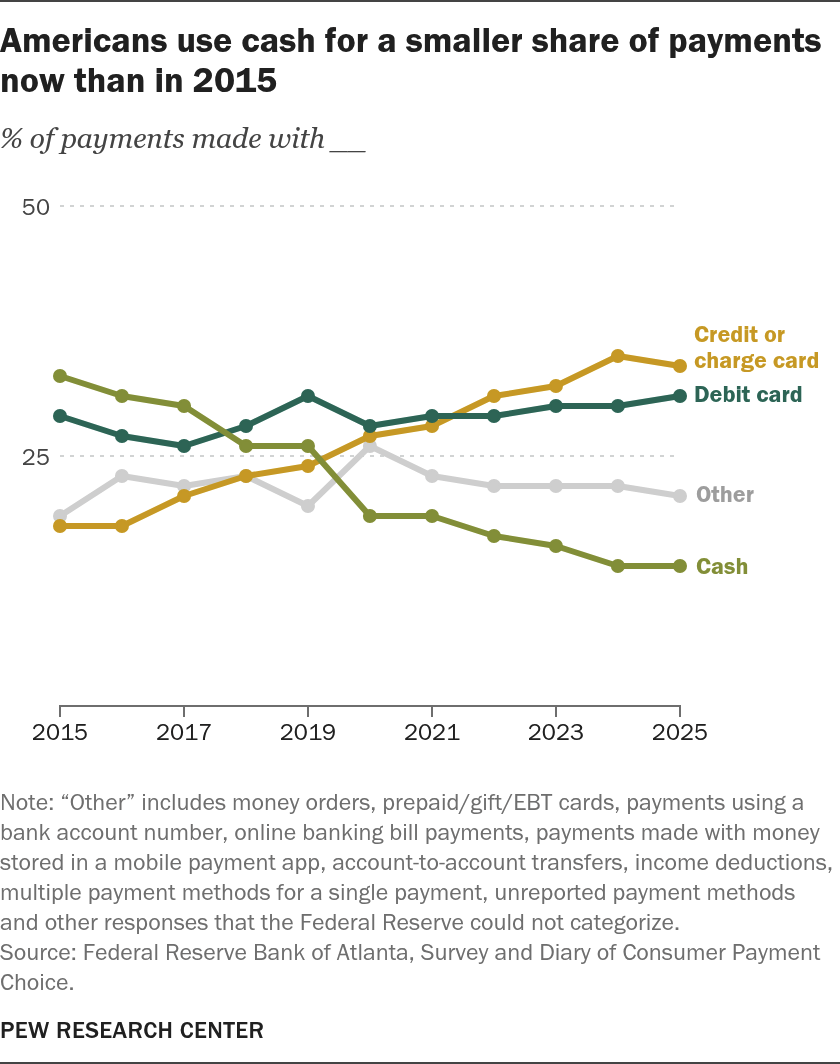
In 2015, cash was still king. It was the most utilized payment method in the country, accounting for roughly one-third of all consumer transactions. Debit cards followed closely at 29%, while credit cards lagged at 18%. At that time, "other" methods—including nascent mobile apps and online banking—made up the remaining 19%.
The Tipping Point (2018)
The year 2018 marked a major psychological and economic turning point. For the first time in modern records, the share of payments made via debit cards eclipsed those made with cash. This signaled that consumers were no longer just using cards for large purchases; they were beginning to rely on them for the everyday "small-ticket" items that were once the sole domain of the twenty-dollar bill.
The Acceleration (2020–2022)
The COVID-19 pandemic acted as a massive catalyst for this shift. Hygiene concerns regarding the handling of currency and the forced migration to online shopping during lockdowns pushed millions of Americans to adopt contactless payment methods. By 2022, the trend had solidified: credit cards began to outperform debit cards in terms of frequency of use, a trend that has held steady through the mid-2020s.
The Current Landscape (2025–2026)
By 2025, the hierarchy of payments had been completely inverted compared to 2015. Credit cards now lead the pack at 34% of all transactions, followed by debit cards at 31%. Together, these two forms of plastic—or digital—payment represent nearly two-thirds of all commerce in the United States. Cash has been relegated to the third spot, representing just 14% of transactions.
Supporting Data: Transactional Dynamics
The Federal Reserve Bank of Atlanta’s Survey and Diary of Consumer Payment Choice provides the granular data necessary to understand this movement. It reveals that how we pay is often dictated by how much we are spending.
There is a distinct "value hierarchy" in payment methods. In 2025, the average cash transaction hovered around $58. This suggests that while cash is still used, it is primarily reserved for mid-sized, everyday purchases. In contrast, credit card transactions averaged $80, and debit card transactions averaged $74.
At the extremes, the divide is even clearer. Purchases involving prepaid, gift, or EBT cards are typically smaller, averaging roughly $35. Conversely, "high-friction" or high-value transactions—such as rent, mortgage, or major service bills—are dominated by checks, online banking, and direct account transfers. These transactions average between $400 and $700, reflecting the reality that while we use our phones for coffee, we still rely on institutional banking protocols for our most significant financial obligations.
Official Perspectives and Research Methodology
The Pew Research Center, in conjunction with the Federal Reserve, has invested significant resources into tracking these shifts to inform policymakers and the public. The methodologies employed are rigorous: the Federal Reserve’s Survey and Diary of Consumer Payment Choice requires participants to log every transaction over a three-day period, providing a real-time window into the actual behavior of U.S. adults.
This data is crucial for economists monitoring inflationary pressures and the velocity of money. As the economy becomes more digital, the Federal Reserve gains better data but also faces new challenges regarding financial inclusion. The "digital divide" remains a concern; for the elderly, the rural poor, and the unbanked, a transition to a cashless society could pose significant barriers to economic participation.
Furthermore, the "preference" vs. "practice" gap is narrowing. Today, nine-in-ten credit and debit card users are using those methods by choice. Conversely, 70% of cash users are actually using cash only because they feel they have no other choice or are fulfilling a specific need, rather than as a primary preference. The cultural affinity for cash is being replaced by a pragmatic reliance on digital credit.
The Implications of a Cashless Future
The move away from cash has profound implications for American society, spanning privacy, consumer debt, and the future of banking.
1. The Death of Privacy
Every digital transaction leaves a data trail. Unlike cash, which offers anonymity, credit and debit card payments are tracked, analyzed, and often monetized by financial institutions and third-party data brokers. As cash disappears, the ability to make a truly private transaction in the United States is rapidly vanishing.
2. The Debt Trap
The rise of credit card dominance is a double-edged sword. While credit cards offer rewards, security, and convenience, they also facilitate impulse spending and high-interest debt. The shift from debit to credit cards—now the most used payment method—may suggest a growing reliance on credit to manage monthly cash flow, a trend that could leave American households more vulnerable during economic downturns.
3. Financial Inclusion and Systemic Risk
A cashless society is inherently exclusionary toward those who do not have access to banking services. Furthermore, total reliance on electronic payments introduces systemic risk. If a widespread cyberattack or grid failure were to disable the payment processing infrastructure, a society without cash would face an immediate, catastrophic freeze of commerce.
4. The Future of Banking
The decline of cash forces banks to rethink their physical footprint. As fewer people visit branches to withdraw cash, the "bank branch" is increasingly becoming a hub for advisory services rather than transactional banking. This transformation will likely lead to further branch closures, potentially hurting small towns that rely on local physical banks.
Conclusion
The data is clear: the American relationship with money has undergone a tectonic shift. We are moving toward an era where the concept of "physical currency" is an exception rather than the rule. While this evolution brings undeniable efficiencies and modern conveniences, it also brings a new set of challenges regarding privacy, debt, and the resilience of our financial infrastructure. As we look toward the end of the decade, the question is no longer whether we will go cashless, but how we will navigate the risks of a world where every dollar spent is a digital footprint.