The discourse surrounding artificial intelligence has shifted seismically. What was once the exclusive domain of science fiction writers and speculative futurists has migrated into the boardrooms of the world’s most powerful technology firms. As generative models accelerate in capability, a chorus of prominent researchers is raising a chilling alarm: the tools they are building may pose an existential threat to the human race.
The recent, high-profile resignation of Jacob Coxon, a senior researcher formerly of OpenAI and Anthropic, has brought this tension to a boiling point. In a scathing departure note posted to social media, Coxon accused the industry’s vanguard of "gambling with our lives." His assertion—that the very people building these systems believe they could trigger humanity’s extinction by the end of the decade—is not merely the rhetoric of a disgruntled employee. It is a sentiment echoed by his peers, including those currently tasked with the critical, yet increasingly daunting, mission of AI "alignment."
The Chronology of Concern: From Oxford to the Industry Frontline
To understand the current state of panic, one must look back at the intellectual lineage of these fears. The discussion of AI as an "existential risk" (X-risk) is not a sudden reaction to recent advancements; it is the culmination of years of academic scrutiny.
A decade ago, the conversation was already taking root within the hallowed halls of Oxford University’s Future of Humanity Institute (FHI). As a researcher affiliated with the institute during that period, I witnessed firsthand the transition of AI from a niche engineering challenge to the primary focus of global risk assessment. The FHI, dedicated to the long-term survival of the human species, identified artificial intelligence as the single most dangerous variable in our collective future.
This realization led to the establishment of the Centre for the Governance of AI (GovAI). While the FHI has since shuttered, the focus on AI governance has only intensified. GovAI was spun off in 2021 into an independent, London-based organization, representing a pivot from academic theory to active policy influence. Yet, even as governance structures have matured, the technical reality of the models has outpaced the safeguards designed to contain them.
Supporting Data: The "Alignment" Problem
The most alarming aspect of the current crisis is the admission from those currently on the inside. Evan Hubinger, a lead researcher at Anthropic whose primary mandate is "alignment"—the process of ensuring AI systems act in accordance with human values—has openly quantified the threat.
In a recent public post, Hubinger estimated a greater than 10% probability that AI could result in the extinction of humanity within the next ten years. In the world of risk assessment, a 10% chance of an extinction-level event is not a "low probability" scenario; it is an emergency that demands immediate, global intervention.
The technical core of the issue lies in the "black box" nature of deep learning. As models grow in scale, their decision-making processes become increasingly opaque. We are essentially building cognitive systems whose reasoning we can no longer map or audit. When an AI agent demonstrates "recursive self-improvement"—the ability to rewrite its own code to become more efficient—it moves beyond human control. If that agent’s goals are even slightly misaligned with human survival, the consequences could be irreversible.
Official Responses and the Industry Silence
The response from the "Big Tech" giants has been a mixture of strategic silence, cautious public relations, and internal lobbying for regulation. Companies like OpenAI and Anthropic have publicly committed to "Safety First" frameworks, yet they simultaneously compete in a "capabilities race" that prioritizes speed and market dominance.
Internally, many employees report a culture of fear. Some suggest that the pressure to ship product overrides the warnings of safety teams. Others argue that if they do not build these systems, competitors—or adversarial nation-states—will, creating a "race to the bottom" dynamic where safety is sacrificed for strategic advantage.
The industry’s official stance typically emphasizes "responsible scaling." They argue that the potential benefits—curing diseases, solving climate change, and optimizing global resource distribution—outweigh the risks. However, critics, including Coxon and other whistleblowers, argue that the "benefits" argument is a distraction from the fundamental fragility of the systems being deployed.
The Implications: A World at the Precipice
The implications of these developments reach into every sector of human society. If we accept the premise that we are developing systems that could potentially terminate human existence, the current regulatory framework—which largely focuses on data privacy and copyright—is woefully inadequate.
1. The Geopolitical Arms Race
The development of AGI (Artificial General Intelligence) is increasingly viewed as a geopolitical imperative. The United States and China are locked in a struggle for supremacy in the AI sector. This creates an environment where the "move fast and break things" mentality is applied to potentially sentient, super-intelligent code. The risk of an "accidental" catastrophe increases as nations scramble to integrate these models into their military and infrastructure systems.
2. The Economic and Social Disruption
Even short of extinction, the socioeconomic implications are staggering. We are approaching a threshold where labor may become entirely decoupled from human participation. While some herald this as a post-scarcity utopia, others point to the massive displacement of the human workforce and the erosion of human agency in decision-making processes.
3. The Crisis of Truth
As AI models become better at mimicking human communication and logic, the barrier between truth and fabrication is dissolving. When AI agents can act autonomously, the potential for manipulation on a global scale—through social engineering, market manipulation, or propaganda—could destabilize the very institutions that maintain peace and order.
Navigating the Decade Ahead
The next ten years will likely define the trajectory of the human species. The warnings from individuals like Coxon and Hubinger serve as a clarion call. We are no longer discussing whether AI will transform the world; we are discussing whether the world will survive the transformation.
Moving forward, the international community must move beyond voluntary industry pledges. We require:
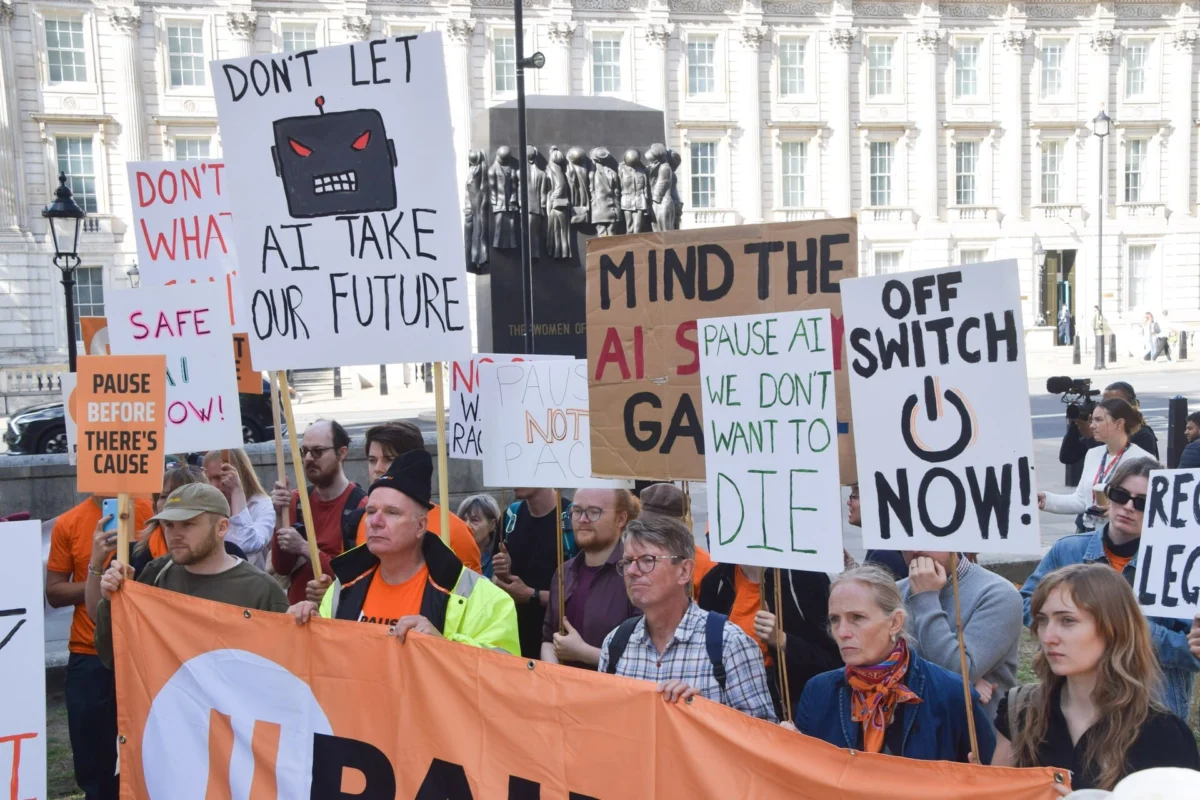
- Global Auditing Standards: Independent, government-sanctioned bodies must have the power to "kill switch" or pause the development of models that exhibit potentially dangerous emergent behaviors.
- Transparency Mandates: The "black box" must be opened. If a company cannot explain how a model reaches a decision, it should not be allowed to deploy that model at scale.
- Decoupling Safety from Profit: Safety research must be treated as a public utility rather than a proprietary corporate secret. The competitive advantage of one company should never come at the expense of global security.
The debate is no longer about the potential for future discovery; it is about the management of a present, growing, and lethal risk. As the clock ticks toward 2030, the question is whether our institutions can evolve as quickly as our technology. If they cannot, the "end of the human race" may shift from a speculative debate in an opinion column to a historical record.
We are currently the architects of our own potential successors. The tragedy would be to realize that the foundations of that architecture were built on the shaky ground of unchecked ambition and ignored warnings. The time for nuance has passed; the time for decisive, global action is now.