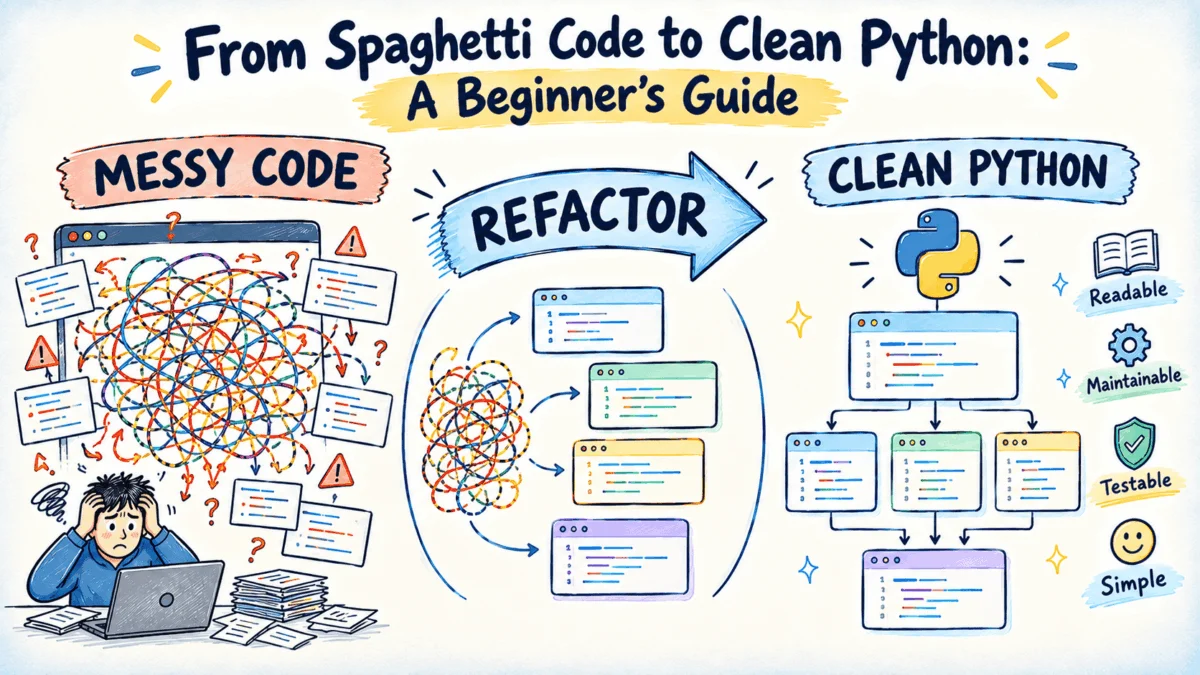
In the world of software engineering, "spaghetti code" is more than just a derogatory term for poorly written scripts; it is a technical liability that accumulates interest over time. When logic becomes hopelessly tangled, with functions that attempt to perform too many disparate tasks, the result is a codebase that is fragile, difficult to debug, and nearly impossible to scale.
For many developers, the path to clean, professional-grade Python begins by recognizing the symptoms of architectural decay. By transitioning from monolithic, "do-it-all" functions to modular, purpose-driven designs, developers can transform unmanageable scripts into robust, maintainable systems.
The Anatomy of Technical Debt: Spotting the Signs
Spaghetti code typically manifests as a violation of the Single Responsibility Principle (SRP). A function should, ideally, do one thing and do it well. Problems arise when developers bundle unrelated logic—such as data processing, state mutation, and external communication—into a single block.
The "All-in-One" Trap
Consider a typical order-processing script. In a messy implementation, a single process_order function might iterate through items, calculate unit prices, apply conditional discounts based on customer types, mutate a global inventory dictionary, determine shipping costs, and dispatch confirmation emails.
This approach creates a hidden, lethal trap: logical dependency on execution order. If a discount is calculated based on a "running total" within a loop, the final price might differ depending on the order in which items are processed. Such bugs are notoriously difficult to track because they do not stem from a flawed formula, but from the flawed structure of the code itself.
Chronology of a Refactor: From Chaos to Clarity
Refactoring is not merely an aesthetic choice; it is a systematic process of engineering improvement. To move from a tangled mess to a clean, production-ready architecture, developers should follow a disciplined, step-by-step approach.
Step 1: Deconstruction of Responsibilities
The first phase of refactoring is the decomposition of the monolithic function. By breaking a large function into smaller, focused helpers, you isolate complexity. For instance, creating distinct functions for calculate_subtotal, apply_discount, and calculate_shipping transforms the logic into a series of predictable inputs and outputs. This separation ensures that the calculation of a discount is no longer tethered to the loop that processes inventory.
Step 2: Strengthening Data Integrity
Passing raw dictionaries with string keys is a common practice in early-stage Python development, but it is inherently dangerous. Dictionaries offer no structural guarantees; they are prone to typos, missing keys, and type mismatches.
The introduction of Python Data Classes (@dataclass) serves as a formal contract for your data. By defining an Order and an OrderItem class, you provide the interpreter and your IDE with the schema of your data. This allows for static analysis and type hinting, which can catch errors during the development phase rather than at runtime.
Step 3: Formalizing Error Handling
A hallmark of amateur code is the reliance on print() statements to signal errors. When a SKU is missing from an inventory, merely printing a warning allows the execution to continue, leading to corrupted data states. Professional code must "fail fast." By raising explicit exceptions (e.g., ValueError), the program halts at the point of failure, allowing developers to trace the origin of the issue immediately.
Supporting Data: Why Modularization Wins
The transition to modular code is supported by empirical improvements in development efficiency. When logic is siloed into small, testable functions, the "blast radius" of a bug is significantly reduced.
| Metric | Monolithic Code | Modular/Refactored Code |
|---|---|---|
| Debuggability | High (System-wide search) | Low (Isolate to specific function) |
| Testability | Requires full pipeline run | Unit-testable per function |
| Readability | Low (High cognitive load) | High (Self-documenting) |
| Error Handling | Implicit (Silent failures) | Explicit (Raised exceptions) |
By utilizing frameworks like pytest, developers can write granular tests for each extracted function. If the apply_discount logic changes, you can verify its correctness in milliseconds without having to mock the entire order-processing pipeline.
Official Perspectives: The Philosophy of Clean Python
Industry experts and the Python community at large advocate for the "Zen of Python" (PEP 20). Phrases such as "Simple is better than complex" and "Readability counts" are not just mantras; they are the foundation of long-term maintainability.
When a function is reduced to a "coordinator"—a high-level orchestrator that calls other specialized functions—the code begins to read like a table of contents. It describes what the system does rather than how it does it. This architectural shift empowers developers to understand the "big picture" of a module within seconds, rather than needing to parse the minutiae of nested if-else blocks and global state mutations.
Implications for Future Development
The implications of adopting these clean-coding practices extend far beyond the immediate script.
1. Enhanced Collaboration
In a team environment, messy code is a bottleneck. When logic is cleanly separated, multiple developers can work on different components of a feature without constant merge conflicts. The code becomes self-documenting, reducing the need for extensive onboarding or "tribal knowledge."
2. Scalability and Flexibility
When the business requirement changes—for example, if a new "loyalty program" discount is introduced—the modular approach allows the developer to modify the apply_discount function in isolation. There is no risk of accidentally breaking the inventory update logic or the shipping calculator, because the dependencies are clearly defined and strictly managed.
3. Tooling and Automation
By using type hints and data classes, you enable the full power of modern developer tooling. Static type checkers like mypy and IDE features like auto-completion and "go to definition" rely on the structured data patterns described in this guide. This creates a safer, faster, and more enjoyable development experience.
Conclusion: The Path Forward
The journey from spaghetti code to clean Python is rarely a single, Herculean effort. Instead, it is an incremental practice. Next time you encounter a function that has grown too large, do not be intimidated by its size. Follow this sequence:
- Isolate: Extract a single piece of logic into its own function.
- Define: Replace loose dictionaries with data classes.
- Validate: Add unit tests to cover the new function.
- Protect: Replace silent print-warnings with explicit exceptions.
By refactoring one piece at a time, you ensure the script remains functional throughout the process. This disciplined approach not only cleans up the current file but also builds a personal library of patterns and habits that will define your career as a professional software engineer.
Remember, clean code is not an end state; it is a continuous commitment to excellence. The goal is to write code that is not only understood by the machine but is also clear, predictable, and maintainable by the human beings who will inherit your work. Happy coding.