
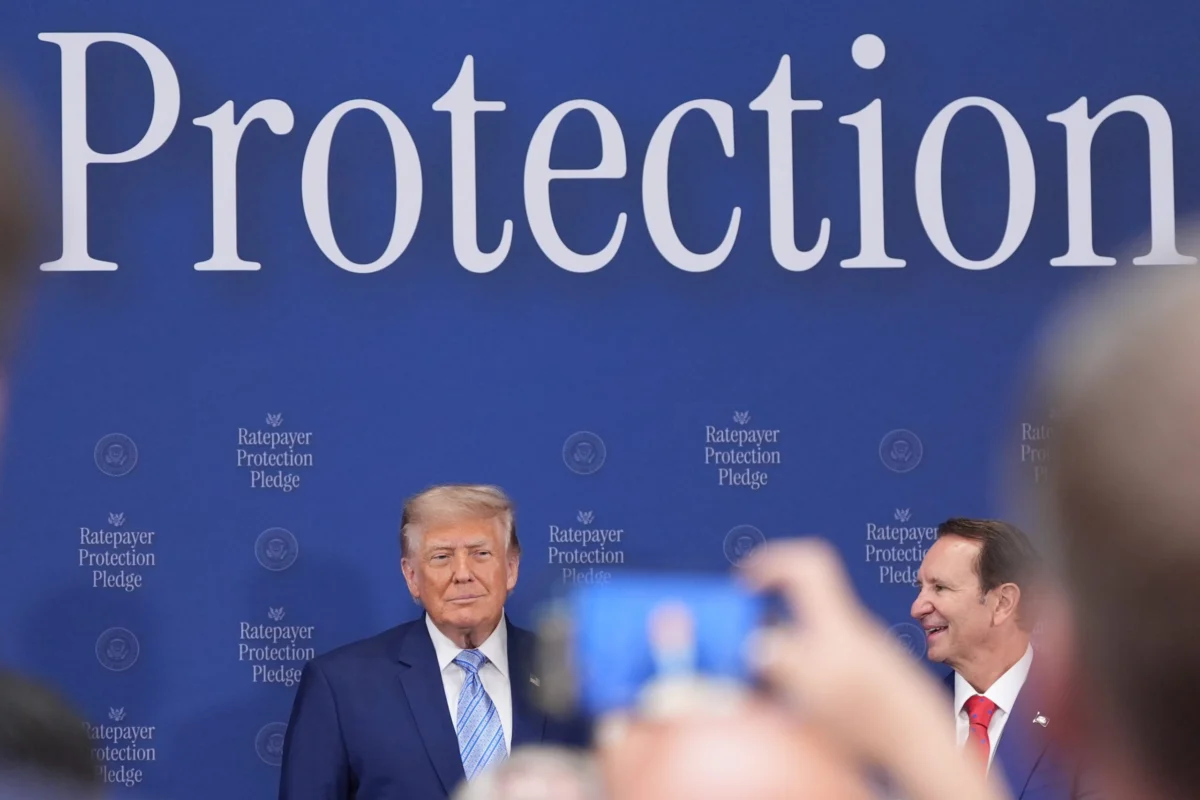
WASHINGTON — In a high-stakes effort to secure America’s technological supremacy without triggering a domestic energy crisis, President Donald Trump stood before the Environmental Protection Agency (EPA) this past Thursday to unveil a new chapter in his administration’s "Ratepayer Protection Pledge." Flanked by state governors—most notably Louisiana’s Jeff Landry—the President sought to reconcile the insatiable power demands of the artificial intelligence (AI) revolution with the mounting economic anxieties of the American electorate.
The initiative, which aims to shield residential utility consumers from the potential price hikes associated with the massive infrastructure required for AI data centers, arrives at a politically sensitive moment. With the midterm elections looming, the "AI build-out" has transitioned from a niche tech-sector concern to a kitchen-table issue, pitting the promise of economic modernization against the reality of rising cost-of-living pressures.
Main Facts: The "Ratepayer Protection" Strategy
At the core of the administration’s strategy is a nonbinding pledge signed by 23 governors and over 187 corporate entities, including 55 major utilities and 27 prominent data center developers. Companies like NextEra Energy, Duke Energy, American Electric Power, Southern Co., and Pacific Gas & Electric have joined developers such as Equinix, Digital Realty, and Prologis in an attempt to assure the public that the "data center boom" will not come at the expense of the average family’s monthly utility bill.
President Trump framed the expansion of these massive server warehouses as a historic opportunity for local communities, suggesting that municipalities hosting these facilities would see a windfall of tax revenue and economic revitalization. "You have to convince your community," the President told the gathered executives. "You can’t fight it. You have to go with it. If you don’t take all that money, somebody else is going to take it. You might as well do it yourselves."
Despite the administration’s optimism, the pledge is voluntary and nonbinding, leading to significant skepticism among policy analysts and consumer advocacy groups who question whether the promise of lower bills can hold up against the reality of a straining national power grid.
A Chronological Perspective: From Innovation to Infrastructure Anxiety
The trajectory of this issue reveals a rapid shift in public sentiment.
- March 2026: The Trump administration first announces the "Ratepayer Protection Pledge" in collaboration with leading AI tech giants. The goal was to signal a cooperative framework between the private sector and the government.
- Spring 2026: Public anxiety begins to mount. Reports surface suggesting that tech companies—often controlled by some of the world’s wealthiest individuals—are competing directly with residents for electricity, water, and land.
- May 2026: Florida Governor Ron DeSantis signs legislation intended to prevent utilities from shifting energy infrastructure costs onto residential and small-business customers, signaling that state-level resistance is beginning to bypass federal guidelines.
- June 2026: New York Governor Kathy Hochul moves to implement a year-long moratorium on the construction of large-scale server warehouses, reflecting deep-seated concerns about the environmental and economic impacts on local communities.
- July 2026: President Trump reinforces the pledge at the EPA, attempting to unify governors and utilities under a single federal umbrella to prevent a fragmented state-by-state regulatory landscape.
Supporting Data: The Cost of the AI Revolution
The urgency of the administration’s intervention is underscored by sobering projections regarding energy consumption. According to a recent analysis by ICF, a prominent consulting and technology services firm, the rapid proliferation of AI data centers could cause monthly utility bills for American families to surge by 15% to 40% by 2030 if the grid is not upgraded or if the costs of expansion are passed directly to ratepayers.
The math behind the anxiety is clear: AI training models require unprecedented amounts of electricity to power the specialized hardware, such as the chips developed by Nvidia. Jensen Huang, CEO of Nvidia, has publicly acknowledged that the primary bottleneck to American AI progress is not necessarily software innovation, but a critical lack of power generation capacity.
The White House has identified the PJM Interconnection—the largest grid operator in the country, serving 13 states—as a major point of friction. Despite a "Statement of Principles" signed by all 13 governors in the PJM region and the administration, White House officials claim the operator has failed to implement necessary governance reforms, leading to fears that the grid will remain vulnerable to sudden spikes in demand.

Official Responses and Political Friction
The administration’s push has met with a mixed reception. While the White House views the pledge as a blueprint for national competitiveness, critics argue that the voluntary nature of the agreement makes it toothless.
The View from the States
The political landscape is fractured. In Texas, a Republican stronghold, the growth of data centers has become a flashpoint. Democratic gubernatorial nominee Gina Hinojosa has capitalized on this, labeling the current climate as the "Wild West of data centers." She argues that the economic benefits are concentrated among the ultra-wealthy, while the risks and costs are socialized among the public.
Conversely, Governor Greg Abbott, despite facing local backlash, has signed the federal pledge, hoping to balance his state’s role as an AI hub with the need for consumer protection.
The Industry Perspective
Industry representatives argue that data centers provide essential tax revenues that fund school districts and infrastructure improvements, which in turn lower property tax burdens for homeowners. However, advocates for reform, such as Matthew Freedman of the Utility Reform Network, note a glaring contradiction: "It is disappointing, but perhaps not surprising, that the same tech companies signing the Ratepayer Protection Pledge are simultaneously opposing efforts at the state level to force them to deliver on their promises."
Implications: The National Security and Economic Calculus
The implications of this debate extend far beyond the price of electricity. There is a strong national security argument fueling the administration’s sense of urgency. The White House posits that any significant slowdown in data center construction could lead to a loss of the U.S. competitive edge in AI, effectively ceding dominance to global rivals like China.
Furthermore, the rise of AI is fundamentally rewriting the "social contract." As the technology gains the ability to automate tasks ranging from software engineering to spreadsheet analysis, the fear of widespread job displacement has joined the list of voter grievances.
Legislative Outlook
Efforts to move beyond voluntary pledges are already underway in Congress. The House Energy and Commerce Committee has advanced a bipartisan bill that would mandate that data centers bear the financial burden of grid upgrades, rather than shifting those costs to residential utility bills. If passed, this would formalize the administration’s goals into law, providing a more robust regulatory framework than the current nonbinding agreements.
As the nation moves toward the midterms, the "data center question" serves as a microcosm of the broader challenge facing the U.S.: how to embrace the next generation of technological growth without fracturing the economic stability of the communities that sustain it. Whether the current administration’s "Ratepayer Protection Pledge" will be viewed as a visionary solution or an insufficient stopgap remains the central question for millions of voters bracing for the potential electricity crunch of the next decade.