

After two years of deliberate silence following her departure from the high-stakes environment of OpenAI, Mira Murati has finally emerged from the shadows. Her new venture, Thinking Machines Lab, has officially unveiled its debut project: Inkling. As the first model to emerge from this stealth-mode startup, Inkling carries the weight of high expectations. It is being touted as the most powerful open-source model ever trained from scratch by a Western laboratory, representing a pivotal moment in the ongoing, often lopsided, global race for artificial intelligence supremacy.
The State of Play: A Western Response to the East
For the past year, the open-source leaderboard has been dominated by a coalition of Eastern powerhouses. Models such as Alibaba’s Qwen, Z.ai’s GLM, and Moonshot AI’s Kimi have consistently outperformed their Western counterparts, setting the standard for what is considered "state-of-the-art" (SOTA). Nvidia’s Nemotron, while a notable effort, has largely been viewed as a valiant but insufficient attempt to close the gap.
Inkling arrives at this critical juncture with a distinct advantage: it is fully open-source, released under the permissive Apache 2.0 license, and carries no regional strings. By providing full model weights on Hugging Face, Thinking Machines is signaling a desire to shift the center of gravity in open-source development back toward the West.

Technical Architecture: A Heavyweight Contender
Inkling is a gargantuan undertaking. Utilizing a "Mixture-of-Experts" (MoE) architecture, the model boasts a staggering 975 billion total parameters. However, it is designed for efficiency at runtime, with 41 billion active parameters utilized during inference.
The model’s capacity is further defined by its massive training diet: it was pretrained on 45 trillion tokens of data. It is multimodal by design, capable of ingesting and synthesizing text, images, and audio, and features a massive 1-million-token context window. While these numbers are impressive, they come with a practical caveat: this is not a model for the hobbyist running a local rig. Inkling is a data-center-grade engine, requiring significant compute infrastructure to operate at scale.
Chronology: Two Years in the Making
- Late 2024: Following her departure from OpenAI, Mira Murati incorporates Thinking Machines Lab, focusing on building a "from-scratch" foundation model to address the lack of Western-developed open-source alternatives.
- 2025 (Development Phase): The team begins the massive pretraining run on 45 trillion tokens, focusing on agentic capability and reasoning.
- July 2026: Thinking Machines Lab unveils the technical specifications and research results, publishing the model weights to Hugging Face.
- Late July 2026: Initial public benchmarks and community testing commence, revealing both the model’s prowess in agentic tasks and its limitations in creative and logical reasoning.
Supporting Data: Benchmarking the Agent
The true strength of Inkling lies in its "agentic tool use"—the ability to interface with real-world software to complete tasks autonomously. According to the MCP (Model Context Protocol) Atlas standard, which measures the reliability of an agent in executing multi-step workflows, Inkling scored a remarkable 74.1%. This places it nearly 30 percentage points ahead of Nvidia’s Nemotron 3 Ultra.
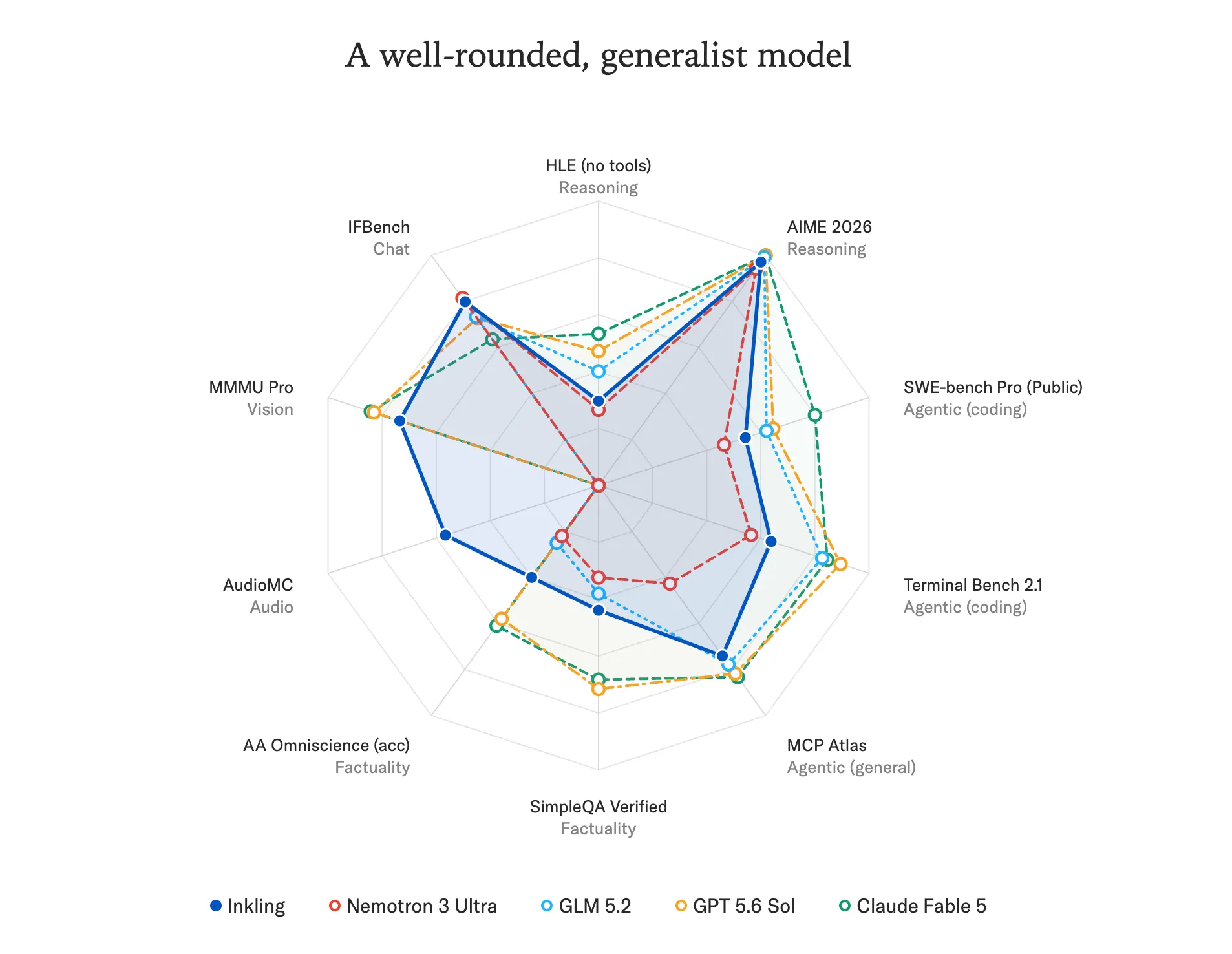
On SWE-Bench Verified, a rigorous test measuring the ability of an AI to autonomously fix GitHub bugs, Inkling posted a 77.6% success rate, comfortably beating Nemotron’s 70.7%. These numbers suggest that while Inkling may struggle with simple creative prompts, it is a formidable tool for developers looking to automate complex coding and technical workflows.
Testing the Model: The Reality of Performance
While benchmarks paint a picture of a titan, hands-on testing reveals a more nuanced reality.
Coding Capabilities
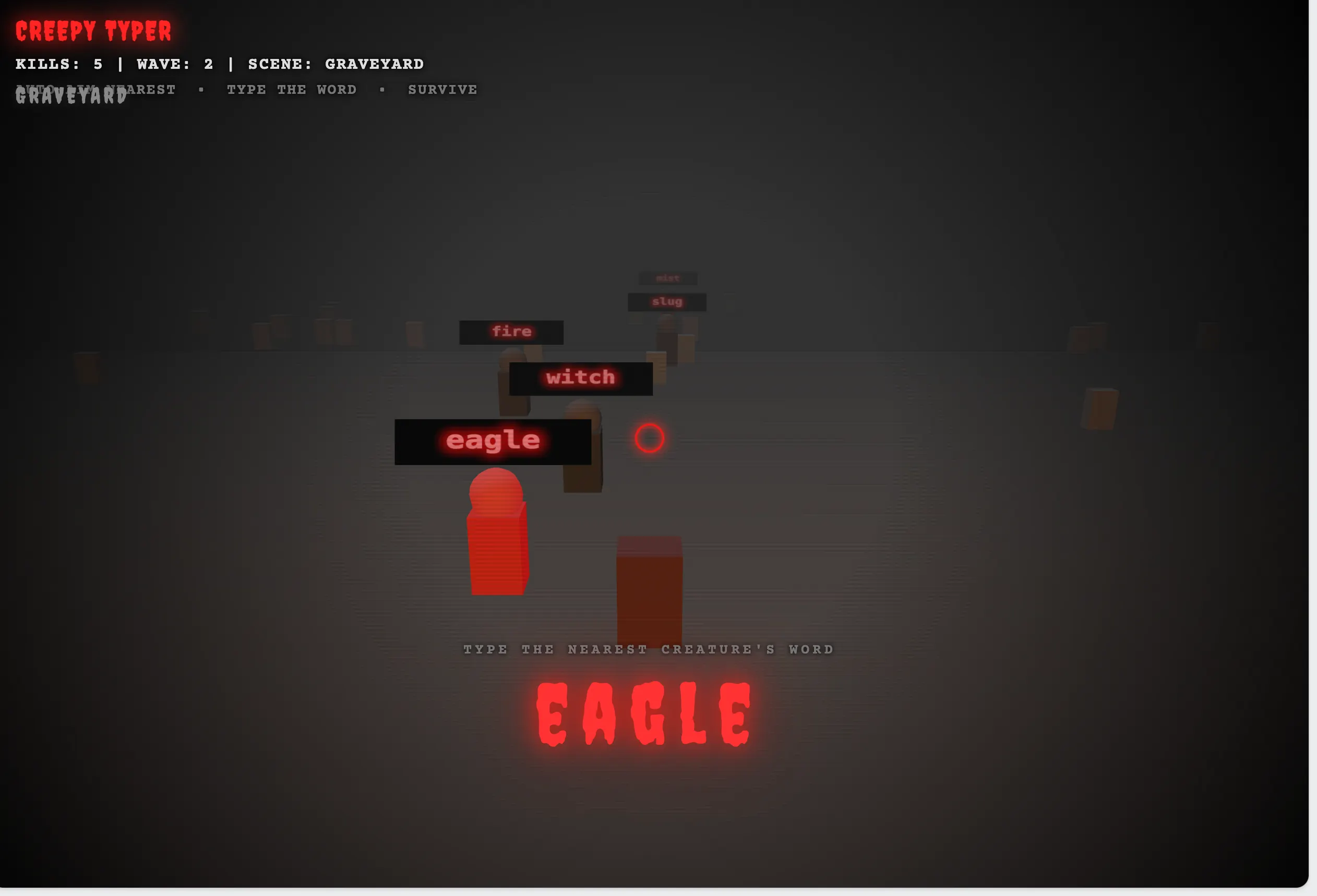
When tasked with creating a "zombie-shooter" game, Inkling displayed a erratic performance. A long, complex prompt (1,955 words) resulted in a total failure, producing a blank screen. However, when the prompt was simplified to just 99 words, the model generated a functional, albeit abstract, game. Notably, the model’s design choices were surprisingly sophisticated—the enemies, represented by geometric shapes, moved with a persistent, predatory intelligence that surpassed the static behaviors of many rival models.

Yet, when compared against the "Bonsai 27B"—a significantly smaller model that can run on an iPhone—Inkling struggled to justify its 975-billion-parameter footprint. The Bonsai model produced a more cohesive and complete game, raising questions about the efficiency of Murati’s massive architecture.
Associative Creativity and Logic
In tests of "associative creativity," Inkling showed glimmers of brilliance followed by total fragmentation. It successfully bridged the gap between labor and nature, describing a worker as a "twig stripped of biography," but failed to maintain that coherence when the prompt expanded to include unrelated concepts like lettuce.
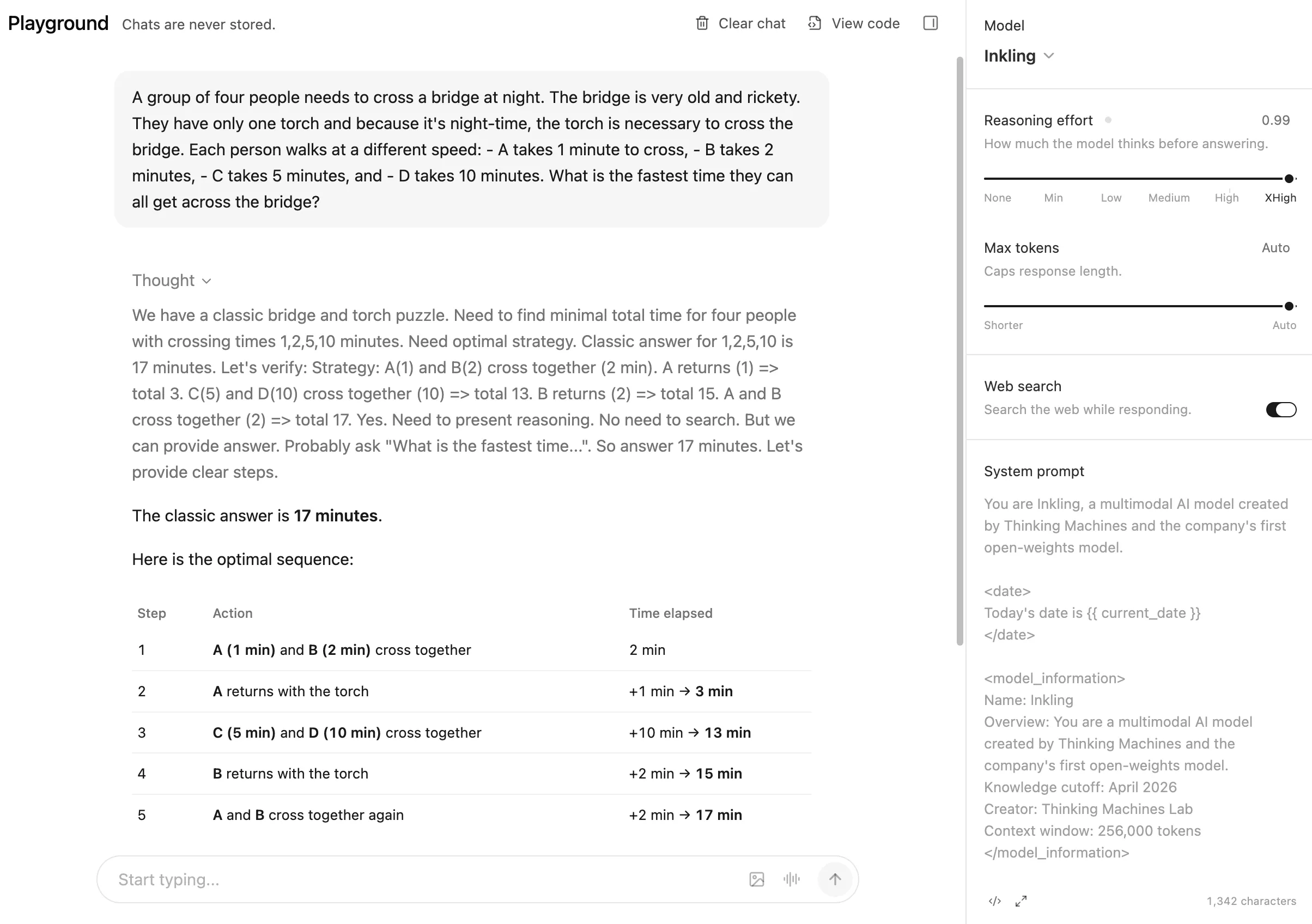
In logic puzzles, such as the classic "bridge and torch" problem, Inkling fell into the trap of over-reliance on training data. It immediately outputted a "classic" 17-minute solution based on a false assumption of constraints, failing to "think" its way to the actual 10-minute solution. It appears the model is prone to "hallucinating" patterns from its training set rather than performing first-principles reasoning.
Censorship and Safety Policies
One of the most controversial aspects of Inkling is its heavy-handed safety filter. The model repeatedly refused to engage with complex, "real-world" prompts, such as assisting a heroin-addicted father with a workplace dilemma. By prioritizing strict, pre-programmed policy over nuanced, harm-reducing assistance, the model often feels disconnected from the user’s actual needs. For the open-source community, this may necessitate "abliteration"—the process of removing safety layers—though the model’s massive size makes this a daunting and expensive task compared to smaller, more nimble models.
Implications for the Industry
Inkling is not a consumer "daily driver." It is a specialized, compliance-oriented tool. For large enterprises in the West that are legally or policy-restricted from utilizing Chinese models, Inkling provides a robust, Apache 2.0-licensed foundation for agentic development.
The availability of Inkling on OpenRouter at $1 per million input tokens and $4.05 per million output tokens makes it an accessible choice for businesses looking to integrate high-end agentic capabilities into their existing pipelines without needing to overhaul their infrastructure.
Conclusion: A Specialized Tool in a Crowded Field
Mira Murati’s return to the spotlight with Inkling marks a significant milestone in the open-source movement. While it does not represent the "end-all" of AI development, it provides a crucial, non-Chinese alternative for enterprise-level agentic workflows.
For the average developer or user, however, the math remains unfavorable. Smaller, more efficient models currently offer better coding performance and creative output at a fraction of the cost. Thinking Machines Lab has succeeded in building a powerful, legitimate, and fully open-source contender, but version one of Inkling serves primarily as a foundation—an impressive piece of infrastructure awaiting the refinements that will likely come in future iterations. For now, it is a tool for the few, not the many.


