July 23, 2026
The American media ecosystem is currently grappling with a dual-front transformation: a landmark legal battle over media consolidation that threatens to reshape the corporate power structure, and a profound shift in how the public interacts with information. As a federal judge blocks the proposed acquisition of Warner Bros. Discovery by Paramount, and as news organizations scramble to capture the attention of a digital-first audience, the fundamental relationship between the media, the public, and the law has never been more scrutinized.
The Antitrust Collision: Paramount and Warner Bros. Discovery
This week, the media industry was brought to a standstill when a federal judge issued a temporary restraining order halting the proposed multi-billion-dollar merger between Paramount and Warner Bros. Discovery. The injunction follows a high-stakes lawsuit filed by a coalition of 12 states, arguing that the consolidation of these two entertainment titans violates federal antitrust laws.
At the heart of the litigation is the concern that the merger would create an unprecedented monopoly in both theatrical distribution and cable television. Should the deal proceed, the resulting entity would command a vast library of intellectual property and control dozens of cable channels, effectively stifling competition in an already tightening market.
A Convergence of Information Power
Perhaps the most significant concern for regulators and media watchdogs alike is the potential consolidation of two of the nation’s most influential news brands. According to a comprehensive 2025 study by the Pew Research Center, one-third of U.S. adults rely on CNN—currently under the Warner Bros. umbrella—for their daily news consumption. Simultaneously, three-in-ten adults turn to CBS News, a core asset of Paramount.
The combination of these two journalistic giants under a single corporate roof has sparked widespread debate regarding media plurality and the potential for a homogenized editorial environment. Critics of the merger argue that such concentration of power could undermine the diversity of viewpoints essential to a functioning democracy, while proponents suggest that scale is necessary to survive the ongoing disruption of the digital advertising market.
Chronology: The Road to the Restraining Order
The path to this week’s judicial intervention was paved with months of speculation and aggressive corporate maneuvering:
- Early 2026: Rumors of a "mega-merger" between Paramount and Warner Bros. Discovery began to circulate, driven by falling cable subscription numbers and the high costs of competing in the saturated streaming wars.
- April 2026: Formal merger talks were confirmed by both parties, sparking immediate concern among consumer advocacy groups regarding the potential for market monopolization.
- May 2026: The Department of Justice began a preliminary review of the deal, citing concerns over "vertical integration" that could harm independent content creators.
- June 2026: A bipartisan coalition of 12 states officially filed suit, alleging that the deal would create a "chokehold" on the distribution of news and entertainment, violating the Clayton Antitrust Act.
- July 2026: A federal judge granted the temporary restraining order, citing the "irreparable harm" that could be done to the competitive landscape before a full trial can be adjudicated.
The Digital Pivot: Why News Organizations Are Turning to Video
While the boardroom battles dominate the headlines, a secondary, perhaps more consequential, evolution is happening within the newsrooms themselves. As print and digital text-based media face stagnant growth, major outlets—including The New York Times and The Wall Street Journal—have significantly pivoted their resource allocation toward video production.
Revisiting the "Pivot to Video"
This movement has drawn comparisons to the mid-2010s, a period when many publishers attempted to shift their business models toward video, often at the expense of their core editorial staff. However, media analysts note that the current iteration is fundamentally different. Today’s shift is driven by empirical data showing a marked preference for visual storytelling across social media platforms like YouTube, TikTok, and Instagram.
The data supports this aggressive pivot. According to recent Pew Research Center findings, 35% of U.S. adults regularly consume news on YouTube, a significant increase from the 23% recorded in 2020. Across all demographics, 44% of Americans state that they prefer to watch the news rather than read or listen to it, compared to only 37% who prefer text and 19% who prefer audio. This preference has remained remarkably stable since 2016, suggesting that the "pivot" is not a temporary trend, but a permanent adaptation to user behavior.

Supporting Data: Understanding the Public’s Engagement
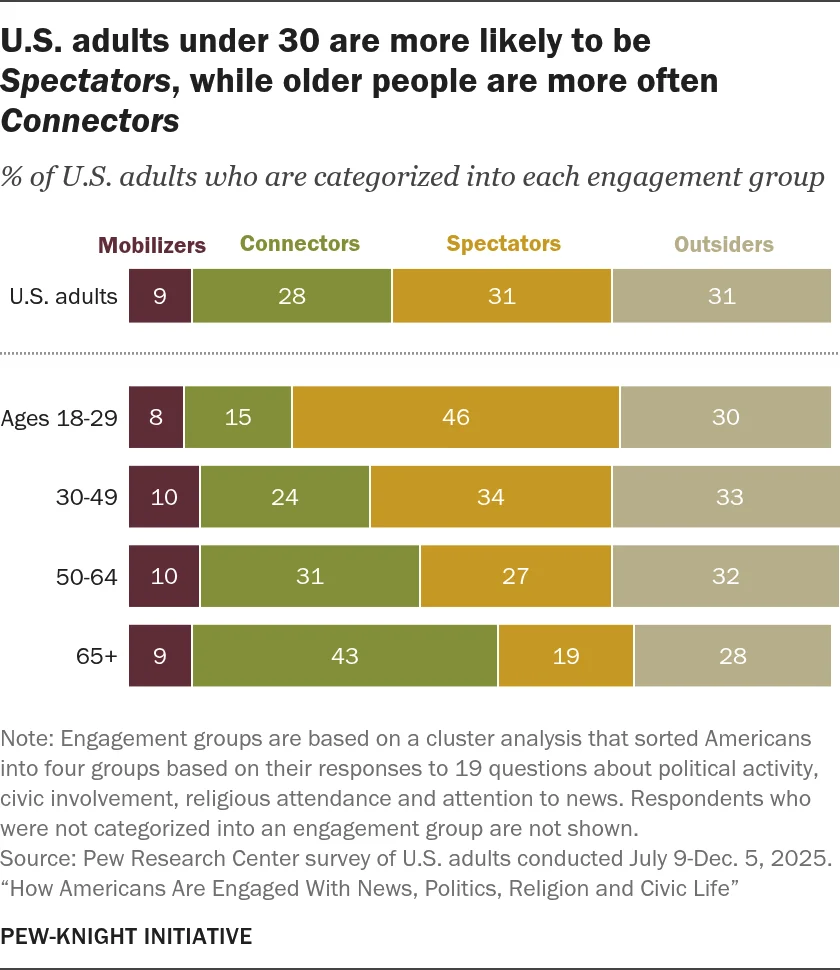
The recent report from the Pew-Knight Initiative, “How Americans Are Engaged With News, Politics, Religion and Civic Life,” provides a granular look at the demographic divide in civic participation. By utilizing a cluster analysis of 19 distinct metrics—including voting patterns, charitable giving, and news consumption—researchers identified four unique "engagement groups" within the U.S. population:
- Mobilizers: Highly active in all areas of civic and political life.
- Connectors: Deeply embedded in community and religious life, with high levels of civic participation.
- Spectators: Follow the news closely and engage digitally but participate less in face-to-face civic activities.
- Outsiders: Exhibit low levels of engagement across all measured categories.
The Generational Divide
The data reveals a stark age-based disparity. Younger adults (ages 18-29) are significantly more likely to be classified as "Spectators," consuming large quantities of news and political content online but showing lower levels of community-based engagement. Conversely, older Americans (65+) are disproportionately represented in the "Connector" category, favoring direct involvement in local organizations and religious institutions.
| Group | U.S. Adults | Ages 18-29 | 30-49 | 50-64 | 65+ |
|---|---|---|---|---|---|
| Mobilizers | 9% | 8% | 10% | 10% | 9% |
| Connectors | 28% | 15% | 24% | 31% | 43% |
| Spectators | 31% | 46% | 34% | 27% | 19% |
| Outsiders | 31% | 30% | 33% | 32% | 28% |
Source: Pew Research Center, 2025.
Official Responses and Industry Outlook
The legal community remains divided on the potential outcome of the Paramount-Warner merger trial. Representatives for the media conglomerates have argued that the merger is a defensive necessity. In a statement released shortly after the injunction, a spokesperson for the companies noted, "This merger is intended to create a more resilient entity capable of investing in high-quality journalism and entertainment in a fragmented, globalized digital market."
However, the states’ attorneys general have maintained a firm stance. "A deal of this magnitude is not merely a business transaction; it is an encroachment on the public’s right to a diverse and competitive information environment," noted one representative from the coalition.
Implications: A Future in Flux
The intersection of these two stories—the legal challenge to consolidation and the shift toward video-centric news consumption—points toward a future of high-stakes competition. If the merger is ultimately blocked, it will signal a new era of antitrust enforcement that could discourage further consolidation across the tech and media sectors. If it succeeds, it will likely accelerate the trend of mega-conglomerates dominating the media landscape.
Simultaneously, the news industry’s reliance on video platforms owned by Big Tech companies presents its own set of risks. As newsrooms pour resources into YouTube and TikTok, they become increasingly beholden to the algorithms and platform policies of these corporations.
As we look toward the remainder of 2026, the question is not just who will own the media, but how that ownership—and the medium of delivery—will shape the way Americans understand their world. The "Spectator" generation, now the dominant demographic for news consumption, represents both an opportunity for reach and a challenge for sustained, deep civic engagement.
The Briefing will continue to monitor these developments as they unfold in the courts and in the digital feeds of millions of Americans. For now, the future of the media remains, like the proposed merger itself, in a state of suspended animation.
The Briefing is compiled by the Pew Research Center staff. For further data, including the full report on public engagement, visit the Pew Research Center website.