In an era where generative AI floods social feeds with generic, automated prose, a counterintuitive trend is emerging on LinkedIn: human-centric content is outperforming machine-generated copy by a significant margin. Despite the platform’s massive user base, data suggests that only 1% of LinkedIn users are active content creators. This glaring supply-and-demand gap presents a golden opportunity for professionals who can master the art of the scroll-stopping post.
According to LinkedIn growth strategist Kasey Brown, success on the platform is not a byproduct of AI-assisted volume; it is the result of a deliberate, human-first strategy. Brown, alongside media veteran Michael Stelzner, has codified this approach into the "Triple S" framework—a methodology designed to Stop the scroll, help the reader Stay engaged, and inspire them to Share the content.
The Foundation: Knowing Your "Who" and "Why"
Before a single word is typed, Brown argues that creators must secure three foundational pillars. Without these, even the most eloquent writing will fail to gain traction.
1. The Precise Ideal Client Profile (ICP)
Most creators define their target audience with vague demographics. Brown posits that an effective ICP must be granular enough for a virtual assistant to identify specific prospects in a search. Rather than targeting "consultants," a high-performing ICP targets "consultants earning at least $20k per month who need organic content systems to scale." Specificity acts as a filter, ensuring your content speaks directly to those most likely to convert.
2. The Defined Transformation
Every post must promise a specific transformation. Whether it is a 30-day journey or a 5-minute shift in mindset, the reader must walk away with something they didn’t have before. If the content doesn’t facilitate a change in the reader’s state, it is likely ego-driven rather than value-driven.
3. The Reader-First Mandate
The most common mistake on LinkedIn is publishing content that focuses on the creator’s achievements. To break through the noise, creators must pivot from "How do I sound smart?" to "What does the reader gain from this?" When the value shifts to the audience, engagement compounds, driving business growth as a natural byproduct.
1: Stop – The Science of Interrupting the Scroll
With the foundations laid, the first phase of the Triple S framework begins: Stopping. Because 80% of a post’s performance is determined by the image and the first two lines of text, this is where the heaviest lifting occurs.
Visual Disruption
Brown’s research highlights a fascinating irony: professional, polished, high-resolution headshots often perform worse than raw, authentic photography. In one A/B test, a wide-angle, 0.5x zoom selfie from a speaking stage—which felt casual and unposed—generated 3,000 leads. A professional, high-definition photo of the same speaker at the same event yielded only 200 leads.

The takeaway? LinkedIn users are conditioned to ignore "corporate polish." Authenticity creates curiosity. Furthermore, vertical imagery is prioritized by the platform’s interface, occupying more screen real estate and preventing unwanted cropping. For informational content, Brown suggests embedding dense data into images—making them look like "working documents" rather than decorative title cards.
The Five Cs of Hook Writing
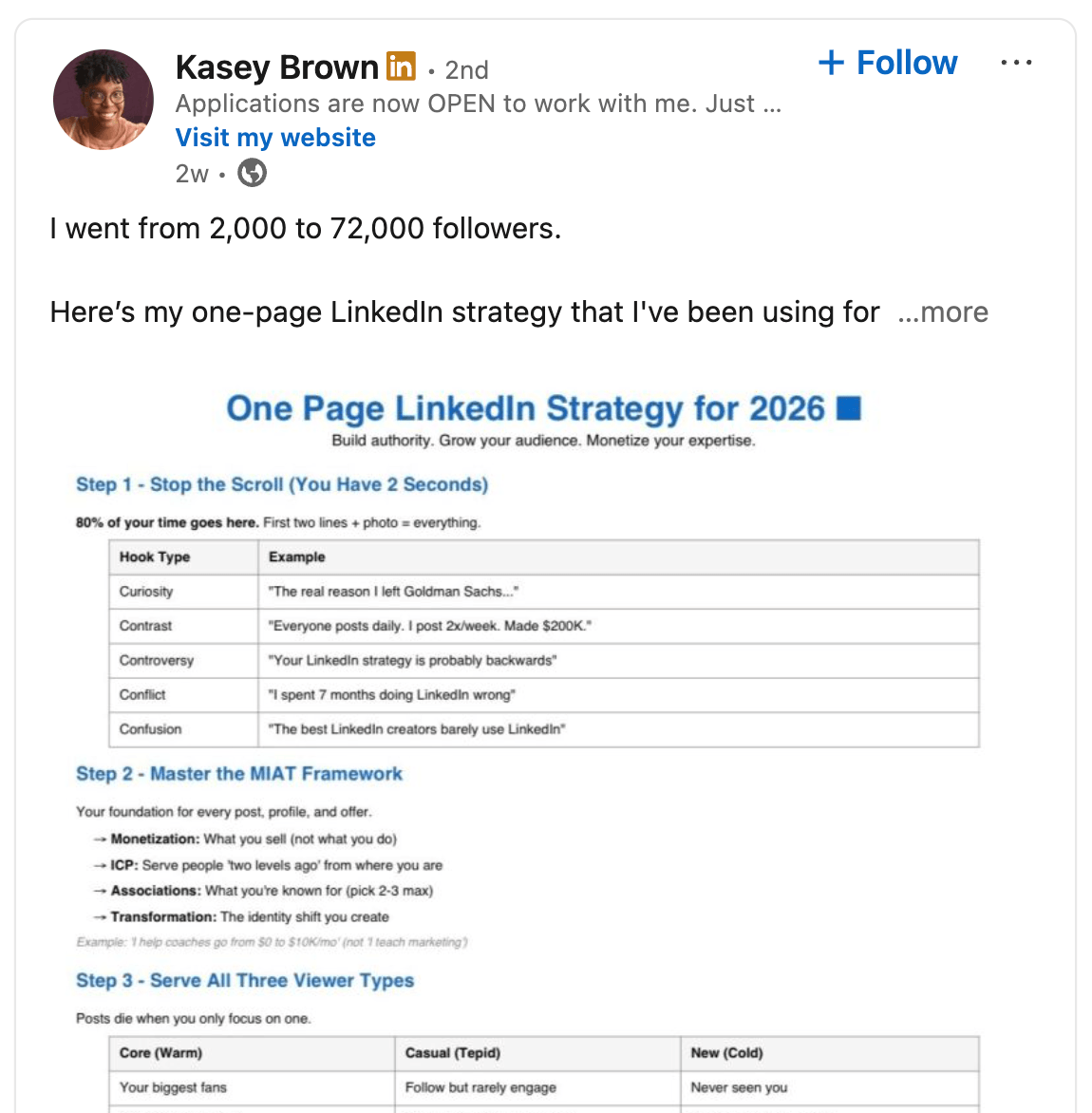
The first two lines of a post exist solely to earn the "See More" click. To write a compelling hook, Brown applies a psychological lens known as the Five Cs:
- Curiosity: Does this make the reader wonder what happens next?
- Contrast: Does this present two opposing ideas?
- Contradiction: Does this challenge common beliefs?
- Controversy: Does this address an uncomfortable truth?
- Confusion: Does this pique interest through an unexplained scenario?
A weak hook is descriptive (e.g., "I had a great time on vacation"). A strong hook utilizes these elements to create tension (e.g., "I was at a job I hated in 2021. Today, I’m living in Bali. Here is how I funded the exit").
2: Stay – Keeping the Reader Hooked
Once the "See More" click is earned, the challenge shifts to retention. This is where many creators fail, often by resolving the story too early.
The Re-Hook
The third line of the post—the "re-hook"—must deepen the tension, not resolve it. If the hook is a promise, the re-hook is the bridge that keeps the reader moving forward. By holding back the resolution, the creator forces the reader to stay invested in the narrative, mirroring the high-retention tactics used in the first 60 seconds of a viral YouTube video.
Rhythmic Structure and Readability
Visual flow is as important as the words themselves. Brown advocates for a rhythmic cadence: a sequence of short, one-sentence lines followed by a dense, two-to-three-sentence paragraph. This prevents the "wall of text" effect that causes mobile readers to bounce.
Because 70% of LinkedIn consumption happens on mobile, formatting for a small screen is mandatory. Tools like Hemingway (to ensure a 4th-to-7th grade reading level) and Authored Up (to preview mobile rendering) are essential parts of the editorial process.
3: Share – The Ultimate Metric of Success
While likes and views are vanity metrics, the Share is the true indicator of resonance. A share means a user has staked their own reputation on your content by broadcasting it to their network.
The Shareability Ratio
Brown tracks a specific metric: Shares per Impression. A ratio of 0.3 is considered a baseline for success, while 0.5 is exceptional. Posts that hit this 0.5 threshold are essentially "evergreen" and should be repurposed every 60 to 90 days.
The "Goodie Bag" Closing
A post earns a share when it provides a tangible takeaway—a "goodie bag" at the end of the party. After providing the personal story or the professional insight, the creator must offer a concrete, step-by-step framework. This turns a subjective narrative into an objective resource that a reader feels compelled to save or share with a colleague.
Implications for Modern Content Strategy
The implications of the Triple S framework are clear: the era of "automated thought leadership" is waning. As AI-generated content becomes commoditized and easily identifiable by readers, the premium on human-to-human connection increases.
The shift required is foundational. Creators must move away from the "publish and pray" model of content creation and toward a deliberate, architected approach. By focusing on the specific ICP, creating deep tension in the hook, maintaining that tension through a rhythmic re-hook, and providing a high-value, shareable conclusion, creators can build an organic engine that serves their business objectives.
Ultimately, LinkedIn remains a platform of immense opportunity because most users are still playing by the rules of 2015. For those willing to study the mechanics of attention, the platform remains wide open. By focusing on the reader’s transformation rather than the creator’s ego, professionals can bypass the noise and build an audience that is not just passive viewers, but active participants in their professional ecosystem.
Kasey Brown is the founder of Digital Kairos, an agency dedicated to helping founders, speakers, and consultants build organic LinkedIn systems. For further insights on organic growth, visit her professional profiles on LinkedIn and YouTube.