

As global digital advertising expenditure hurtles toward a projected $740 billion by 2026, marketing teams face an existential paradox: while the number of available channels has exploded, the capacity to coordinate them has stagnated. For the modern marketer, the challenge is no longer about "being everywhere"—it is about ensuring that "everywhere" feels like a single, coherent conversation with the customer.
This is the domain of cross-channel marketing. It is a strategic discipline that moves beyond the simple act of broadcasting messages and enters the realm of orchestrated engagement. By ensuring that data from paid, owned, and earned channels informs the messaging and timing of the next touchpoint, businesses can transform a noisy, repetitive digital presence into a seamless, continuous brand journey.
The Evolution of Marketing Architecture: Multichannel vs. Cross-Channel
To understand the necessity of cross-channel strategy, one must first dismantle the common misconception that "being on many channels" equals success. This is the "multichannel trap."

Running ads on Google, Meta, and an email newsletter simultaneously does not make a team a cross-channel marketer; it makes them a multichannel participant. Multichannel is simply coverage—a static, disconnected presence. In contrast, cross-channel is coordination.
The Operational Pillars
A campaign only earns the title of "cross-channel" if it satisfies three operational requirements:
- Unified Audience Definition: A single source of truth for the target audience that is synced across all platforms, rather than siloed lists.
- Integrated Creative Systems: Creative assets rendered natively for each channel but tied together by a singular campaign promise or offer.
- Holistic Measurement: A framework that treats channel-level data not as an end-goal, but as an input for a singular ROI calculation.
If you strip away any of these pillars, you revert to multichannel marketing—a strategy characterized by disjointed signals and wasted ad spend.
Defining the Landscape: Cross-Channel vs. Omnichannel
Confusion often reigns when distinguishing between cross-channel and its more ambitious cousin, "omnichannel." The differences are critical for resource allocation, particularly for small-to-medium businesses (SMBs).
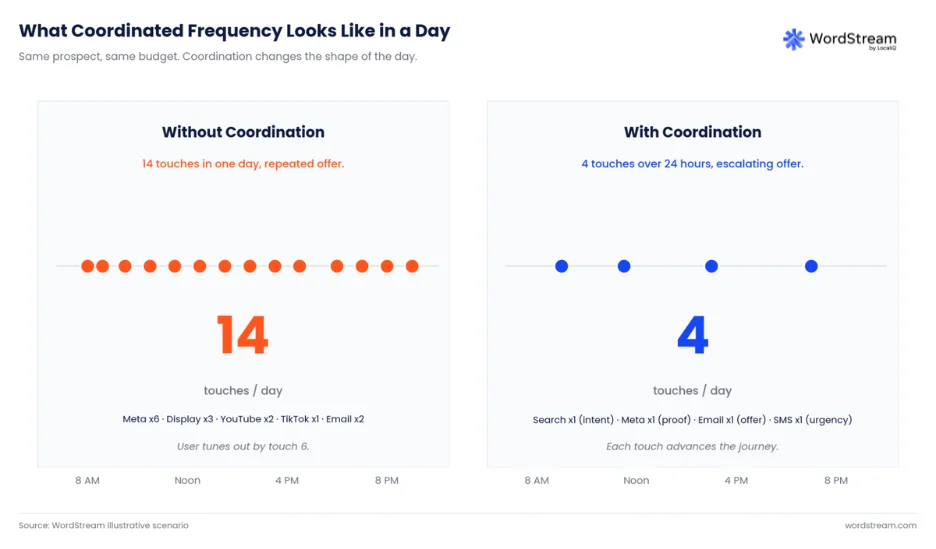
- Multichannel: You are present on many channels, but they do not share data. Each platform operates in a vacuum.
- Cross-Channel: You are coordinated. A behavior in one channel (e.g., a search ad click) triggers a specific, relevant action in another (e.g., a Meta retargeting impression). This is the "sweet spot" for most growth-focused organizations.
- Omnichannel: This is the all-encompassing frontier. It includes every offline and online touchpoint—in-store, customer service, support tickets, and commerce—integrated in real-time. For most SMBs, omnichannel is an aspirational goal; attempting to implement it without the requisite data infrastructure often leads to organizational bloat.
Strategic Mapping: The Cross-Channel Mix
Marketers today manage an average of 10 customer engagement channels, yet high-performing teams typically limit full personalization to only six of them. The "four-channel gap" represents the difference between channels utilized and channels truly coordinated.
Channel Buckets by Funnel Role
Effective cross-channel marketing does not require utilizing every available medium; it requires that the ones you do use share signals.
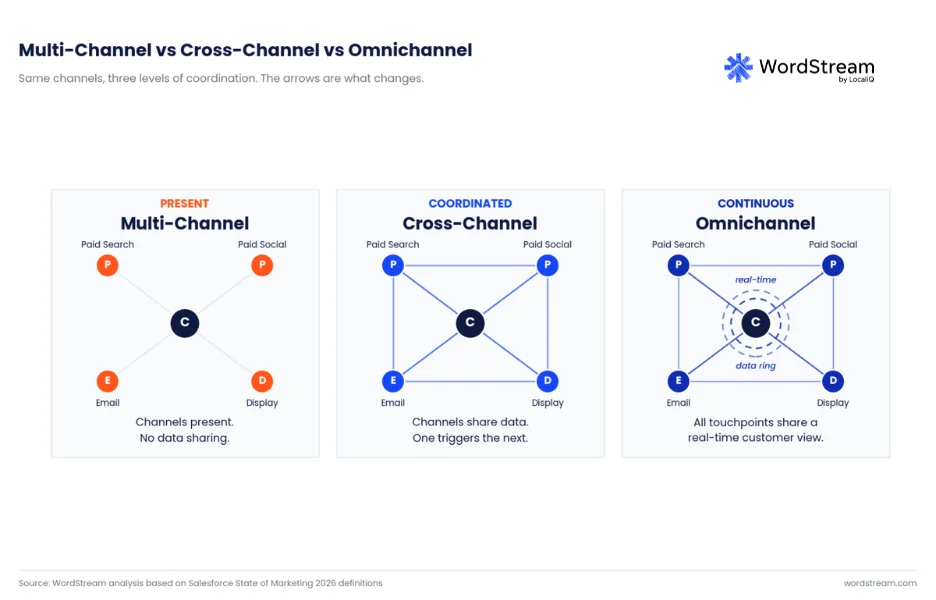
- Conversion (Search/Shopping): Google, Microsoft, and Apple Search Ads capture high-intent, in-market demand.
- All-Funnel (Paid Social): Platforms like Meta, LinkedIn, and TikTok serve as the primary engine for awareness and retargeting seeds.
- Awareness (Display/CTV): Emerging channels like Connected TV (CTV) and Over-the-Top (OTT) media are rapidly becoming the primary growth lanes for 2026.
- Owned (Email/SMS/Push): These are the workhorses of the 1:1 relationship, ideal for re-engaging users after a top-of-funnel interaction.
- Offline (Direct Mail/OOH): Often overlooked, these can be integrated into the digital loop through QR codes, unique URLs, and promo codes.
The Financial and Psychological Payoff
What does a business actually gain from the heavy lifting of cross-channel coordination? The answer lies in efficiency rather than raw reach.
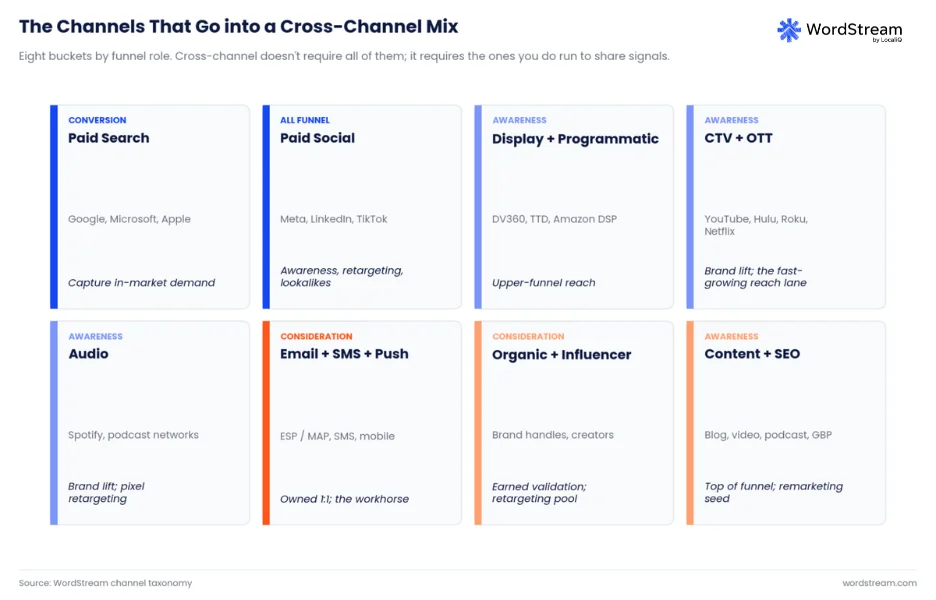
By implementing cross-channel frequency caps, companies avoid the "spam" phenomenon, where a prospect is hit with 14 redundant ads across different platforms when four would have sufficed. This prevents the erosion of brand trust and significantly improves the Return on Ad Spend (ROAS). It is not about reaching more people; it is about getting more yield from your existing budget.
Execution: A Step-by-Step Strategy
Building a cross-channel framework requires a fundamental shift in how teams operate.
1. Define the Audience, Not the Platform
Build your audience in your CRM or a dedicated data source first. Once the definition is finalized, push it out to the platforms (Google Customer Match, Meta Custom Audiences, etc.). This ensures that when a user moves from an email list to a social platform, the system recognizes them as the same entity.
2. Map the Journey Before the Budget
Most teams suffer from "budget-first" planning, where they allocate funds based on last year’s spending and shoehorn the customer journey in later. Reverse this. Define the customer journey stage, then select the channel, then craft the message, and finally, assign the budget.
3. The Signal-Sharing Mandate
The most critical technical hurdle is identity resolution. If your ad platforms don’t know when a user has already purchased from your site, you are wasting money on acquisition ads for existing customers. At a minimum, businesses must implement "Enhanced Conversions" in Google Ads and the "Conversions API" in Meta. This is the single highest-impact data upgrade a team can make.
Real-World Applications: Three Case Studies
Case Study 1: B2C E-commerce
An apparel brand uses a unified audience for browse-abandonment. A user browses a product, triggers a three-impression cap across Meta, Google, and email, and receives a follow-up SMS at the 48-hour mark. Because the systems share a signal, the user doesn’t receive redundant ads, saving the brand thousands in wasted impressions.
Case Study 2: B2B/ABM
In B2B, the "buyer" is a group of six to 10 people. An account-based marketing (ABM) platform monitors intent signals across LinkedIn and the company website. When a target account shows interest, the system automatically triggers direct mail to the decision-makers. When the account goes quiet, the system alerts the sales team to pivot, ensuring resources are only spent on "warming" leads.
Case Study 3: Local SMB
A local auto-service shop connects its phone-call conversions from Google Ads back into Meta. A prospect who calls for a brake quote is then retargeted with an oil-change discount—not the same service ad they already ignored. This "signal flow" creates a personalized experience that drives repeat visits without the need for a complex, expensive Customer Data Platform (CDP).

The Future of Measurement: Post-Cookie Realities
The "last-click" attribution model is dead. In a post-cookie landscape, traditional tracking misses between 40% and 70% of conversions. To survive, teams must adopt a layered measurement stack:
- Server-Side Tracking: For clean, reliable data inputs.
- Data-Driven Attribution (GA4): For day-to-day tactical optimization.
- Media Mix Modeling (MMM): For high-level budget allocation.
- Incrementality Testing: For causal validation of whether your ads are actually driving new business.
Final Reflections: Avoiding the Common Pitfalls
Even with the best tools, teams often stumble by falling into familiar traps. They over-credit themselves by summing ROAS from individual platforms, ignoring the fact that Google and Meta both claim credit for the same sale. They fail to set cross-channel frequency caps, leading to customer fatigue. And perhaps most dangerously, they "cherry-pick" metrics on dashboards to justify poor performance.
The path to maturity is clear: stop treating channels as separate silos. Start treating them as a single, coordinated ecosystem. By prioritizing shared audiences, unified signals, and holistic measurement, marketers can turn the complexity of the modern digital landscape into their greatest competitive advantage. In an era of infinite noise, the brand that tells a single, continuous story is the brand that wins.