In the high-stakes environment of sugar manufacturing and co-generation power plants, the quest for operational excellence is a relentless pursuit of thermal efficiency. At the heart of this process lies a critical utility: the cooling system. Whether it is maintaining the vacuum at a pan station in a sugar refinery or condensing turbine steam in a power plant, the ability to shed heat effectively is the difference between a profitable operation and one plagued by downtime and excessive energy consumption.
As traditional cooling towers and spray ponds face mounting pressure from environmental regulations, water scarcity, and the need for higher output, a paradigm shift is underway. Mist Cooling Technology (MCT) has emerged as a disruptive alternative, promising not just incremental improvements, but a fundamental redesign of how industrial plants manage their thermal cycles.
The Critical Role of Cold Water in Process Industries
The efficiency of a process plant is inextricably linked to the availability of cold water at design temperatures throughout the year. In tropical climates, this challenge is exacerbated during summer and monsoon months, when ambient wet-bulb temperatures (WBT) rise, rendering conventional systems less effective.
In a sugar plant, the "boiling house" relies on direct contact condensers to maintain a vacuum of 25–26 inches Hg. If the cooling water temperature rises, the vacuum drops. This collapse in vacuum pressure leads to increased batch times, higher steam consumption, and a degradation in sugar quality. Similarly, in co-generation power plants, heat exchangers under vacuum are required to condense turbine steam efficiently. If the cooling medium—the circulating water—is too warm, the condensate recovery rates plummet, forcing the plant to draw more power and water from external sources.
Chronology of Cooling: From Once-Through to Mist
The evolution of industrial cooling has been driven by the dual mandates of efficiency and environmental stewardship.
The Era of Once-Through Systems
In the early days of industrialization, plants were situated near rivers or large ponds. The "Once-Through Cooling System" utilized natural water bodies as heat sinks. Water was pumped through heat exchangers and discharged back into the source at a higher temperature. While simple, this approach proved to be a major source of thermal pollution, damaging local aquatic ecosystems and consuming vast, unsustainable quantities of water.
The Rise of Wet Cooling Systems
As environmental regulations tightened, the industry transitioned to closed-loop wet cooling systems. By recirculating water and cooling it via evaporation in spray ponds or cooling towers, plants significantly reduced their reliance on raw water. This shift marked the beginning of modern industrial water management, where "make-up water" is only required to compensate for evaporation, drift, and blow-down.
The Mist Revolution
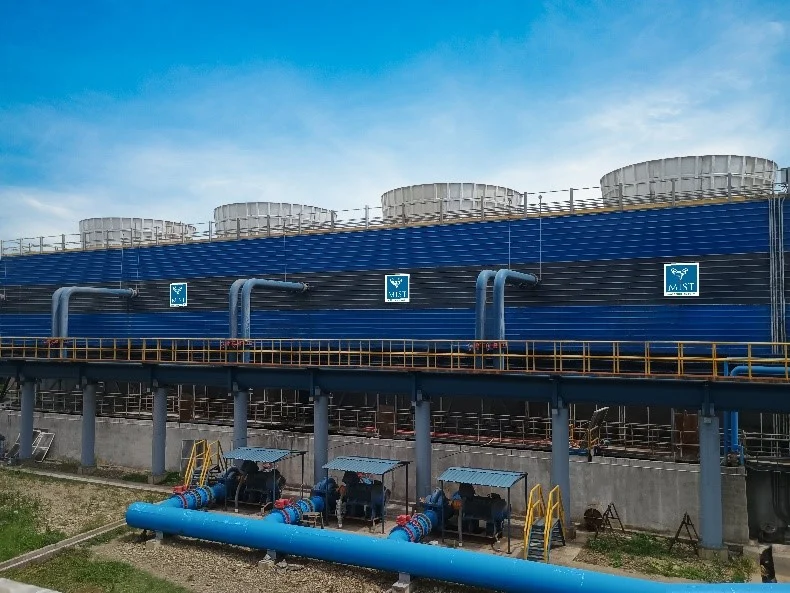
While spray ponds and mechanical draft towers served the industry for decades, they were inherently limited by their physics. Spray ponds, for instance, are notoriously space-intensive, requiring 25–50 times more surface area than cooling towers. Conventional mechanical draft towers, while more compact, often struggle with "fill" maintenance—the internal structures that increase surface area for heat exchange but also act as traps for scaling and debris. Mist Cooling Technology (MCT) represents the next logical step: by using pressure-driven atomization to create 5-micron droplets, MCT maximizes surface area for evaporative cooling without the need for traditional fills.

Technical Analysis: The Superiority of Mist Cooling
The fundamental difference between conventional spray systems and Mist Cooling lies in the droplet size and the physics of atomization.
The Physics of Efficiency
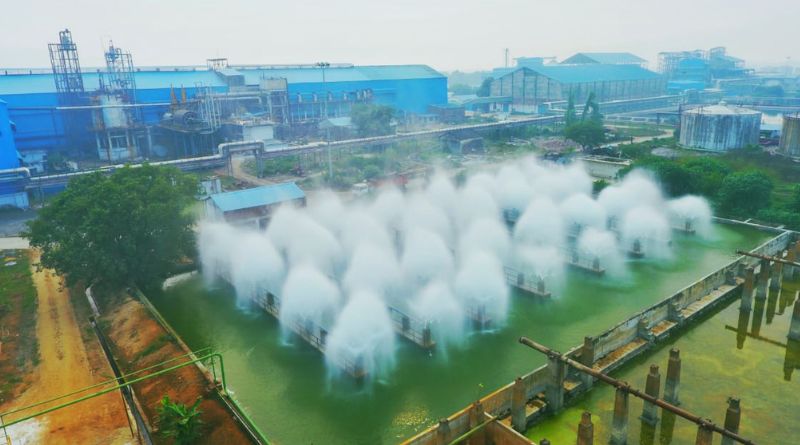
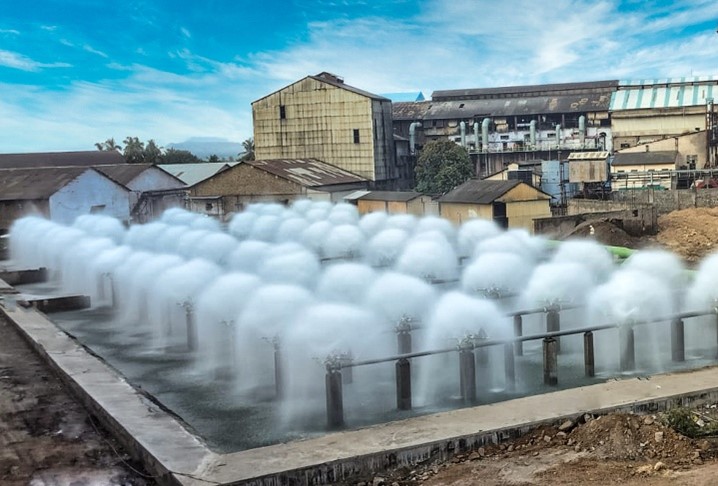
A conventional spray system typically produces droplets in the 3–6 mm range. These droplets are heavy, have a smaller surface-area-to-volume ratio, and require significant pressure to maintain. In contrast, the patented Mist Cooling System (MCS) utilizes specialized nozzles that leverage water pressure to create an ultra-fine 5-micron mist.
This mist creates a massive cumulative surface area for heat transfer. Because the mist is so light, it rises 6–8 meters, creating a dense "cloud" that facilitates near-instantaneous evaporative cooling. This allows the system to achieve a 1–2°C approach to the wet-bulb temperature, compared to the 5–6°C approach common in conventional spray systems.
Efficiency Comparison
The cooling tower efficiency ($eta$) is defined by the relationship between the temperature drop and the wet-bulb temperature:
$$eta = left[ fract_i – t_ot_i – WBT right] times 100$$
Where $t_i$ is the inlet temperature, $t_o$ is the outlet temperature, and $WBT$ is the wet-bulb temperature.
| Metric | Conventional Cooling Tower | Mist Cooling System (MCS) |
|---|---|---|
| Approach to WBT | 5–6°C | 1–2°C |
| Thermal Efficiency | ~69% | ~90% |
| Nozzle Opening | Variable (Clog prone) | 25 mm (Choke-free) |
| Maintenance | High (Fill cleaning) | Negligible (Fill-less) |
Implementation Models for Modern Industry
To cater to different site conditions, Mist Cooling Technology has been engineered into three distinct models, each addressing specific footprint and performance requirements.
Model-I: Open Type Mist Cooling System
Designed for sugar plants with available land, this open-loop configuration provides a high-efficiency cooling environment with minimal drift loss (0.1 to 0.25%). It is ideal for plants looking to maximize cooling performance without the complexity of enclosed structures.
Model-II: Louver Type MCS
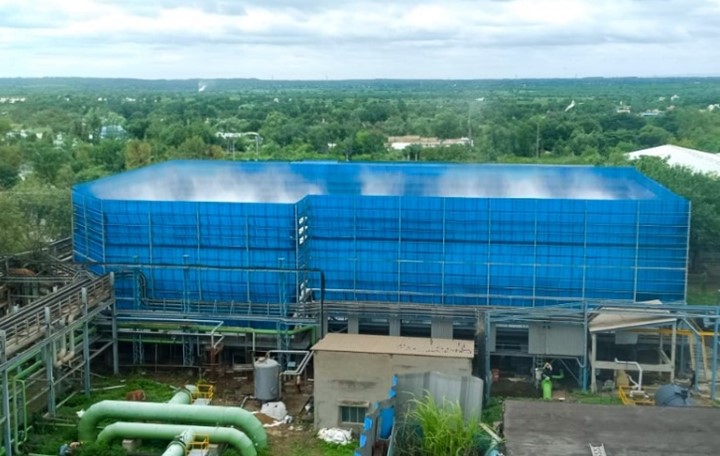
For plants with space constraints, the Louver Type MCS uses side-sheeting up to a height of 8–10 meters to create a semi-enclosed environment. This design reduces the required plot size by 60% compared to open ponds and slashes drift loss to a negligible 0.02%, making it a direct, high-performance competitor to conventional induced-draft cooling towers.
Model-III: Induced Draft Mist Cooling Tower (IDMCT)
This represents the pinnacle of the technology. By combining mist creation with an induced draft fan, this fill-less design eliminates the primary maintenance burden of conventional towers. Because the system lacks fills, the air pressure drop is significantly reduced, leading to a 30–50% reduction in fan power consumption. This model is particularly effective for large-scale co-generation plants requiring consistent, high-volume cooling.
Implications for the Sugar and Co-Generation Sectors
The adoption of Mist Cooling Technology has profound implications for the bottom line of sugar and power operations.
- Energy Optimization: By maintaining a constant, lower cooling water temperature, vacuum systems operate at peak efficiency. This directly reduces the steam required at the pan station and increases the electrical output of co-generation turbines.
- Sustainability and Water Security: With water becoming an increasingly expensive commodity, the low drift and high efficiency of MCS allow plants to operate with a smaller environmental footprint, ensuring compliance with tightening water-use regulations.
- Capital and Operational Expenditure: The ability to refurbish existing conventional towers by removing inefficient fills and installing mist nozzles offers a rapid ROI. Plants can transform aging, underperforming infrastructure into high-efficiency systems without the cost of a full greenfield construction.
- Operational Stability: The "choke-free" design of the 25 mm mist nozzles ensures that, unlike traditional spray nozzles that require constant cleaning, the MCS remains operational for long periods without interruption, ensuring steady production cycles during the peak crushing season.
Conclusion: A Strategic Necessity
In the modern industrial landscape, cooling infrastructure is no longer a "set-and-forget" utility. It is a strategic asset that dictates the overall throughput and energy efficiency of a plant. As sugar mills and co-generation plants face the pressure to scale up, the transition to high-efficiency cooling is inevitable.
Mist Cooling Technology provides the tools to bridge the gap between legacy limitations and future requirements. By prioritizing thermal physics and modular, low-maintenance design, this technology is setting a new standard for reliability. For the industry, the move toward Mist Cooling is not just an upgrade—it is a foundation for sustainable, high-output growth in an increasingly competitive global market.
Author Note: Makarand A. Chitale, Whole-time Director (Technical) at Mist Resonance Engineering Pvt. Ltd., Pune, emphasizes that the transition to Mist Cooling is a transformative step for any plant seeking to harmonize high-capacity production with energy-conscious operations.