
The landscape of Corporate Performance Management (CPM) is undergoing a seismic shift. As organizations grapple with economic volatility, the integration of advanced analytics, and the relentless pressure to digitize financial processes, the role of CPM software has evolved from a back-office utility to a strategic boardroom imperative.
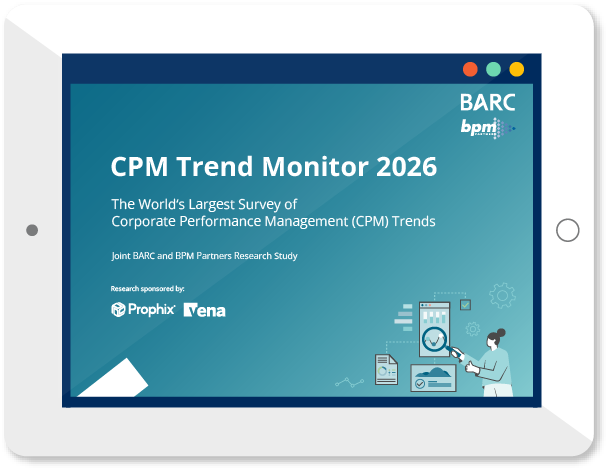
The recently released Chapter 3 of the CPM Trend Monitor 2026 provides an exhaustive look into these developments. Based on an extensive survey of 989 industry professionals—the largest of its kind—the report synthesizes the collective expertise and priorities of the global finance and analytics community. Spearheaded by industry stalwarts Craig Schiff of BPM Partners and Dr. Christian Fuchs of BARC, this research serves as a compass for CFOs, CIOs, and data strategists navigating the complex transition toward more agile, AI-driven performance management.
Main Facts: Defining the 2026 Priorities
The core findings of the CPM Trend Monitor 2026 reveal that the industry is no longer satisfied with mere "automation." Instead, the focus has shifted toward high-velocity decision-making. Organizations are increasingly prioritizing the democratization of data, moving away from siloed spreadsheets toward unified, cloud-native platforms that allow for real-time scenario planning.
Key takeaways from the survey data include:
- The Shift to Integrated Business Planning (IBP): Nearly 70% of respondents identified the integration of operational and financial planning as their primary goal for 2026.
- The AI Imperative: While Artificial Intelligence was once a buzzword, the survey confirms it has entered the implementation phase, with a focus on predictive forecasting and anomaly detection in financial reporting.
- Scalability and Cloud Migration: The vast majority of enterprises are finalizing their migration to cloud-based CPM solutions to facilitate remote collaboration and ensure data consistency across global entities.
Chronology: The Evolution of the CPM Trend Monitor
To understand the significance of the 2026 findings, one must view them through the lens of recent technological history.

- 2022–2023: The market was characterized by the "Great Pivot," where businesses scrambled to replace legacy on-premise systems with cloud alternatives following the global shift to remote work.
- 2024: The industry saw the "Analytical Awakening," where the focus moved from simple data collection to advanced visualization and the integration of BI (Business Intelligence) with CPM.
- 2025: Organizations began aggressively testing Large Language Models (LLMs) and Generative AI within their financial workflows, identifying specific use cases for narrative reporting and automated variance analysis.
- 2026 (The Current Horizon): The focus has matured into operationalizing these technologies. The industry is now moving toward a "Unified Truth" model, where financial and operational data exist in a singular, immutable flow, minimizing manual reconciliation.
Supporting Data: Why CPM is at a Crossroads
The data derived from 989 professionals highlights a stark dichotomy between "leaders" and "laggards." Companies that have successfully integrated their CPM suites with broader enterprise data stacks report a 35% reduction in monthly close times.
Furthermore, the survey indicates that the biggest barrier to success is no longer the technology itself, but change management. Over 40% of respondents cited "cultural resistance to new planning methodologies" as their biggest obstacle. This highlights that for organizations to extract value from their 2026 investments, they must invest as much in training and organizational redesign as they do in software procurement.
Expert Perspectives: Insights from the Authors
The report is bolstered by the deep analytical rigors of its authors.
Craig Schiff, CEO of BPM Partners, brings over 30 years of experience in budgeting, forecasting, and consolidation to the table. Having been a founding member of Hyperion (now Oracle) and a pioneer in the industry, Schiff emphasizes that "CPM is no longer just about the numbers; it is about the strategy behind them." His work focuses on how modern CPM tools can bridge the gap between high-level corporate strategy and granular daily operations.
Dr. Christian Fuchs, Head of Data & Analytics Research at BARC, provides a rigorous, data-centric perspective. His work centers on the architecture of decision support systems. According to Dr. Fuchs, the 2026 trend is defined by the "interoperability of ecosystems." He argues that modern CPM tools must be capable of talking to disparate ERPs, CRMs, and data lakes seamlessly. His guidance has become essential for companies undergoing the complex process of vendor selection, particularly as the market becomes saturated with specialized point solutions.
Implications: The Strategic Future of Finance
The implications of these findings are profound for every level of the organization.
For the CFO:
The CFO is no longer just the "chief accountant" but the "chief value officer." The 2026 trends suggest that the CFO must become a technologist. By leveraging the insights from the CPM Trend Monitor, CFOs are better positioned to advocate for budget allocations toward platforms that provide predictive foresight rather than historical hindsight.
For the IT Department:
The burden on IT is shifting from "maintaining systems" to "governing ecosystems." With the rise of self-service reporting, the IT department must ensure data integrity while providing the agility that business users demand. The 2026 report emphasizes that the "best-of-breed" approach is winning out over "all-in-one" monolithic suites, meaning IT teams must become experts in API management and middleware integration.
For the Workforce:
The democratization of data means that non-finance professionals are now expected to participate in planning and forecasting. This requires a cultural shift where data literacy becomes a core competency across the entire enterprise, not just within the finance department.
Conclusion: A Call to Action
The CPM Trend Monitor 2026 is more than a report; it is a roadmap. For organizations that have yet to address the inefficiencies of their current planning processes, the message is clear: the cost of inaction is rising. As competitors move toward AI-enabled, integrated planning models, those tethered to legacy processes will find themselves at a distinct competitive disadvantage.

For those looking to dive deeper, the full findings are available through specialized research platforms like BARC+. Accessing this level of intelligence is critical for any organization that intends to lead in the increasingly complex global data landscape. By understanding the trends identified by Schiff, Fuchs, and their cohorts, leaders can move beyond the status quo and build a resilient, forward-looking financial foundation for the years ahead.
Note: For further information on the survey methodology or to gain access to the full repository of data, visit the official BARC research portal. Access to comprehensive, expert-led analytics is essential for those who want to remain at the cutting edge of the data and analytics world.