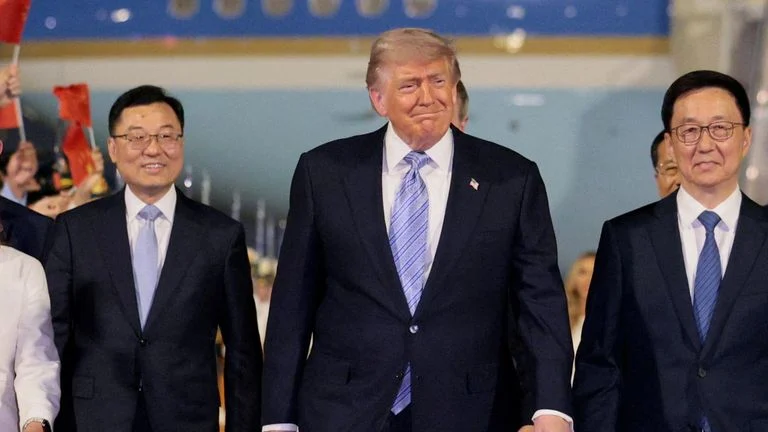
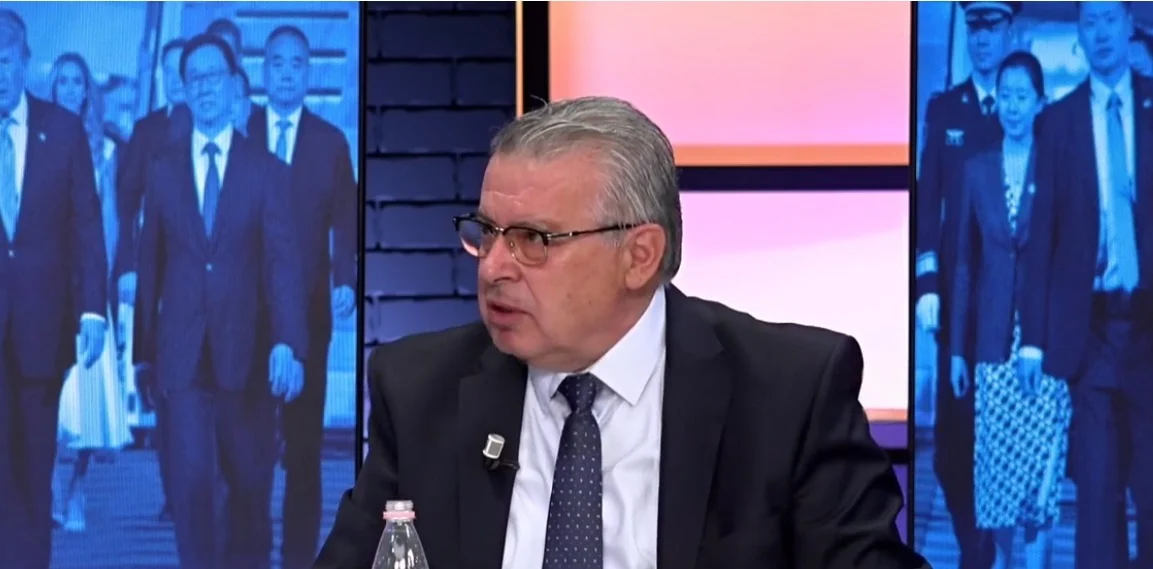
TIRANA, ALBANIA – In a pivotal analysis that reverberates through the annals of contemporary geopolitics, security expert Xhavit Shala has characterized former U.S. President Donald Trump’s visit to China as a landmark event destined to be etched in history. Speaking on the television program "Now me Erla Mëhillin," Shala posited that this visit unequivocally marked the genesis of a new world order, fundamentally reshaping the global power dynamic. His insights underscore a profound shift in how the two preeminent global powers, the United States and China, officially perceive and acknowledge each other.
Main Facts: A Paradigm Shift in Superpower Relations
Shala’s central thesis asserts that for the first time, the United States and China are officially recognizing each other as the world’s two primary superpowers. This unprecedented acknowledgment, he argues, signals a departure from previous diplomatic postures and ushers in an era of overt, albeit complex, competition. This new approach, according to Shala, was conspicuously reflected in President Trump’s own public declarations, wherein he openly conceded the contemporary global superpower status of both nations.
This development represents a critical inflection point in American foreign policy. Historically, the U.S. has often maintained a nuanced or even dismissive stance regarding the full extent of China’s global power parity. The explicit recognition by a sitting American president, however, shatters this tradition, bringing a long-evolving geopolitical reality into the forefront of political discourse.
Further substantiating this tectonic shift, Shala highlighted changes in U.S. national security and defense strategic documents. He noted that China is no longer categorized as an "enemy" or "adversary" but rather as a "competitor." This seemingly subtle terminological adjustment, he contends, is far from semantic; it signifies a fundamental reconfiguration of the relationship between the world’s two largest economies and military powers. This recalibration acknowledges a rivalry that, while intense, operates within a framework that implicitly accepts a shared, albeit contested, global leadership.
Chronology: The Road to Mutual Recognition
To fully grasp the magnitude of Shala’s claims, it is essential to contextualize Trump’s China visit within the broader arc of U.S.-China relations and the specific diplomatic tenor of his administration.
For decades, the relationship between Washington and Beijing has been a complex tapestry woven with threads of cooperation, competition, and occasional confrontation. From Nixon’s historic opening to China in 1972, which sought to exploit the Sino-Soviet split, to China’s entry into the World Trade Organization (WTO) in 2001, U.S. policy often oscillated between engagement and containment. The prevailing hope in many Western capitals was that economic liberalization would inexorably lead to political liberalization in China – a hope that largely proved unfounded.
By the time Donald Trump assumed the U.S. presidency in January 2017, the global landscape had undergone significant transformations. China’s economic ascent had been meteoric, transforming it from a developing nation into an industrial and technological powerhouse. Its military capabilities had expanded rapidly, challenging U.S. dominance in the Asia-Pacific region. Beijing’s ambitious Belt and Road Initiative (BRI) signaled its intent to project economic and political influence across continents, while its actions in the South China Sea demonstrated a willingness to assert territorial claims forcefully.
Trump’s approach to China was characterized by a blend of transactional pragmatism and aggressive rhetoric. He frequently criticized China’s trade practices, accusing it of currency manipulation, intellectual property theft, and unfair subsidies. This culminated in the initiation of a sweeping trade war, marked by the imposition of tariffs on billions of dollars worth of Chinese goods, eliciting retaliatory measures from Beijing.
It was against this backdrop of escalating trade tensions that President Trump embarked on his state visit to Beijing in November 2017. While the visit was framed around bilateral trade discussions and efforts to enlist China’s cooperation on North Korea’s nuclear program, Shala argues that its deeper significance lay in the implicit and explicit acknowledgments exchanged. Trump, known for his unconventional diplomacy, engaged in high-profile meetings with President Xi Jinping, characterized by opulent ceremonies and personal rapport.
Crucially, Shala points to Trump’s public statements during and after the visit, where he reportedly acknowledged the dual superpower status. This was a significant rhetorical shift. While previous administrations might have implicitly recognized China’s rise, few, if any, American presidents had so openly articulated a vision of the world governed by two equally dominant powers. This "proclamation," as Shala terms it, signaled a willingness to engage with China not merely as a rising power to be managed, but as an established peer, albeit a rival, in the global hierarchy. The visit, therefore, served as a public coming-out for this new conceptualization of the international order, moving beyond the unipolar moment that followed the Cold War.
Supporting Data: Unpacking the New Geopolitical Reality
The shift described by Shala is underpinned by a confluence of economic, military, and strategic realities that have reshaped the global stage.
Economic Parity and Interdependence:
The sheer economic scale of both nations necessitates mutual recognition. China has surpassed the U.S. in terms of purchasing power parity (PPP) GDP and is rapidly catching up in nominal GDP. Both economies are inextricably linked through vast trade flows, global supply chains, and financial investments. As Shala noted, China has consistently advocated for cooperation, recognizing that the global economy benefits when the two largest economies work in concert. This interdependence, however, also creates vulnerabilities and points of leverage. The trade war initiated by Trump demonstrated both the capacity of the U.S. to exert pressure and China’s growing resilience. China’s ability to resist American economic pressures, as evidenced during the tariff disputes, stems from its massive domestic market, robust industrial base, and strategic investments in critical technologies and infrastructure (e.g., Made in China 2025 initiative).
Strategic Document Shift: From Enemy to Competitor:
The terminology used in official U.S. strategic documents is meticulously crafted and reflects fundamental policy orientations. Shala’s observation that U.S. national security and defense strategies now refer to China as a "competitor" rather than an "enemy" or "adversary" is profoundly significant.
- "Enemy" implies an existential threat requiring direct confrontation and, potentially, military conflict.
- "Adversary" suggests a hostile relationship, often with ideological components, where interests are fundamentally opposed.
- "Competitor," however, acknowledges a rivalry for influence, resources, and technological supremacy, but within a framework that might allow for limited cooperation or coexistence. It suggests a contest where both parties are powerful and legitimate players, vying for advantage. This shift aligns with the concept of "great power competition," which became a dominant theme in U.S. foreign policy discourse during the Trump administration and has continued into the Biden era. It implies a long-term, multifaceted contest across diplomatic, economic, technological, and military domains.
Points of Contention and Common Interests:
Despite the mutual acknowledgment of superpower status, numerous deep-seated disagreements persist, as Shala correctly identified:
- Taiwan: China views Taiwan as an integral part of its territory, destined for reunification, by force if necessary. The U.S. maintains a policy of "strategic ambiguity," providing Taiwan with defensive capabilities while not explicitly endorsing its independence. This remains one of the most volatile flashpoints in the relationship.
- Iran: The U.S. and China have divergent approaches to Iran’s nuclear program and its regional activities. While the U.S. often seeks to isolate Tehran, China maintains significant economic ties and advocates for a diplomatic resolution that includes sanctions relief.
- Tariffs and Trade Imbalances: Although the immediate tariff disputes have evolved, underlying issues of market access, intellectual property rights, state subsidies, and technology transfer continue to fuel economic tensions.
- National Security Concerns: Broader national security issues include cyber espionage, military buildup in the South China Sea, human rights abuses in Xinjiang and Hong Kong, and ideological competition.
- Rare Earth Minerals: Shala’s analogy of rare earth minerals being China’s "Hormuz" is particularly insightful. China controls a vast majority of the world’s processing capacity for rare earth elements, which are crucial for advanced technologies, defense systems, and renewable energy. This gives Beijing immense leverage, akin to the strategic importance of the Strait of Hormuz for global oil supplies. Any disruption to this supply chain could cripple industries worldwide, providing China with a potent economic and strategic weapon.
However, areas of common interest also exist, preventing an outright Cold War-style confrontation. These include global challenges such as climate change, pandemic preparedness, nuclear non-proliferation, and regional stability in certain areas. These shared challenges often necessitate a degree of cooperation, even amidst fierce competition.
Official Responses: Rhetoric and Reality
Shala’s assertion that President Trump publicly acknowledged the dual superpower status marks a significant rhetorical shift, moving beyond the more guarded language of previous administrations. This was not merely an off-the-cuff remark but, as Shala suggests, a reflection of a deeper re-evaluation within U.S. strategic thinking.
U.S. Official Stance (Trump Era):
Under Trump, the U.S. increasingly framed its relationship with China as one of "strategic competition." While the administration focused heavily on trade imbalances and intellectual property theft, there was an underlying recognition of China’s growing power. Trump’s own statements, often direct and unconventional, cut through traditional diplomatic euphemisms. By declaring "we and China are two superpowers today," he arguably gave voice to a reality that many in the foreign policy establishment had been grappling with for years. This public acknowledgment, though potentially jarring to some, arguably set the stage for a more direct, confrontational, yet also pragmatic engagement. It was a recognition that China could no longer be treated as a junior partner or a mere regional power.
Chinese Official Stance:
From China’s perspective, the narrative of its "peaceful rise" and its status as a great power has been a consistent theme for decades. Beijing has long sought international recognition commensurate with its economic and military might. China’s state media and official pronouncements often highlight its unique socialist system with Chinese characteristics, presenting it as a viable alternative or complement to Western liberal democracy. They have frequently called for a "new type of great power relationship" with the U.S., implying a relationship based on mutual respect, non-confrontation, and win-win cooperation, even as they assert their core interests. The Chinese leadership would likely view Trump’s acknowledgment as a belated, but necessary, recognition of its rightful place on the global stage, validating its own long-held view of a more multipolar world. They have consistently emphasized that a cooperative relationship between the two countries benefits the entire world, given their economic interconnectedness.
Implications: The Dawn of a Bipolar Century
The mutual, albeit grudging, recognition of superpower status between the U.S. and China, as highlighted by Xhavit Shala, carries profound implications for the 21st century.
Global Geopolitics:
The most immediate implication is the solidification of a nascent bipolar world order. While some argue for a multipolar system with other significant actors like the EU, India, or Russia, the sheer economic and military might of the U.S. and China places them in a league of their own. This bipolarity will likely manifest as intensified competition for influence across various regions, from Africa and Latin America to Southeast Asia and the Arctic. Nations will increasingly find themselves navigating between these two gravitational centers, often compelled to choose sides or balance their allegiances carefully. This could lead to a fragmentation of international institutions or the emergence of parallel structures aligned with either Washington or Beijing.
International Alliances:
For U.S. allies, this new reality presents both challenges and opportunities. Allies in Asia, such as Japan, South Korea, and Australia, are on the front lines of this competition and will seek stronger security guarantees from Washington while maintaining crucial economic ties with Beijing. European allies may face pressure to align more closely with U.S. policies on China, potentially impacting their own economic interests. The acknowledgment of China’s peer status could also compel allies to shoulder more responsibility for their own defense and contribute more actively to a collective strategy to manage Chinese influence.
Economic Stability and Innovation:
The "competitor" framework implies a continued, intense economic rivalry. This could manifest in a race for technological supremacy, particularly in critical areas like artificial intelligence, quantum computing, semiconductors, and biotechnology. While competition can drive innovation, it also risks further decoupling of economies, the creation of separate technological ecosystems, and potential disruptions to global supply chains. The weaponization of trade and technology, as seen with rare earth minerals or sanctions on tech companies, could become more common, posing significant risks to global economic stability.
Global Governance and Norms:
The U.S. and China hold vastly different views on human rights, democracy, internet governance, and the role of the state in the economy. The competition between them is not just about power but also about the shape of future global norms and institutions. China’s rise and the U.S. acknowledgment of it mean that Beijing will play a much larger role in shaping international rules, potentially challenging the liberal international order established after World War II. This ideological competition will extend to narratives about development models, governance, and the very definition of "progress."
Risk of Conflict:
While the "competitor" label implies a desire to avoid direct military conflict, the inherent tensions in a bipolar world heighten the risk of miscalculation or escalation. Flashpoints like Taiwan, the South China Sea, or even cyber warfare could trigger broader confrontations. The challenge for both powers, and indeed for the international community, will be to manage this competition responsibly, establish clear guardrails, and maintain open channels of communication to prevent minor disputes from spiraling out of control.
In conclusion, Xhavit Shala’s assessment of Donald Trump’s China visit as a historical marker for a new world order appears increasingly prescient. The explicit recognition of mutual superpower status, coupled with the strategic reclassification of China from adversary to competitor, signifies a fundamental and irreversible shift in international relations. The implications are far-reaching, setting the stage for an era defined by intense, multifaceted competition between two global titans, whose interactions will largely determine the trajectory of the 21st century.