In the high-stakes theater of modern healthcare, the divide between clinical care and administrative efficiency is rapidly narrowing. At the center of this transformation is Commure, a healthcare AI powerhouse that has quietly—but methodically—shifted from a niche documentation tool provider to a comprehensive digital infrastructure architect. By moving beyond the confines of the exam room to capture the entire lifecycle of a patient visit, Commure is signaling a bold ambition: to own the “before, during, and after” of the modern health system experience.
Main Facts: A Pivot Toward Full-Spectrum Automation
The core of Commure’s recent momentum lies in its deepening integration with the industry’s most critical gatekeeper: Epic Systems. Last week, the company achieved a significant technical milestone when its autonomous coding product earned the coveted “Epic Toolbox” designation. This follows the previous success of its ambient AI scribe in securing the same status.
For the hundreds of health systems already tethered to the Epic ecosystem, this is more than a mere software update. It represents a seamless, "in-workflow" capability where a patient’s visit can be documented and medical billing codes generated in real-time, all without the physician ever having to toggle between applications.
However, documentation is merely the tip of the spear. Commure is aggressively diversifying its product suite. In June, the company launched "Orchestrator," a specialized platform designed to streamline the chaotic world of patient referrals. Simultaneously, it is building "Air," an AI-native Electronic Health Record (EHR) platform, and expanding its geographic footprint into the European and UK markets. By combining these services, Commure is effectively attempting to rewire the operational nervous system of the hospital.
Chronology: The Evolution of a Digital Titan
Commure’s ascent has been characterized by a “buy-and-build” strategy that prioritizes rapid scalability over organic development.
- The Foundation: Commure established itself as a reliable partner for health systems, focusing on interoperability and documentation.
- The M&A Engine: With seven strategic acquisitions under its belt, the company has mastered the art of absorbing specialized players. Notable among these is the 2024 privatization of Nasdaq-listed Augmedix, a move that significantly bolstered its ambient documentation capabilities. Similarly, the acquisition of Rx.Health transformed that asset into "Commure Engage," cementing the company’s presence in patient outreach and engagement.
- The May 2026 Expansion: Following a $70M Series F extension in May, the company found its coffers brimming with the capital necessary to pursue its next phase of growth.
- The Global Push: By September, Commure initiated the rollout of its ambient AI solutions across Europe and the UK, signaling that its model is not just a localized U.S. phenomenon, but one with global applicability.
Supporting Data: Mapping the Strategic Gap
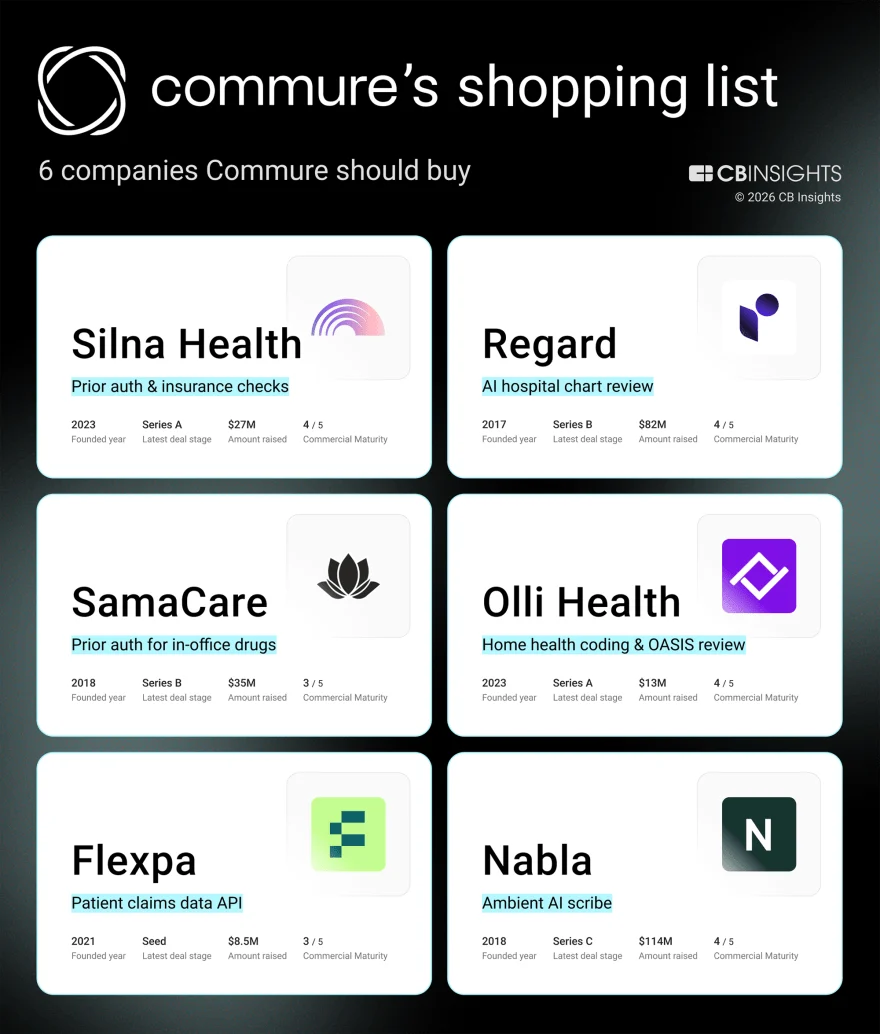
Commure’s strength lies in its existing network—a vast ecosystem comprising over 500 health systems and clinical practices. When the company identifies a gap in its software suite, it doesn’t necessarily start from scratch. Instead, it utilizes data analytics—leveraging the CB Insights platform—to identify high-performing, VC-backed startups that can be integrated into its existing infrastructure.
The current strategy involves a rigorous screening process. By evaluating startups with less than $150M in funding and analyzing them against a proprietary “Mosaic” score (which measures financial health, market momentum, and product-market fit), Commure identifies targets that fill critical gaps in areas such as prior authorization, post-acute care, and health data interoperability.
The logic is simple: Buy a finished, proven product with an existing customer base and immediately cross-sell it into the 500+ health systems already under the Commure umbrella. This creates an immediate "network effect" that competitors, who are forced to build from the ground up, struggle to replicate.
Official Responses and Strategic Rationale
While the company remains tight-lipped regarding specific future acquisition targets, the intent behind its recent moves is clear. Executives have consistently emphasized the need for "AI-native" workflows. In an era where burnout among clinicians is at an all-time high, Commure’s pitch is humanitarian as much as it is financial: by offloading the drudgery of coding and referral management to AI, the company claims it can return the "joy of medicine" to the provider.
Industry analysts observe that by becoming a “platform of platforms,” Commure is positioning itself as the primary interface layer for the hospital. If the EHR is the database, Commure is effectively becoming the operating system that runs on top of it. This strategy mitigates the risk of vendor lock-in for health systems, as Commure’s tools are designed to work alongside existing legacy systems rather than demanding a painful "rip and replace" migration.
Implications: The Future of Health Systems
The implications of Commure’s trajectory are profound for three key stakeholders:
1. For Health Systems and Hospital Admins
The "Epic Toolbox" integration is a harbinger of a consolidated future. Health systems have long been plagued by "app fatigue," where the average hospital uses dozens of disparate, non-communicating tools. Commure’s strategy of building an all-encompassing suite simplifies vendor management and data silos. If the company succeeds in its goal of owning the pre- and post-visit workflow, hospital admins will have a unified view of patient revenue cycles and clinical outcomes that was previously impossible.
2. For Competitors and Incumbents
The move puts significant pressure on established revenue cycle management (RCM) players like R1 and Waystar. These companies now face a competitor that is not just selling a software service, but is actively integrating itself into the clinical workflow through AI-native features that incumbents are still struggling to retrofit. The threat is not just that Commure will take market share, but that it will redefine what "good" looks like in terms of user experience.
3. For the Patient Experience
Patients stand to gain from reduced administrative friction. If Commure’s Orchestrator can handle referrals more efficiently, the "wait-time" between a primary care recommendation and a specialist appointment—a notorious pain point in modern healthcare—could drop significantly. Furthermore, with the expansion of ambient AI, the clinical encounter becomes less about the physician staring at a screen and more about the actual patient-doctor interaction.
Conclusion: The Path Forward
Commure is currently in the "growth at scale" phase of its corporate life cycle. By leveraging its Series F funding to acquire niche, high-value startups, it is effectively playing a game of corporate Tetris, fitting pieces together to form a complete, end-to-end solution for the healthcare sector.
The road ahead, however, is not without challenges. Integrating disparate technologies is notoriously difficult, and maintaining the quality of service while scaling to global markets will test the company’s internal engineering and management rigor. Yet, if the current pace of innovation and acquisition is any indication, Commure is well on its way to becoming the essential layer that connects the fragmented parts of the healthcare industry.
As it moves to dominate the space before and after the visit, the company is proving that the future of healthcare isn’t just about better medicine—it’s about better software. For the 500+ systems already in its orbit, the transformation has already begun; for the rest of the industry, the race to keep up is well underway.