Updated: 27 October 2026 – 17:24 GMT+1
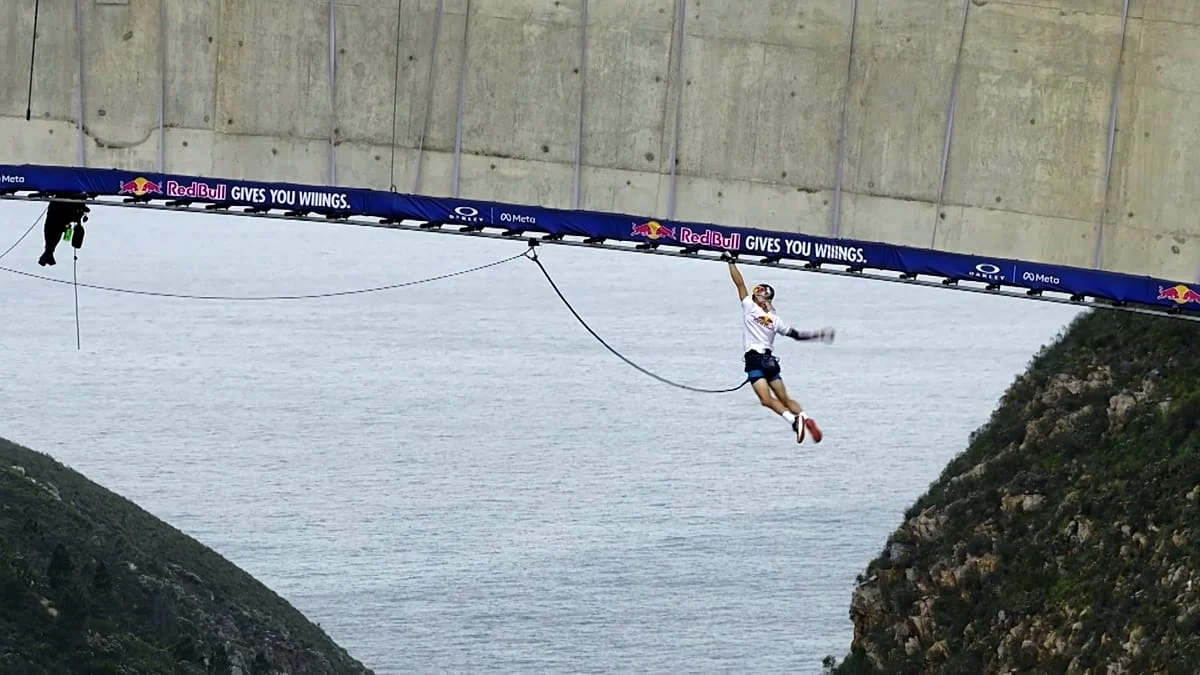
In an extraordinary display of human endurance and technical precision, South African obstacle course racing (OCR) world champion Thomas van Tonder has etched his name into the annals of extreme sports history. Suspended 216 metres above the Bloukrans River, Van Tonder successfully navigated a custom-built course of 600 monkey bars, traversing more than 280 metres of the bridge’s iconic steel arch. The "Red Bull Bridge Bars" challenge, a feat never before attempted, pushed the limits of physical and psychological resilience, ultimately concluding in a masterclass of athletic focus.
The Main Facts: A World-First Ascent
The Bloukrans Bridge, renowned primarily as the site of one of the world’s highest commercial bungee jumps, served as the backdrop for a different kind of vertical challenge on October 27, 2026. Thomas van Tonder, a titan of the OCR world, spent precisely 47 minutes and 37 seconds suspended in the air.
The course consisted of 600 individual monkey bars arranged in a continuous, grueling chain. To complete the crossing, Van Tonder had to maintain a constant, iron-clad grip while navigating an architecture that defied traditional movement. The objective was clear but Herculean: move from one end of the arch to the other without ever touching the ground or losing momentum.
Chronology of the Challenge: Minute-by-Minute Endurance
The Start: Battling the Incline
At 10:21 AM, the atmosphere surrounding the Bloukrans Bridge was thick with anticipation. As Van Tonder made his initial contact with the first bar, his heart rate was recorded at a steady 150 beats per minute—an elevated baseline that reflected the immense physiological load he was about to undertake.
The immediate challenge was not the length of the course, but its initial geometry. The first section of the bridge required a 45-degree ascent. For an athlete hanging by their hands, this meant fighting gravity in a literal sense, pulling his body weight upward bar by bar while facing backwards. This segment served as an immediate "litmus test" for his grip strength and core stability, forcing him to engage muscles that are rarely pushed to such extremes in traditional obstacle racing.
The Mid-Section: Friction and Fatigue
As Van Tonder moved into the middle phase of the 280-metre stretch, the physical toll began to manifest. The repetitive motion of gripping and swinging, performed thousands of times over, caused the protective tape on his fingers to deteriorate. With the tape failing, the raw metal of the bars began to abrade his skin, increasing the risk of slips.
"Battling exhaustion," as noted by observers on-site, became the central theme of the middle duration. Unlike a standard race where an athlete can adjust their gait or pace, the Bridge Bars challenge offered no reprieve. Every movement had to be calculated; one slip of the fingers would have resulted in an immediate fall, mitigated only by the safety harness system, which would have ended the record-breaking attempt.
The Descent and Final Stretch
The final phase of the crossing presented a new set of dangers. As the arch began its downward slope, gravity, which had previously been his primary enemy during the ascent, became a factor of momentum. The descent required extreme technical control; Van Tonder had to brake his movement to avoid swinging uncontrollably between the bars. By the time he reached the final sequence, his forearms were likely operating on lactic acid reserves, yet his focus remained singular. He completed the final bar with the precision of a seasoned champion, concluding the 47-minute ordeal with a final, definitive pull.
Supporting Data: The Anatomy of a Record
To understand the magnitude of Van Tonder’s achievement, one must look at the specific parameters of the challenge:
- Total Height: 216 metres above the Bloukrans River gorge.
- Total Distance: Over 280 metres of continuous suspension.
- Course Composition: 600 individual monkey bars.
- Total Duration: 47 minutes and 37 seconds.
- Starting Heart Rate: 150 BPM.
- Environmental Factors: The Bloukrans Bridge is subject to significant wind shear and shifting thermal currents, adding an unpredictable layer of complexity to the athlete’s balance.
The logistical planning required for this event was unprecedented. Engineers had to ensure that the bar structure could withstand the intense, localized stress of a world-class athlete’s body weight repeatedly snapping onto each bar, while simultaneously ensuring the safety of the athlete at all times.
Official Responses and Personal Reflection
Following the successful completion of the course, Thomas van Tonder was met with overwhelming support from the extreme sports community. In a brief statement following his recovery, Van Tonder revealed the depth of his commitment to this project.
"This has been one of my biggest dreams and missions for the last two years," Van Tonder stated. The phrase "I have finished what I started" echoed through the gorge, serving as a testament to the internal drive that kept him moving when his physical faculties were signaling for him to stop.
The Red Bull organization, which facilitated the event, noted that this challenge represents a new frontier in the sport of OCR. "Thomas has demonstrated that the boundaries of what we consider ‘obstacle racing’ are purely psychological," a spokesperson noted. "By bringing this sport into the vertical, open-air environment of a 216-metre bridge, he has redefined the ceiling of the discipline."
Implications: The Future of Obstacle Course Racing
The success of the Red Bull Bridge Bars challenge holds significant implications for the future of extreme athletics.
1. The "Verticalization" of Extreme Sports
We are seeing a trend where traditional ground-based obstacle courses are being replaced by high-altitude, high-stakes environments. This shift attracts a broader audience and tests not only athletic ability but also the psychological fortitude required to perform under the constant threat of height and exposure.
2. Technological Integration in Athletics
The use of specialized equipment to track heart rate, grip pressure, and kinetic energy during the crossing suggests that future challenges will rely more heavily on real-time bio-data. This data will not only ensure athlete safety but will also provide fans with a deeper, more granular look at the physiological toll of these superhuman feats.
3. The Legacy of the Bloukrans Bridge
While the Bloukrans Bridge is famous for bungee jumping, it has now gained a reputation as a laboratory for human potential. It is likely that this event will trigger a surge in interest for similar high-altitude endurance challenges, potentially leading to a new sub-discipline of "Extreme Suspension Racing."
4. Psychological Resilience Training
Van Tonder’s ability to maintain composure for nearly 50 minutes while suspended hundreds of metres in the air offers a valuable case study in mental toughness. His strategy—focusing on "one bar at a time"—is a technique often utilized in high-stress environments, and its success here reinforces the importance of cognitive segmentation in endurance sports.
Conclusion
Thomas van Tonder’s crossing of the Bloukrans Bridge is more than just a world-first; it is a profound statement on the capabilities of the human body and mind. By stripping away the comfort of the ground and placing himself in the most precarious of positions, he has provided a roadmap for the next generation of athletes. As he moves forward from this historic 47-minute ordeal, one thing is certain: the bar for obstacle course racing has been raised, quite literally, to new heights.