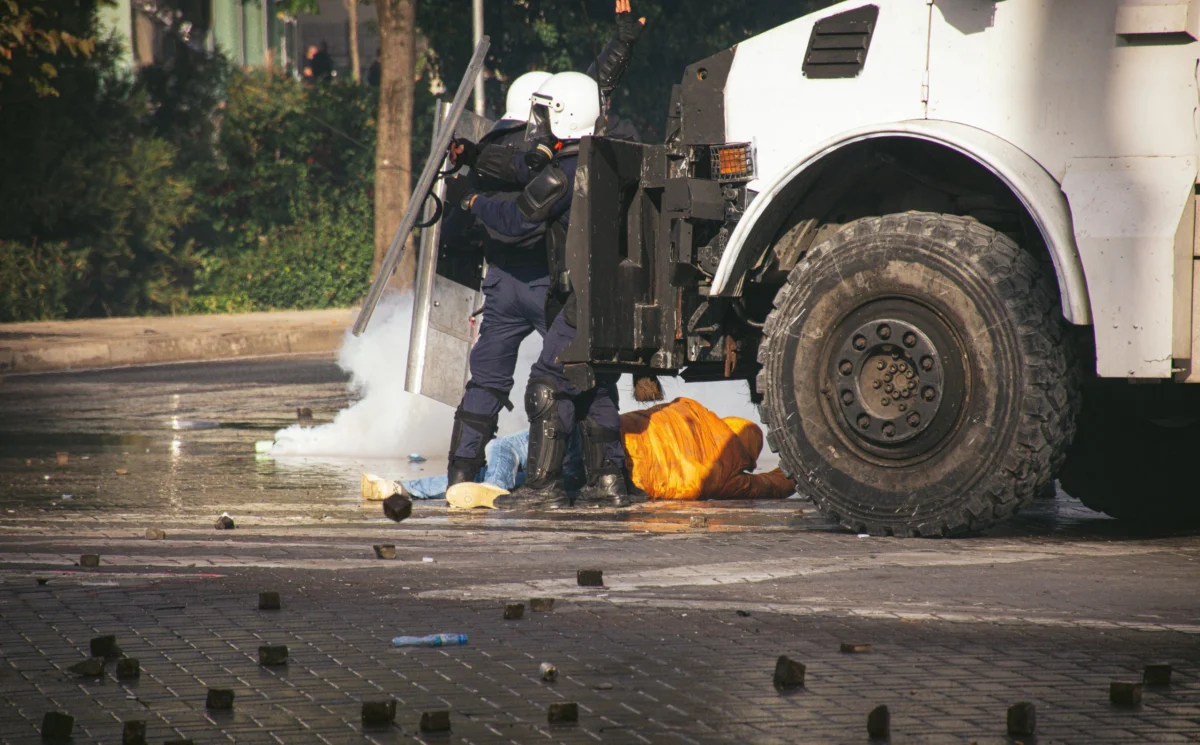
Tirana, Albania – A palpable tension has gripped the Albanian capital as a wave of anti-government protests, initially sparked by environmental concerns, has evolved into a broader outcry against perceived corruption, economic hardship, and political mismanagement. What began as a peaceful demonstration against a tourism resort project in the protected Zvërnec area has, over recent months, escalated into a series of increasingly volatile confrontations between citizens and law enforcement, painting a stark picture of deep-seated societal frustration.
Saturday’s events underscored this escalating crisis, as thousands of Albanians, primarily young people, took to the streets demanding the resignation of Prime Minister Edi Rama. The day’s demonstrations, characterized by both peaceful marches and violent clashes, highlighted the growing chasm between the government and a significant portion of its populace. The heavy-handed police response, involving tear gas, water cannons, and rubber bullets, only seemed to fuel the protesters’ determination, revealing a cycle of unrest that shows no signs of abating.
A Day of Escalation: From Calm to Chaos
The afternoon of Saturday began with an eerie calm in front of the Prime Minister’s Office. Police officers, many of them young women, stood in formation, their presence a silent testament to the anticipated unrest. The only sounds were the crackle of their radios, relaying fragmented orders and observations. "Disperse. There are forty people… Is he in blue the organizer?" a voice crackled, referring to a group of protesters near the Ministry of Education.
Within minutes, the scene transformed. Hundreds of citizens, initially gathered before the Ministry of Education, dispersed and regrouped, attempting to evade the tear gas and converge on Skanderbeg Square and the surrounding streets. The aim was clear: to mobilize and present a united front before the Prime Minister’s Office.
The sheer volume of protesters swelled rapidly. From numerous side streets feeding into the main boulevard, thousands, predominantly young men and women, flooded the square. Organized groups, some wearing makeshift uniforms, led the march, their chants for the Prime Minister’s resignation echoing through the city. Behind them, countless other citizens joined the peaceful procession, their collective voice a powerful testament to their discontent.
The Saturday gathering was not an isolated incident but a continuation of a broader anti-government movement that commenced on May 31st. Initially focused on the environmental implications of a proposed tourism resort in the Zvërnec protected area, the protests have since broadened their scope. Fueled by a relentless barrage of corruption scandals, a soaring cost of living, and numerous other perceived failures of governance, the movement has coalesced diverse groups – students, professionals, and ordinary citizens – under a singular, overarching demand: the resignation of Prime Minister Edi Rama.

By 3:05 PM, the boulevard was still teeming with demonstrators. However, at the forefront, near the Prime Minister’s Office, the anticipated clashes between a few dozen protesters and the police had begun. What followed, however, was a disturbing escalation. Within minutes, thousands of peaceful demonstrators, positioned hundreds of meters away from the initial point of conflict, found themselves caught in a sudden and unprovoked barrage of tear gas.
The police response intensified dramatically. Dozens of police forces and armored vehicles equipped with water cannons moved in, effectively splitting the protesters. A significant portion found themselves trapped between the large bridge over the Lana River and the National Gallery of Arts. Caught in what felt like a deliberate trap, protesters retaliated by throwing stones in both directions. However, the police blanketed the entire boulevard with tear gas, unleashing dozens of canisters in rapid succession. The resulting thick fog enveloped Rinia Park and the adjacent boulevard, forcing protesters to scatter in various directions, seeking refuge down Myslym Shyri street, the Pedestrian area, the Ring Road, and other connecting routes. The square quickly emptied, with police units pursuing fleeing demonstrators down several streets.
The Cycle of Resistance: Resilience Amidst Repression
Despite the forceful dispersal, the protesters demonstrated remarkable resilience. Within thirty minutes, a new formation emerged. Approximately 200 to 300 individuals positioned themselves opposite the police at the entrance to Rinia Park. Simultaneously, thousands more regrouped in Skanderbeg Square, facing a police cordon that blocked access to the boulevard. Here, the dynamic shifted once more. Protesters hurled stones and Molotov cocktails, prompting the police to respond with tear gas and rubber bullets.
The scene was one of chaos and defiance. A 28-year-old woman, drenched from the water cannons and with eyes reddened by tear gas, told BIRN that resistance was the only viable option. "If we leave today, there will be no tomorrow. We will all leave here, we will all leave Tirana," she stated, trying to regain her composure in a gas-free zone.
This sentiment of unwavering determination resonated with a significant portion of the protesters. "I can only say there is no turning back," declared a man who identified himself as a lecturer at the Polytechnic University. He explained his presence at the protest stemmed from accumulated dissatisfaction. He emphasized that the protesters’ ability to withstand the "bombardment" of gas and return to the streets was a testament to their resolve. However, he chose to remain anonymous, as did many others in public administration, fearing professional repercussions. "The administration is the most dissatisfied with the prime minister," he stated, adding that the ongoing scandals have made public servants feel increasingly marginalized. He saw no alternative but the continuation of protests.
Another protester, accompanying him, shared their story. They had returned to Albania in 2013 after studying abroad, harboring hopes for the country’s transformation and a desire to avoid being compelled to leave again. This woman, who studied piano, observed that the widespread dissatisfaction was palpable. "If you look, you see people from different strata and ages, with different physiognomies. It shows that this has affected a much larger part of the population than just one group," she remarked.

The fear of identification among public administration employees was not unfounded. A former employee of the Albanian Road Authority (ARRSH) recounted being dismissed in July after participating in June protests. She learned of her termination through friends within the institution, lamenting that there was no meritocracy in the administration, only "patronage." "I was currently removed from my job, even though I had the most complete and qualified CV at ARRSH after a year and a half working there. I privately messaged the Prime Minister to inform him about the situation, and Mr. Prime Minister couldn’t provide a solution. He cannot provide a solution for Albania," she stated, referring to an unanswered message on her phone. She added that after 12 days of escalating protests, public anger had only intensified.
The Underlying Causes: A Nation’s Grievances
The current wave of protests is rooted in a deep well of public discontent, encompassing a range of issues that have eroded trust in the government.
- Corruption and Governance Scandals: A series of high-profile corruption cases and allegations of cronyism have fueled public anger, with citizens feeling that their government is not serving their interests.
- Economic Hardship: The rising cost of living, coupled with stagnant wages and high unemployment, has placed immense pressure on Albanian households, exacerbating a sense of economic injustice.
- Environmental Concerns: The initial spark of the protests – the development project in Zvërnec – highlights broader anxieties about the unchecked exploitation of natural resources and the perceived disregard for environmental protection.
- Lack of Accountability: Protesters and critics alike express frustration over the perceived lack of accountability for government officials involved in scandals, further fueling demands for political change.
Official Responses and Their Impact
The government’s response to the protests has largely been characterized by a firm stance on maintaining public order, often resorting to strong law enforcement tactics. While officials have occasionally addressed the protesters’ concerns, the dominant narrative from the government has focused on condemning the violence and emphasizing the need for stability.
The heavy deployment of police forces, the use of tear gas, and water cannons, and reports of rubber bullet usage have been widely criticized by human rights organizations and segments of the public as excessive and disproportionate. This approach, rather than de-escalating the situation, has often served to further inflame tensions and reinforce the protesters’ perception of a government unwilling to engage in genuine dialogue or address their grievances.
Implications for Albania’s Future
The escalating protests in Albania carry significant implications for the country’s political and social landscape.
- Deepening Political Polarization: The confrontations are likely to further deepen the existing political divides within Albania, making future consensus-building more challenging.
- Erosion of Trust in Institutions: The repeated clashes and the perception of heavy-handed policing risk further eroding public trust in democratic institutions, including the police and the judiciary.
- Potential for Continued Instability: Without a fundamental shift in governance and a more responsive approach to public concerns, the cycle of protests and repression is likely to continue, potentially leading to prolonged periods of social and political instability.
- Impact on International Standing: The ongoing unrest and the government’s response could also impact Albania’s international standing, particularly as it seeks closer integration with European Union structures.
As night fell over Tirana, the acrid smell of tear gas lingered in the air. The protests, which had continued for hours, saw further clashes in various parts of the city. By late evening, a tally of injured individuals remained unpublished. Following the dusk, police reportedly intensified their tactics, stopping and assaulting citizens in narrow streets.

The determination of the protesters, however, remains evident. In Skanderbeg Square, amidst the drifting tear gas canisters and projectiles, Ardi, a 19-year-old medical student studying in Budapest, expressed his conviction. He had returned specifically for the protest, hoping for a change in his country. His friend, grimacing against the gas, suggested that meaningful change was tied to a change in the political class. "Why is this state controlled by people who do not wish this country well? I am 18 years old; he has been in power for most of my life, and he has left us no possibility except for a new system," he stated, as another wave of gas engulfed the square.
Mishel, a film directing student at the Academy of Arts, removing her anti-gas mask and goggles, articulated the driving force behind her and her peers’ endurance. "Hope. Hope that perhaps, our little Albania with so much history and so many values will manage to become a state where all Albanians are happy. Hope is what keeps us here every day," she said.
For them and other young people, the recent protests represent the only hope against widespread dissatisfaction. "All Albanian students suffer, they sacrifice to get an education, and to gain knowledge. Knowledge should be everywhere without payment. Knowledge should be gifted everywhere, because it is what moves everyone forward," Mishel continued, describing an Albania where families struggle to make ends meet.
The persistent scent of tear gas hanging over Tirana as night descended symbolized the unresolved grievances and the ongoing struggle for a better future. The protests continued into the night, with clashes reported in other parts of the city. The heavy police presence and the ongoing confrontation underscore the deep societal divisions and the urgent need for a responsive and accountable government.