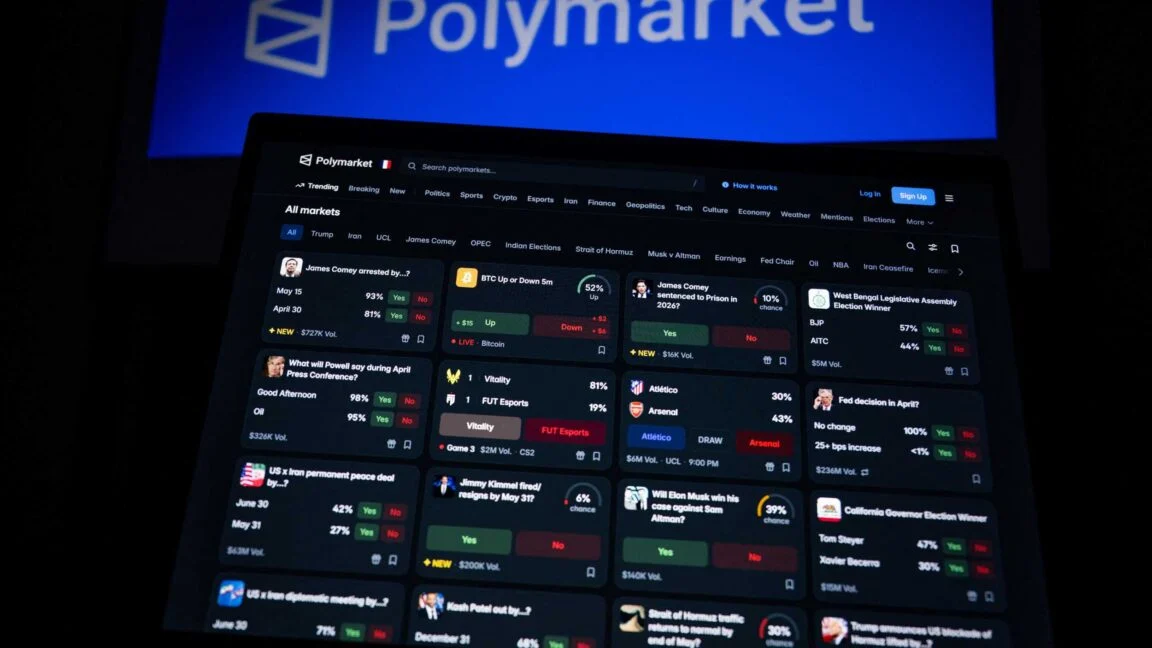
In a sweeping directive aimed at safeguarding national security, the Department of War has officially barred its personnel from utilizing nonpublic information to engage in financial speculation within prediction markets. The memorandum, issued by Secretary of War Pete Hegseth, signals a significant escalation in the federal government’s response to the rise of platforms like Kalshi and Polymarket, which have increasingly become venues for high-stakes gambling on sensitive geopolitical and domestic policy outcomes.
The directive is unequivocal: Department of War personnel are strictly prohibited from engaging in financial transactions—either directly or via third-party intermediaries—if those transactions are predicated on information not available to the general public. Violations of this policy will not be treated as mere regulatory infractions; rather, they are set to be met with severe administrative, disciplinary, and potential criminal consequences under the Uniform Code of Military Justice (UCMJ) and broader federal statutes.
The Core Mandate: Protecting Operational Integrity
Secretary Hegseth’s memorandum strikes at the intersection of national security and financial ethics. Beyond the obvious risks to operational security (OPSEC), Hegseth emphasized that the presence of financial stakes fundamentally compromises the objective judgment of those tasked with making life-or-death decisions.
“Beyond operational security, financial stakes can warp judgment,” Hegseth wrote in the memo. “A logistician with money riding on a strike date has an interest in that date. An analyst with a position on an outcome has an interest in that outcome.”
This logic highlights a burgeoning concern within the Pentagon: the "gamification" of intelligence. When individuals embedded in the decision-making apparatus of the state gain the ability to monetize information—such as the timing of a troop movement, the specifics of a ceasefire negotiation, or the nuances of a president’s prepared remarks—the risk of "insider trading" transitions from a white-collar financial crime to a direct threat to the mission. While platforms like Kalshi and Polymarket maintain internal policies against insider trading, the Pentagon’s new stance suggests that these private-sector deterrents are insufficient. The threat of a court-martial, according to the administration, provides a far more potent deterrent than a simple platform ban.
A Chronology of Escalation: From Oversight to Crackdown
The move comes following a series of high-profile incidents that exposed the vulnerability of these markets to well-informed actors within the government. The transition from a "light-touch" regulatory environment to a restrictive, punitive posture was not abrupt; it was the result of mounting evidence that the system was being gamed.
The Iran Ceasefire Incident (April)
The catalyst for the current scrutiny began in April, when a series of new, highly specific accounts on Polymarket placed massive, well-timed bets on the outcome of U.S.-Iran ceasefire negotiations. The trades occurred just before President Donald Trump made the official announcement. The precision of these bets resulted in hundreds of thousands of dollars in profits, raising immediate red flags among market observers and federal investigators. The White House issued its first internal warning against the use of private information for prediction market speculation on the very day that reports of the suspicious activity surfaced.
The Teleprompter Aide Scandal (July)
The pressure intensified in July, when reports emerged that a teleprompter aide to President Trump had leveraged proximity to the President’s prepared remarks to net $100,000 on Kalshi. By betting on the specific phrasing or content of the President’s upcoming addresses, the aide highlighted a glaring loophole in existing ethics guidelines. The incident became a focal point for critics who argued that prediction markets were becoming an unofficial, unregulated "insider trading ring" for those with access to the halls of power.
Supporting Data: The Growth of Prediction Markets
The proliferation of these platforms has been facilitated by the current administration’s preference for a light-touch regulatory approach. Prediction markets operate by allowing users to purchase "shares" in the outcome of specific events—ranging from election results to military strikes. Proponents argue these markets serve as a sophisticated "wisdom of the crowd" mechanism, aggregating decentralized data to provide more accurate forecasts than traditional polling or expert analysis.
However, the economic model of these markets relies on the flow of information. When that information is proprietary or classified, the market ceases to be a predictive tool and becomes an extraction machine. The growth of these platforms has been meteoric, with trading volumes on major exchanges reaching record highs over the last eighteen months. Yet, as the volume grows, so does the incentive for bad actors to leak information in exchange for a cut of the betting pool.
Official Responses and Regulatory Friction
The federal government’s internal crackdown is unfolding against a backdrop of intense legal and legislative debate. The Trump administration has aggressively defended the autonomy of these markets, even going so far as to attempt to block state-level regulators from imposing their own restrictions. The administration’s legal theory rests on the argument that the Commodity Futures Trading Commission (CFTC) holds exclusive jurisdiction over these markets, preempting any state laws.
This has created a patchwork of conflicting legal standards. While the White House pushes for a centralized, federal approach that favors market freedom, state governments are increasingly alarmed by the potential for election interference and financial fraud within their borders. Several states have moved to challenge the CFTC’s authority, leading to a series of court cases that are widely expected to reach the Supreme Court.
The irony of the current political climate is palpable. In some instances, former proponents of these markets have transitioned into lobbying roles. For example, a Senator who once spearheaded efforts to ban gambling on prediction markets recently made headlines after accepting a position as a lobbyist for Kalshi—a move that critics point to as evidence of the "revolving door" culture that enables these markets to thrive despite ethical concerns.
Implications for the Future of Intelligence
The implications of this directive are profound, both for the Department of War and for the broader intelligence community.
1. The Erosion of "Neutral" Analysis
If analysts and logisticians feel they can profit from the outcomes they are tasked with predicting, the integrity of the intelligence cycle is fundamentally compromised. The Pentagon’s move is an attempt to insulate the intelligence process from the corrupting influence of financial gain. By mandating a strict separation between "personnel" and "market participation," the Department of War is seeking to restore the perception of objectivity.
2. The Legal Precedent
The threat of using the Uniform Code of Military Justice (UCMJ) to prosecute market participants is a bold assertion of authority. It effectively classifies the act of trading on nonpublic information as an act of subversion or breach of duty. This sets a dangerous, yet potentially necessary, precedent for the digital age, where information is the most valuable commodity on earth.
3. The Future of Prediction Markets
The existence of these markets now faces an existential threat. If the Pentagon and other federal agencies continue to ramp up enforcement, the pool of potential "insiders" becomes a liability rather than an asset. While these platforms have thrived on the "light-touch" regulatory environment, the intersection of national security and financial speculation is proving to be a bridge too far for even the most ardent market libertarians.
Conclusion: A Delicate Balance
As the Department of War moves to enforce its new policy, the tension between technological innovation and national security will only intensify. The administration is attempting to walk a fine line: maintaining the benefits of prediction markets as a forecasting tool while ruthlessly excising the corruption that threatens to undermine their legitimacy.
For the personnel serving in the Department of War, the message is clear: the era of betting on the outcomes of their own operations has come to an end. Whether this crackdown will be sufficient to prevent future breaches remains to be seen. In an age where every piece of information has a price, the Pentagon’s new directive is a necessary, albeit late, recognition that when national security is treated like a commodity, the consequences can be catastrophic.
As the legal battles over jurisdiction continue to play out in the courts, the focus remains on whether the government can effectively police the digital frontier. For now, the Pentagon’s internal memo serves as a stern warning: the cost of a bad bet is no longer just the loss of a wager, but the potential loss of a career, a reputation, and, ultimately, freedom.