As the 2026 midterm elections approach, the American political landscape is undergoing a silent, digital transformation. While Artificial Intelligence (AI) chatbots like ChatGPT, Copilot, and Gemini have surged into the mainstream, becoming daily fixtures for approximately half of the U.S. adult population, their role as a primary source for political inquiry remains surprisingly limited.
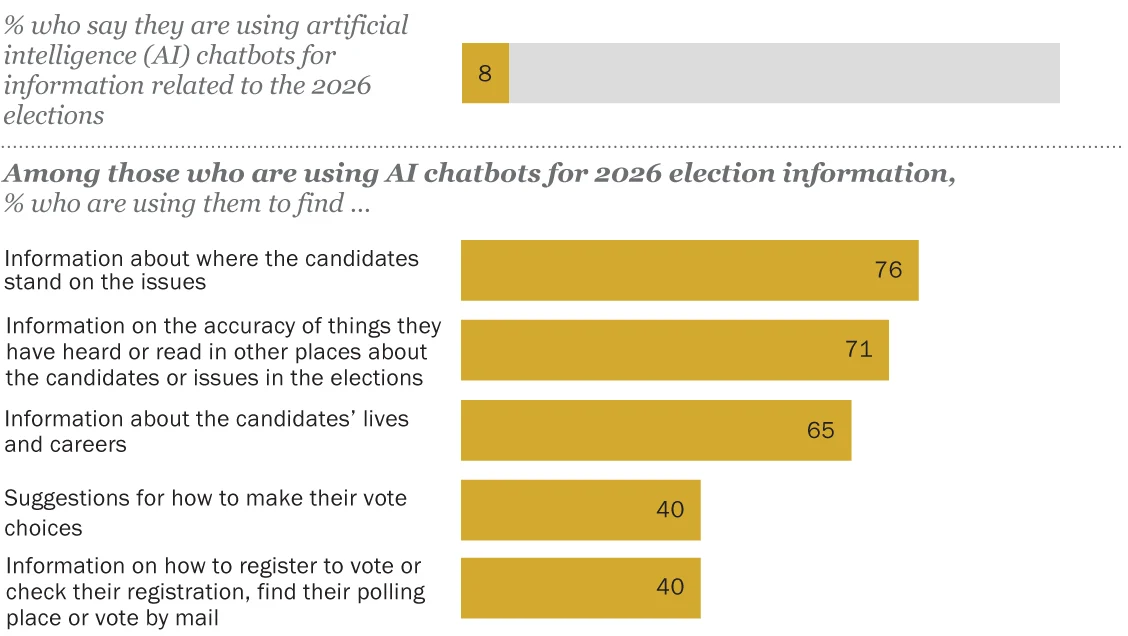
According to a new study conducted by the Pew Research Center, only about 8% of U.S. adults are currently utilizing AI chatbots to navigate the complex information ecosystem surrounding the 2026 midterms. This modest figure suggests that while the technology has been widely adopted for productivity and entertainment, the public remains cautious or perhaps habit-bound when it comes to relying on generative AI for high-stakes civic decision-making.
The State of Play: Main Findings
The survey, which captured the perspectives of 5,273 U.S. adults between October 12 and October 18, 2026, offers a revealing snapshot of the intersection between emerging technology and democratic participation.
The most striking takeaway is the disconnect between the high general usage of AI and its specific application to the ballot box. While chatbots have become proficient in summarizing documents, coding, and creative writing, voters are not yet treating these platforms as their "digital political consultants."
However, for the small minority who are turning to these tools, the interaction is highly targeted. Among those utilizing AI for election-related purposes, the primary intent is not merely casual browsing. Instead, users are seeking high-value information:
- Policy Positions: 76% of users are asking chatbots to clarify where candidates stand on key issues.
- Fact-Checking: 71% are using the tools to verify the accuracy of claims they have encountered elsewhere.
- Candidate Backgrounds: 65% are looking for details regarding a candidate’s life, career, and professional history.
A Chronology of AI Adoption in Civic Discourse
The path to this moment has been rapid. Following the public release of advanced large language models (LLMs) in 2023, the integration of AI into the American household was swift. By 2024 and 2025, chatbots transitioned from novelties to essential tools for work and education.
- Early 2024: AI begins to permeate the research habits of the "digital native" demographic, with early adopters using chatbots for quick summaries of complex news topics.
- Late 2025: As AI tools integrate into search engines and browsers (like Copilot and Google’s Gemini), the barrier to entry for political research effectively vanishes.
- October 2026: The current survey period highlights a pivotal moment. With the midterm elections mere weeks away, the data shows a plateau in usage for political purposes, suggesting that while the tools are available, the public trust or perceived necessity for using AI in this specific context has not yet reached a critical mass.
Supporting Data: Demographics and Utility
The survey data clarifies that the use of AI for political information is not evenly distributed across the electorate. Rather, it is a mirror of existing digital divides.
The Age Gap
Age remains the most significant predictor of AI engagement. Adults under the age of 50 are significantly more likely to leverage chatbots for election information—coming in at 11% compared to just 4% of those aged 50 and older. This trend aligns with broader adoption patterns where younger generations are more comfortable navigating, prompting, and evaluating AI-generated responses.
The Utility Spectrum
Beyond the top-tier requests for candidate positions and fact-checking, there is a secondary tier of utility. About 40% of those using chatbots for election purposes are doing so for "logistical" assistance—such as searching for voter registration deadlines, locating polling stations, or understanding the rules for mail-in voting. This suggests that for a significant segment of users, the chatbot acts more as a digital clerk than a political analyst.
Official Perspectives and Expert Context
Pew Research Center, which has tracked political views and technology trends for decades, emphasizes that this research is vital for understanding how the "information architecture" of the 21st century impacts democratic health.
"We have studied Americans’ views of politics for decades, and we’ve also explored their views of artificial intelligence and chatbots in recent years," researchers noted in the study documentation. By bridging these two fields, the Center aims to provide decision-makers—from election officials to platform developers—with the data necessary to understand the potential risks and opportunities of AI in a political context.
The methodologies employed—relying on the American Trends Panel—ensure that the results are representative of the full U.S. adult population. The transparency of the study, including the public release of survey questions and response sets, allows for independent scrutiny of how these numbers were derived.
The Implications for Democracy
The fact that only 8% of the public is using AI for election information carries profound implications for the future of political campaigning and information literacy.
The "Trust" Hurdle
The primary hurdle for widespread adoption appears to be the issue of accuracy. As chatbots are prone to "hallucinations"—or the generation of confident but incorrect information—voters may be wary of relying on them for sensitive topics like election integrity or candidate stances. The 71% of users who are using AI to check the accuracy of things they have heard elsewhere indicates that users are currently using AI as a secondary source, rather than a primary one.
The Potential for Misinformation
Conversely, the 40% of users who are looking for voting logistics—such as registration deadlines—highlights a potential point of failure. If a chatbot provides incorrect information regarding a polling place or a mail-in ballot procedure, it could directly disenfranchise a voter. As we move toward future election cycles, the reliability of these systems in providing non-partisan, accurate logistical information will become a significant concern for election regulators.
A New Era of Campaigning
For political campaigns, this data serves as a warning and an opportunity. While the audience for AI-assisted political research is currently small, it is highly motivated. Candidates who fail to ensure their platforms, histories, and fact-check data are clearly and accurately available to the LLMs that power these chatbots may find themselves misrepresented or ignored by the next generation of voters.
Conclusion: The Quiet Before the Surge
We are currently in a "wait and see" period regarding AI and the democratic process. The 2026 midterms demonstrate that while the technology is ready, the public’s reliance on it for political engagement remains in its infancy.
However, if history is any guide, the trajectory of technology adoption is rarely linear. As AI becomes more deeply embedded in the operating systems of our phones and computers, the 8% figure is likely to climb in future cycles. Whether this transition will be a net positive for democratic engagement—by providing instant, clear access to candidate information—or a hurdle—by introducing new vectors for misinformation—will depend on the interplay between technological development, public regulation, and the continued vigilance of the American voter.
For now, the American voter remains largely old-fashioned in their approach to the midterms, favoring traditional news sources and personal research over the automated suggestions of the silicon brain. Yet, as the digital landscape continues to shift, the silent, behind-the-scenes role of the chatbot in our political lives is likely just beginning to find its voice.