The search industry is currently gripped by a collective obsession: "Generative Engine Optimization" (GEO). Across digital marketing forums, SEO agencies, and corporate boardrooms, there is a frantic push to optimize content for Large Language Model (LLM) visibility—specifically, trying to ensure that ChatGPT and its peers cite your brand. However, as the digital landscape shifts from a repository of information to an agent-driven utility, this singular focus on LLM citations is not just a distraction—it is a strategic miscalculation of where the actual return on investment (ROI) resides.
Recent data analysis suggests that for the vast majority of websites, the traffic driven by LLMs is statistically negligible compared to the enduring, dominant force of Google Organic Search. As we enter the era of the "Agentic Web," the goalposts for search are moving, and businesses that fail to pivot from passive link-chasing to active agentic participation risk obsolescence.
The Myth of the LLM Traffic Surge: A Data-Driven Reality Check
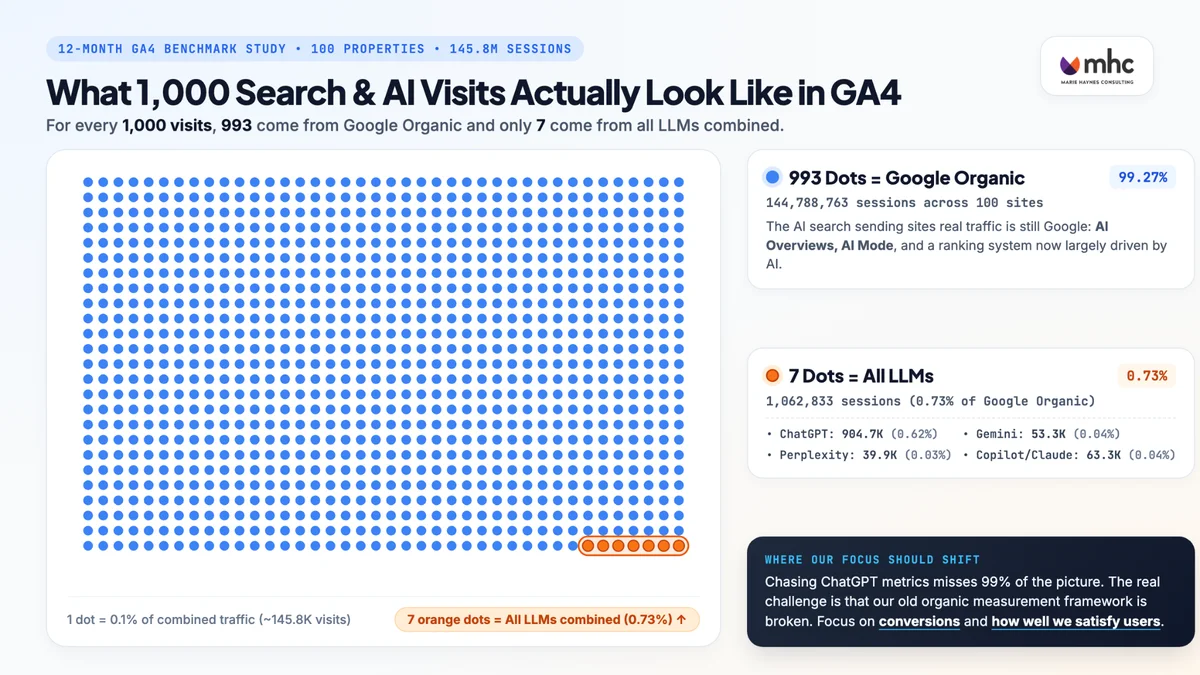
To understand the current state of search, one must look past the hype and examine the raw numbers. In a comprehensive study of 12 months of GA4 data across 100 websites of varying sizes—totaling over 145 million sessions—the findings were stark.
Sessions originating from ChatGPT amounted to a mere 0.62% of the volume driven by Google Organic. Even when all other LLMs were aggregated into the dataset, that number rose to a meager 0.73%. To put this into perspective: for every 1,000 visitors arriving via a Google search, fewer than eight are coming from an AI chatbot.

Chronology of the Plateau
When ChatGPT first disrupted the market, the industry observed a period of exponential growth in referral traffic. Many analysts predicted that this trend would continue, eventually cannibalizing Google’s market share. However, data from the last 18 months tells a different story.
The exponential growth of ChatGPT referrals hit a hard ceiling in August 2025, coinciding with the release of GPT-5. Since that milestone, the referral volume from ChatGPT has not just leveled off; it has begun a steady, measurable decline. The "new" search channel that marketers feared would replace the traditional SERP has, in practice, become a niche traffic source.
The Conversion Paradox: Quality vs. Quantity
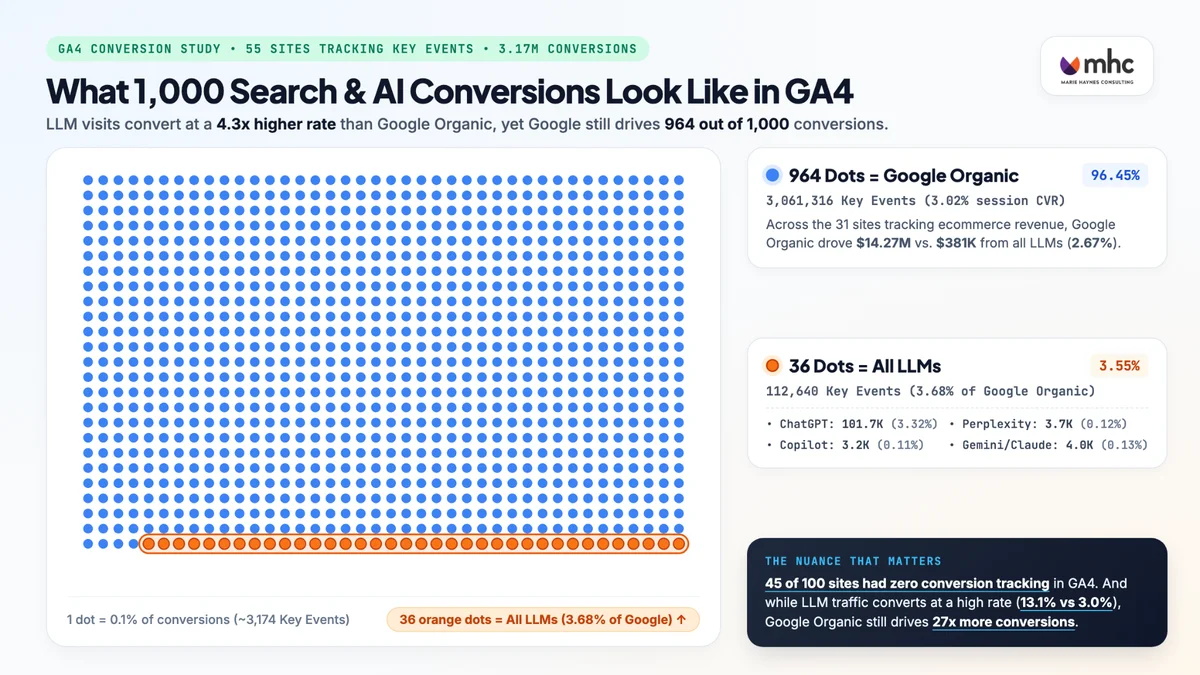
Critics might argue that while LLM traffic is lower in volume, it is higher in intent—a "quality over quantity" argument. It is true that, based on the same 100-site dataset, ChatGPT visitors convert at a rate approximately 4.5 times higher than their Google Organic counterparts.
However, volume still dictates the bottom line. Despite the superior conversion rate of AI-driven users, Google Organic still accounted for 96.5% of total conversions across all analyzed channels. In this specific study, Google drove 27 times more total conversions than all LLMs combined. The data is clear: while AI-referred users are valuable, they are not currently a viable substitute for the massive, intent-rich funnel provided by Google.
Google’s Strategic Evolution: The Agent Manager
If LLMs aren’t the primary drivers of traffic, who is? The answer remains Google, but the way Google delivers results has fundamentally changed. Google is no longer just an index of links; it is rapidly transforming into an "Agent Manager."
Through AI Overviews, "AI Mode," and a core ranking system deeply integrated with deep learning, Google is successfully keeping users within its own ecosystem. Millions of people interact with AI-driven search results daily without ever clicking through to a publisher’s website. We can lament the decline of clicks to informational content, but from a strategic standpoint, we must acknowledge that Google has succeeded in its goal: providing the answer directly to the user.
The Implications: Moving Toward the Agentic Web
The shift from "finding information" to "executing tasks" is the defining characteristic of the next decade of the internet. Google’s leadership has been transparent about this trajectory. Sundar Pichai’s assertion that "Search will become an agent manager" signals the end of the passive web.
This transition relies on several key pillars that businesses must begin to understand and implement:

1. The Universal Cart
Google is increasingly acting as a merchant aggregator. The "Universal Cart" allows users to add products from multiple vendors and check out via Google Wallet without ever visiting the retailer’s site.
- The Opportunity: Businesses must move beyond basic SEO and master the Google Merchant Center. Success now depends on providing high-fidelity product data, real-time stock updates, and competitive pricing that makes your items "bundle-ready" for Google’s automated shopping systems.
2. Universal Commerce Protocol (UCP)
Developed in concert with industry giants like Shopify and Stripe, the UCP provides an open discovery layer that allows AI agents to compare inventory and purchase natively.
- The Opportunity: Technical SEO must evolve. It will soon include the optimization of "agentic discovery endpoints." Professionals who understand how to configure
/.well-known/ucpand manage how product options are surfaced to AI will have a significant competitive advantage.
3. WebMCP (Model Context Protocol)
WebMCP is the bridge between websites and AI agents. It allows websites to expose interactive functions—such as booking schedulers, loan calculators, or form-fillers—directly to AI.
- The Opportunity: While still in the early stages, forward-thinking companies should be brainstorming how their unique interactive tools can be exposed to AI agents. The goal is to make your business a "plug-in" for the AI that a user is already talking to.
4. The Rise of "Intelligent Eyewear"
Google’s pivot toward Android XR-powered "Intelligent Eyewear" represents the final frontier of this shift. This technology promises to move search from our screens into our field of vision.
- The Opportunity: This is not just about visual search; it is about ambient assistance. Whether it is an AI guide for a DIY plumbing project or a real-time fashion assistant, brands that create useful, intent-aligned applications for these platforms will dominate the next generation of consumer interaction.
Strategic Recommendations for the Modern Business
The obsession with "GEO" is a distraction because it focuses on being talked about by an AI. The real challenge—and the real opportunity—is being useful to an AI.
To prepare for this future, your team should consider the following actions:
- Stop Tracking Vanity Metrics: Move away from rank tracking and focus entirely on measuring "key events" or conversions. If 45% of sites aren’t tracking a single conversion event, they are effectively flying blind.
- Focus on User Satisfaction: Google’s AI ranking systems are increasingly sophisticated at predicting what users find helpful. Stop optimizing for algorithms and start optimizing for human satisfaction.
- Experimental Implementation: Use the following framework to assess your readiness:
- Universal Cart: Is your product feed data optimized for Google’s automated merchant requirements?
- WebMCP: What one interactive task could you expose to an agent to make a customer’s life easier?
- Ambient Use Cases: How does your service solve a problem in the physical world that could be assisted by a multimodal AI?
Conclusion: The New Era of Search
The web of 2036 will be unrecognizable to the web of 2016. As Sergey Brin and Demis Hassabis have noted, it is impossible to predict the exact form of the future web, but the direction is clear: it will be an agent-first ecosystem.
The companies that succeed will not be the ones that spent years trying to get a chatbot to mention their name. They will be the companies that built the infrastructure, the data feeds, and the interactive tools that allowed AI agents to solve their customers’ problems instantly, efficiently, and natively. The blue link is not dead, but it is no longer the destination—it is merely the beginning of an automated, agentic transaction.