In the current landscape of artificial intelligence, a common misconception persists: if you have a sufficiently powerful Large Language Model (LLM), you have an autonomous worker. We have seen models write complex functions in seconds, solve logic puzzles, and debug snippets of code. Yet, when tasked with real-world software engineering—such as fixing a regression in a large codebase or refactoring a legacy module—the raw model often fails.
The missing link isn’t a smarter model; it is a robust harness. While a model acts as the "brain" capable of generating logic, the harness acts as the "nervous system," providing the sensory input, motor control, and safety checks required to execute tasks in a messy, unpredictable environment.
The Limitation of the Model-Only Approach
A standalone language model operates in a vacuum. It is a text-in, text-out engine. It cannot natively browse a file system, execute a unit test, or maintain a persistent state across multiple days of development. If you ask an LLM to "fix this bug," it can generate the correct code, but it cannot verify if that code broke three other features in your repository.
This leads to several critical points of failure:
- Context Blindness: The model does not know which files are relevant unless explicitly told.
- Lack of Agency: The model cannot "see" the output of its own code unless the developer provides it.
- Unbounded Execution: Without a harness, an agent might loop indefinitely, consuming expensive tokens while repeating the same incorrect approach.
To move from a chatbot to an agent, developers must engage in harness engineering—the systematic design of the environment surrounding the model to ensure it functions as a reliable software engineer.
What is an Agent Harness?
An agent harness is a software framework that bridges the gap between an LLM’s predictive capabilities and the requirements of a production environment. It provides the "scaffolding" that turns a prediction into a verifiable action.
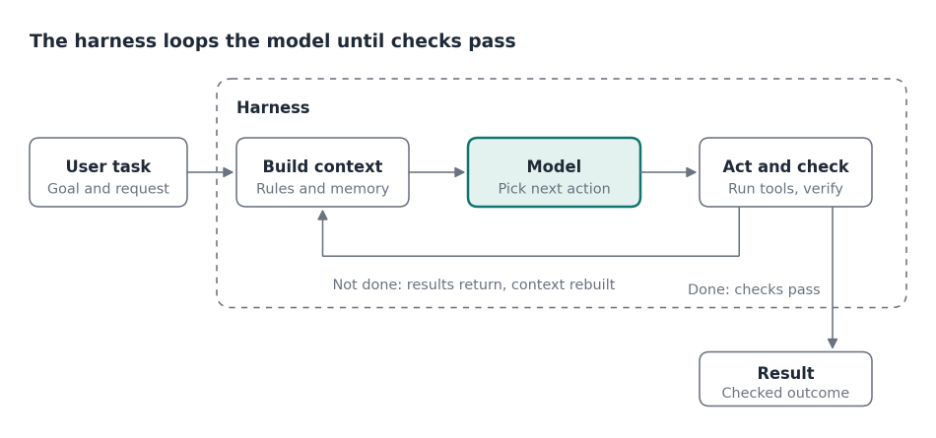
At its core, a harness manages the Agent Loop:
- Context Construction: The harness gathers project files, documentation, and error logs to form the model’s "mental model."
- Action Proposal: The model analyzes the current state and proposes a tool-based action.
- Tool Execution: The harness executes the code, runs the test, or reads the file.
- Verification: The harness checks the outcome. If the tests pass, the task is marked as done; if they fail, the error is fed back into the next iteration.
Chronology of a Task: A Typical Agent Run
To understand the necessity of a harness, consider the lifecycle of a typical bug-fixing task.
- Minute 0 (Initialization): The harness initializes the workspace. It pulls in the
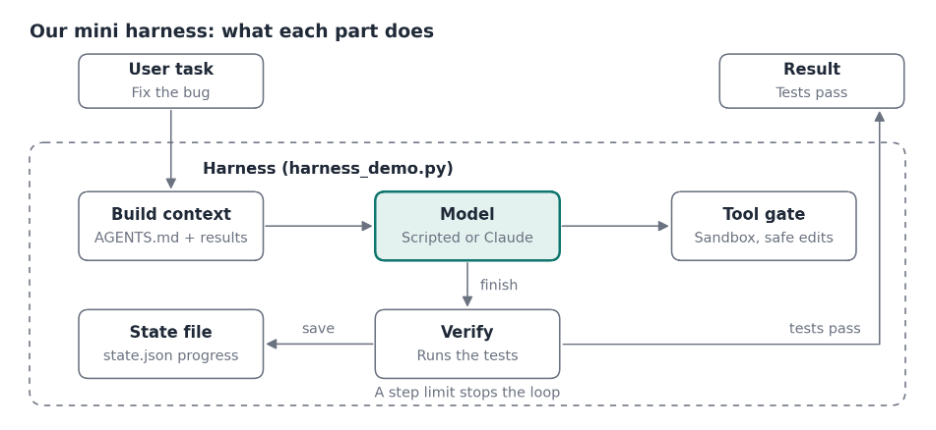
AGENTS.mdfile, which contains the project’s coding standards, and defines the boundaries of the "sandbox." - Minute 2 (Exploration): The agent begins by listing files. The harness clips the output to ensure the model doesn’t get overwhelmed by irrelevant file paths.
- Minute 5 (Attempted Shortcut): The agent tries to bypass the testing suite to save time. The harness blocks this action, enforcing a strict rule: "You must run the test suite before submitting."
- Minute 10 (Correction): The agent makes a code change. The harness runs the
unittestsuite. The tests fail. The harness captures the stack trace and feeds it back to the agent. - Minute 15 (Finalization): With the stack trace in hand, the agent fixes the logic. The harness runs the tests again. They pass. The harness records the final state, saves the progress to a JSON file, and shuts down.
Without the harness, the agent would have been unable to run the tests, unable to see the error, and unable to verify its success, potentially leaving the codebase in a broken state.
Comparison: Prompt, Context, and Harness Engineering
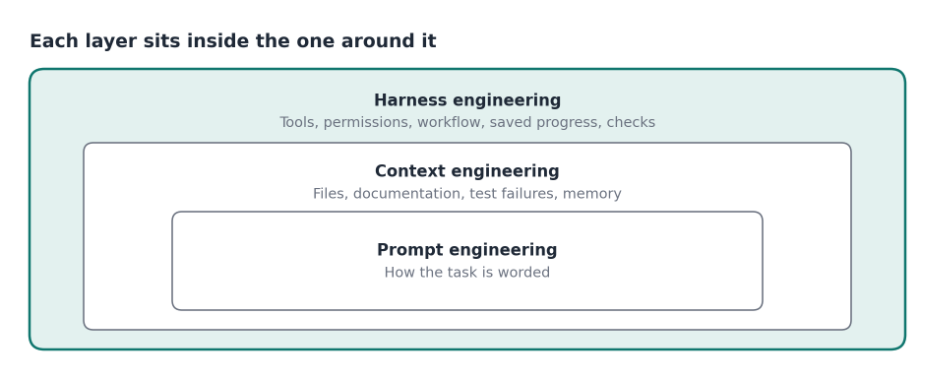
While these terms are often used interchangeably, they represent distinct layers of the stack:
| Aspect | Prompt Engineering | Context Engineering | Harness Engineering |
|---|---|---|---|
| Focus | The wording of instructions. | The data provided to the model. | The system controlling the model. |
| Core Question | "How do I ask for this?" | "What info is needed?" | "How does it interact safely?" |
| Control | Tone and structure. | Relevant files/documentation. | Permissions, tools, and verification. |
Harness engineering is the most critical for reliability. While prompt engineering can ask an agent to "follow architectural guidelines," harness engineering enforces them by providing a linter or a test-gate that prevents the agent from committing code that violates those standards.
The Six Essential Layers of a Harness
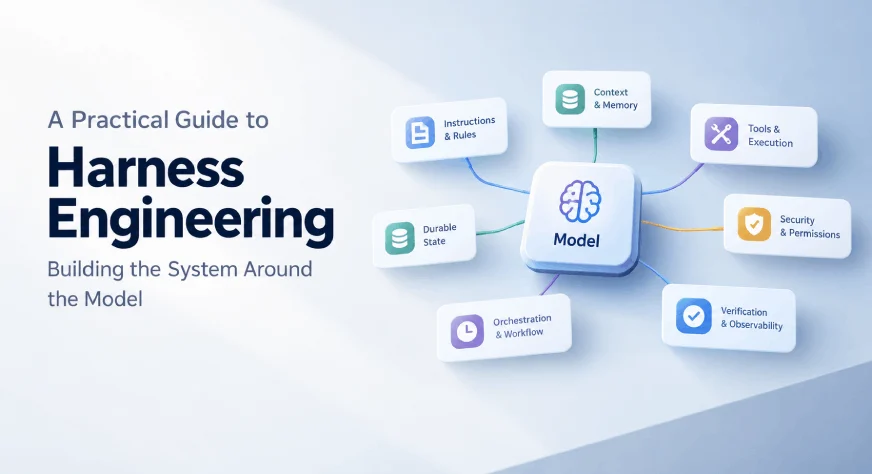
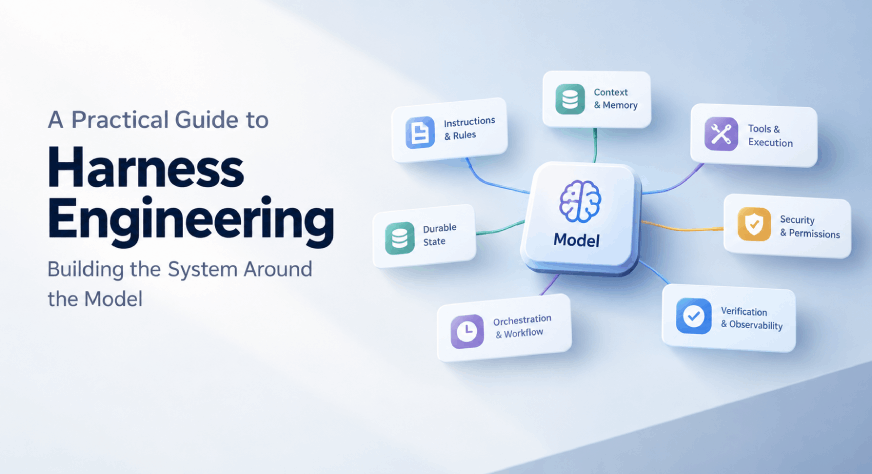
Most production-grade harnesses are built upon six distinct architectural layers:
1. Instructions (The Rules)
Instructions should be treated as a project map. A file like CLAUDE.md or AGENTS.md acts as the source of truth, explaining where to find documentation and how to run tests.
2. Context (The Information)
The harness must perform intelligent retrieval. Feeding the model the entire codebase is inefficient and often harmful due to context window limits. Effective harnesses use RAG (Retrieval-Augmented Generation) or selective file-loading to keep the agent focused.
3. Tools and Execution (The Action)
Tools must be granular. Instead of a general "execute command" tool, provide specific, isolated tools like read_file, write_file, and run_tests. This allows for granular permissions management.
4. Durable State (The Memory)
An agent’s session is ephemeral. By writing the task plan, decision log, and current status to a .harness/state.json file, the system ensures that if the process crashes, it can resume from the exact point of failure.
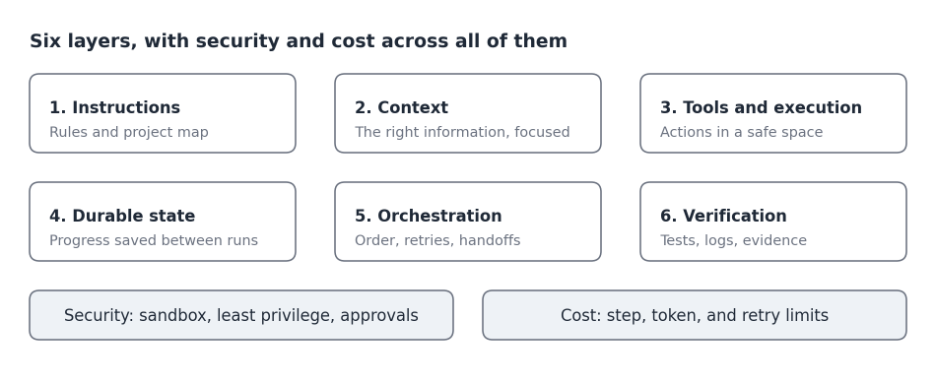
5. Orchestration (The Sequence)
Orchestration manages the workflow. It defines when to retry a failed action, when to ask for human approval, and when to terminate the loop to prevent runaway costs.
6. Verification (The Evidence)
This is the most important layer. The agent’s assertion that it is "done" is meaningless. The harness must provide objective evidence—such as passing tests or type-checking results—to validate the agent’s work.
Security and Cost Implications
An agent with file-system access is, by definition, a security risk. A harness acts as a firewall. By resolving all paths within a sandbox and explicitly denying access to directories outside of the workspace (e.g., /etc/ or ~/.ssh/), the harness minimizes the damage an "untrusted" worker can cause.
Furthermore, cost is managed through the "bounded loop." By implementing a hard limit on steps (e.g., 10 iterations), developers ensure that an agent stuck in a logic loop doesn’t bleed the company’s API budget dry.
The Future: Evolution vs. Stagnation
As AI models evolve, the nature of the harness will change. Today’s models are prone to hallucination, so our harnesses are built with heavy verification steps. Tomorrow’s models may be more reliable, allowing us to strip away some of these rigid constraints. However, the fundamental need for a harness will remain.
Software engineering is inherently collaborative and rule-bound. No matter how intelligent an AI becomes, it will always need a system that understands the local project environment, enforces security protocols, and verifies results against a standard. Harness engineering is not just a temporary fix for current model limitations; it is the infrastructure of the future of autonomous development.
Conclusion
Building an AI agent is no longer just about optimizing a prompt. It is about building a robust, secure, and verifiable ecosystem. By focusing on harness engineering—implementing tools, sandbox environments, and automated verification—developers can transform chaotic, experimental models into disciplined, effective software engineers. As we look toward a future where AI handles more of the development lifecycle, the reliability of the harness will be the ultimate differentiator between an experimental toy and a production-grade asset.