As Brazil approaches its pivotal presidential runoff on October 25, the world is watching with bated breath. The contest between incumbent President Luiz Inácio Lula da Silva and right-wing challenger Flávio Bolsonaro is far more than a domestic political struggle; it is a high-stakes referendum on the survival of the Amazon rainforest.
Spanning 6.9 million square kilometers and encompassing 40% of the South American continent, the Amazon is the planet’s most significant terrestrial carbon sink and its most vital bastion of biodiversity. With the scientific community warning that the forest is nearing a catastrophic "tipping point," the electoral outcome will determine whether Brazil continues its path toward ecological restoration or pivots back to an era of aggressive industrial expansion and environmental deregulation.
The Chronology of Conflict: From Bolsonaro’s Legacy to Lula’s Restoration
To understand the weight of the upcoming runoff, one must look at the recent historical trajectory of the Amazon. For decades, the forest has been a battleground for competing visions of development and conservation.
During Lula’s first two terms (2003–2010), Brazil achieved international acclaim for drastically reducing deforestation rates. Upon his return to office in 2023, his administration moved quickly to dismantle the policies of his predecessor, Jair Bolsonaro. The senior Bolsonaro’s term (2019–2023) is remembered by environmentalists as an era of "assault," characterized by the systematic weakening of the National Institute for the Environment (IBAMA) and a blatant prioritization of cattle ranching and soy cultivation over indigenous land rights.
The current challenger, Flávio Bolsonaro, represents a continuation of his father’s doctrine. While he has attempted to frame his platform with more moderate rhetoric, critics and policy analysts warn that the underlying goal remains the same: the dismantling of the institutional safeguards that keep the "forest police" and land protections in place.

The Tipping Point: A Scientific Reality
The urgency of this election is rooted in hard science. Forest governance advisor Artur Monteiro, founder of the advisory platform Makaxera, warns that the Amazon is closer to a point of no return than ever before.
"We are close to achieving the tipping point," Monteiro told Earth.Org. "By the time this critical threshold is reached, it could trigger the rainforest’s collapse within 10 years."
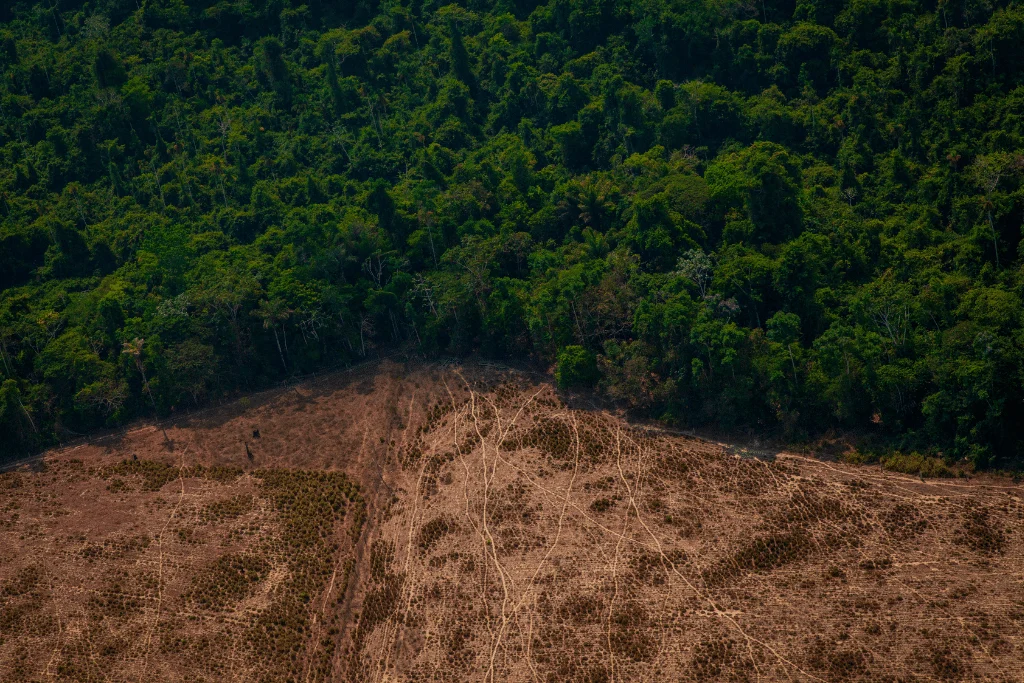
The ecological mechanism is straightforward but terrifying: as the forest is cleared, it loses its ability to generate its own rainfall. The current cycle of rising temperatures and increased wildfires threatens to push the ecosystem toward a permanent transformation. "The forest could get drier and drier, and eventually transform into a savannah," Monteiro explained. Such a collapse would not only erase countless species but would release massive quantities of stored carbon back into the atmosphere, rendering global climate targets effectively impossible to meet.
Supporting Data: The High Cost of Deregulation
The evidence from the 2019–2023 period provides a grim blueprint for what a victory for the right-wing opposition might entail. During those years, the rate of Amazon deforestation reached 13,000 square kilometers annually—the highest level in over a decade.
The human cost was equally staggering. The weakening of environmental enforcement led to a surge in illegal land invasions and a dramatic rise in the assassination of Indigenous leaders. Data from the era reveals that 98% of fines levied by IBAMA against environmental criminals remained unpaid, effectively signaling that the rule of law had been suspended in the region.

Conversely, the "resilience" of Brazil’s institutions has been tested under the current administration. Felix Finkbeiner, founder of the global non-profit Plant for the Planet, notes that despite the damage, the federal institutions under Lula showed a "surprising amount of resilience." However, this recovery remains fragile. Even if Lula secures a victory, he faces a daunting landscape: the October 4 legislative elections saw a significant shift toward a conservative, pro-industry Congress, which could hamstring environmental initiatives for the remainder of his term.
The Legal Battlefield: Marco Temporal and Constitutional Change
A major flashpoint in the current election is the "Marco Temporal" doctrine. This legal theory suggests that the state should only recognize Indigenous lands if the communities were physically present on those lands in 1988—the year Brazil’s constitution was signed.
Because many Indigenous groups were forcibly displaced by the military dictatorship prior to 1988, this doctrine is effectively a tool to deny land rights. The lower house of Congress has already approved this as a potential constitutional amendment. While the President cannot veto such an amendment, the next leader of Brazil will have the power to appoint four new justices to the Supreme Court. This will be the ultimate battleground for the future of Indigenous sovereignty and, by extension, the integrity of the forest.
International Implications and Global Accountability
The Amazon is a sovereign Brazilian resource, but its health is a global public good. Recognizing this, the international community has attempted to build mechanisms to ensure its preservation.
The European Union’s 2023 Deforestation Regulation (EUDR) is perhaps the most powerful tool in the shed. Once fully implemented, it will mandate that commodities such as soy, cattle, and palm oil imported into the EU must be certified as deforestation-free. This creates a powerful economic incentive for Brazilian producers to play by the rules.

However, financial mechanisms have struggled to keep pace with the crisis. The Tropical Forest Fund (TFFF), launched at COP30, has thus far failed to reach its initial $10 billion funding target, sitting at roughly $7.3 billion. Finkbeiner argues that the fund is essential because it provides a financial incentive for the government to protect the forest, regardless of the political party in power. "The TFFF provides financial incentives for the government to protect the forest, even when they don’t intrinsically care about conservation," he said.
Looking Forward: A Nation at a Crossroads
As Brazilians head to the polls on October 25, they are casting ballots that carry the weight of the global climate. The election is a stark contrast between two futures: one that views the Amazon as an infinite resource to be extracted for short-term gain, and one that views it as the world’s most precious life-support system.
The "institutional strength" that Finkbeiner mentions is currently the only barrier between the current state of conservation and a return to the rapid, unchecked deforestation of the past. Regardless of who wins, the next administration will have to navigate a hostile Congress, a polarized public, and an international community that is increasingly demanding accountability.
The fate of the Amazon is not just a story of Brazilian politics; it is a story of global survival. As the tipping point approaches, the choices made in the halls of Brasília will echo across the globe for generations to come. The world will be watching to see if Brazil chooses the path of preservation, or if it risks the collapse of the planet’s greatest green lung.