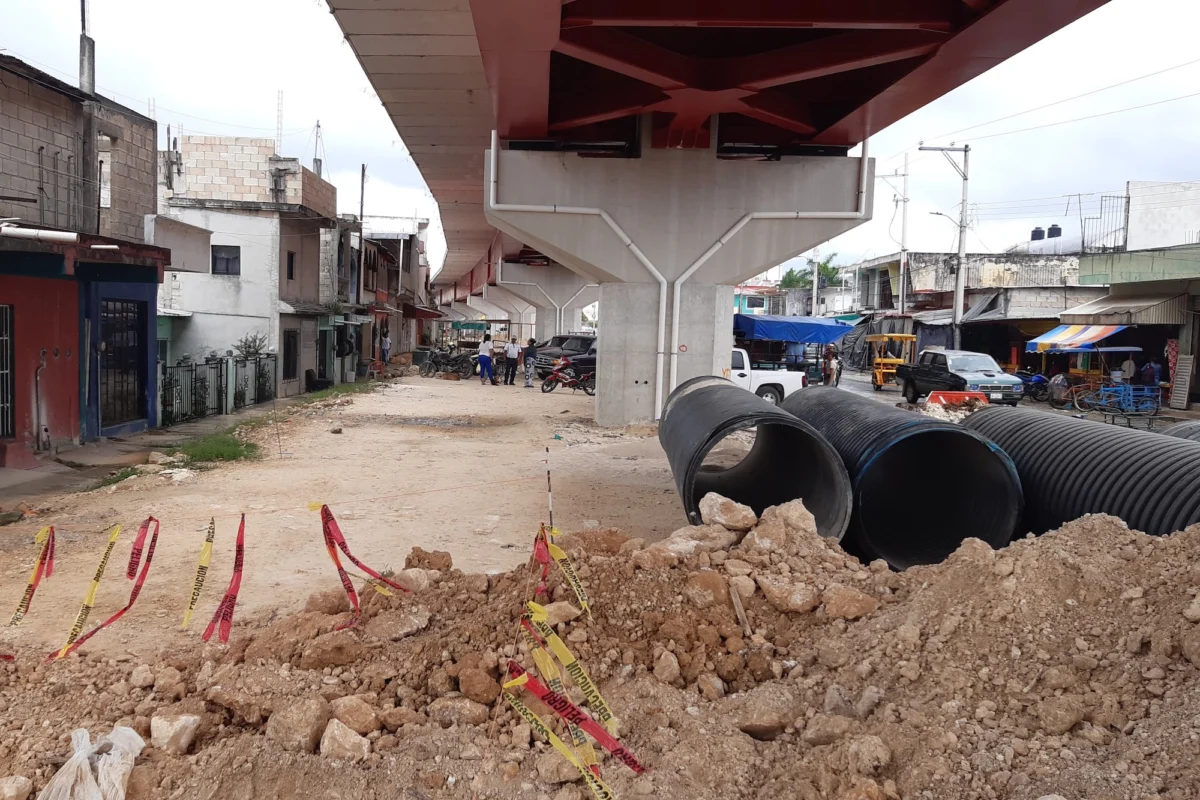
Three years after its inauguration, the Maya Train—once heralded as the crowning achievement of former President Andrés Manuel López Obrador’s administration—stands as a stark monument to the dangers of top-down development. Stretching nearly 1,000 miles across the lush, ancient landscapes of Mexico’s Yucatán Peninsula, the project was envisioned as an economic engine for the country’s neglected interior. Yet, as the dust settles on this multi-billion-dollar endeavor, the reality on the ground is a far cry from the glittering promises of prosperity.
Instead of an economic boom, local communities are grappling with rising costs of living, a disturbing surge in organized crime, and profound environmental destruction. What was promised as a bridge to a better future has, for many, become a barrier to progress.

The Genesis of a Monumental Vision
The Maya Train was born from a campaign promise, unveiled with immense fanfare shortly after López Obrador’s 2018 election victory. The goal was to revitalize the economy of the southeast by connecting major tourism hubs like Cancún with inland archaeological sites such as Palenque, as well as several smaller, historically underserved indigenous communities.
The rhetoric surrounding the project was grandiose. At the inauguration in December 2024, López Obrador declared it "a monumental work," asserting that there was no infrastructure project of its scale anywhere else in the world. It was designed to move millions, stimulate trade, and weave the isolated corners of the peninsula into the national economic fabric. However, the project was plagued by controversy from its inception, characterized by a breakneck construction schedule—built 600 percent faster than similar international rail projects—and a budget that ballooned from an initial $8.5 billion to nearly $30 billion by the time the final spike was driven.

Chronology of a Controversial Construction
The path to completion was never smooth. The project faced immediate resistance from indigenous groups, environmentalists, and urban planners.
- 2018: The project is officially announced, promising to bring jobs and development to the impoverished Mayan heartland.
- 2019: Indigenous communities express deep skepticism. The United Nations releases a report noting that the consultation process failed to meet international standards for "prior, free, informed, and culturally appropriate" consent.
- 2021-2023: Construction begins in earnest. Protests erupt across the peninsula as environmentalists warn of the destruction of the region’s unique ecosystem. Reports emerge of significant delays and the forced relocation of residents.
- December 2024: The train is inaugurated amid grand celebrations, despite widespread criticism regarding its lack of operational readiness and astronomical cost overruns.
- 2025-2026: Operations begin, but the reality sets in: passenger numbers are a fraction of projections, and the promised economic ripple effect fails to reach the local population.
Supporting Data: A Disconnect Between Reality and Projection
The most damning indictment of the Maya Train is the data itself. The federal government initially projected daily ridership of approximately 74,000 passengers. In 2025, however, official figures indicated an average of only 3,320 daily users. Empty carriages have become a common sight, circulating through the jungle as a silent witness to the project’s lack of utility.

Economic indicators provide further cause for alarm. While the state of Quintana Roo saw a temporary 13 percent growth in 2023—largely driven by the construction boom—this was a fleeting sugar high. By 2024, the state had slipped into a recession, and in the first half of 2025, economic activity plummeted by over 9 percent.
The promised employment opportunities for locals also failed to manifest. Economics professor Javier Becerril of the Autonomous University of Yucatán notes that the workforce was largely imported from other parts of Mexico. Once the construction phase ended, there were few sustainable jobs left for the local communities. "There was no economic spillover," Becerril explains. "People who came from outside and received a paycheck sent the money back to their places of origin."

The Human and Environmental Toll
Beyond the spreadsheets and empty stations, the human cost is mounting. For the indigenous communities the train was supposed to serve, the reality has been one of displacement and rising costs. In areas like MÁrida, the promise of improved infrastructure—better electricity, running water, and healthcare—has remained largely unfulfilled.
Perhaps most alarming is the rise in insecurity. Local community leader Pedro Uc, based near MÁrida, points to a 50 percent increase in crime in the region during 2026. He links the surge in violence—including abductions and territorial conflicts—directly to the infrastructure corridors opened by the rail line. "It seems that what arrived in the train cars to the communities is insecurity, gunfire, bodies in bags, and fear," Uc says. "It’s like a scene from a movie."

The environmental impact is equally staggering. The construction required the clearing of 7 million trees, a massive loss of biodiversity. Even more catastrophic is the damage to the region’s subterranean hydrology. The Yucatán Peninsula sits atop a fragile, porous limestone bedrock, which houses one of the world’s most complex and pristine underground river systems. Construction crews drove thousands of heavy pylons into this karst landscape, damaging roughly 130 caves and cenotes. Industrial engineer Guillermo Christy describes the destruction as irreversible: "A forest can recover in 15 years, but a cave that you fracture or fill up? That is lost forever."
Official Responses and the "White Elephant" Critique
The government continues to defend the project as a necessary step for regional modernization. Officials often point to the sheer scale of the engineering feat and argue that long-term benefits will eventually manifest as tourism patterns shift. However, these defenses are increasingly viewed as hollow by experts who point to the lack of "last-mile" connectivity.

Because many stations were moved to the outskirts of cities to avoid construction complications or local protests, they are difficult to access. In the stretch between Cancún and Playa del Carmen, the line was moved five kilometers inland to accommodate the demands of local hoteliers, rendering the train less convenient than existing road transport for both tourists and commuters.
The ticket pricing model has further alienated the local population. With fares often exceeding the daily minimum wage, the train is effectively a luxury item. "There are many rural communities in the center of Yucatán state that have never used the Maya Train—nor will they—due to the fares," says Professor Becerril.

The Broader Implications for Future Development
The Maya Train serves as a cautionary tale for governments worldwide. It highlights the dangers of prioritizing speed and political optics over rigorous planning and community engagement.
Hector Hernández, an engineer who worked on the project, offers a sobering reflection: "What can we learn? Let the shoemaker make shoes. Let the experts do their job." His sentiment echoes the broader consensus among critics: the project lacked a "bottom-up" approach. Instead of asking local communities what they needed—such as basic sanitation, school upgrades, or rural roads—the federal government imposed a singular, massive vision from the top.

The implications for Mexico’s future are significant. The country is left with a "white elephant" that requires massive, ongoing public subsidies just to keep the lights on and the tracks maintained. As the government struggles to justify the project, the focus must shift to mitigating the damage. This includes rigorous environmental monitoring to protect the remaining cave systems, enhanced security measures for the affected communities, and a potential pivot toward making the train more accessible to the very people it was intended to empower.
The Maya Train was meant to bridge the gap between the haves and the have-nots. Instead, it has laid bare the deep fractures within the Mexican state. For a project built in record time, its legacy may be the enduring, slow-moving lesson that infrastructure is only as strong as the community consensus upon which it is built. Until those lessons are learned, the Maya Train will remain a symbol of what happens when ambition outpaces accountability.