J.B. Hunt Transport Services (NASDAQ: JBHT), a titan of the North American logistics landscape, has released its third-quarter earnings report, revealing a performance that managed to narrowly eclipse the lowered expectations set by a cautious market. In the wake of a sobering earnings warning issued in mid-September, the logistics provider faced intense scrutiny regarding its ability to manage escalating operational costs. While the company successfully cleared the bar set by analysts, the results underscore a complex environment defined by both robust revenue growth and persistent margin pressure.
Main Facts: The Numbers Behind the Narrative
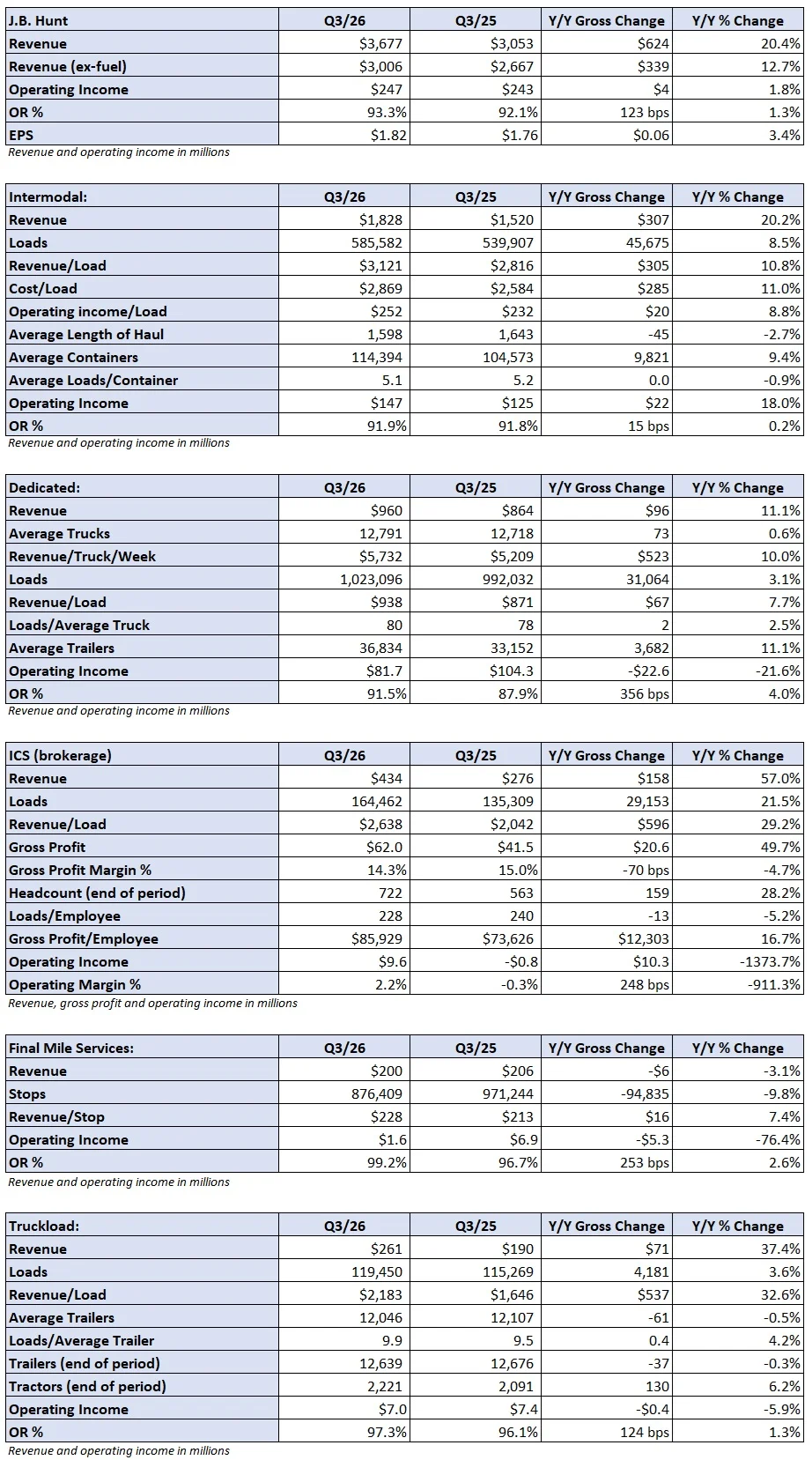
For the third quarter, J.B. Hunt reported revenue of $3.68 billion, comfortably outperforming the consensus estimate of $3.59 billion. Earnings per share (EPS) reached $1.82, edging out the revised analyst expectations by a solitary cent.
However, this figure was achieved despite a notable tax-related headwind that cost the company 4 cents per share. This negative impact was partially mitigated by a 2-cent improvement stemming from a reduction in net interest expense. These results follow a tumultuous period for the stock, which had suffered a 14% decline from mid-September—when the company first flagged operational pressures—through the close of trading on the day of the report.
Despite the broader market skepticism, this quarter marked the fifth consecutive period of year-over-year growth in operating income and EPS, cementing the company’s status as an early leader in the current logistics sector turnaround.
Chronology of a Challenging Quarter
The trajectory of J.B. Hunt’s third quarter was defined by the transition from optimistic growth to reactive cost management. In September, management issued an urgent update, forecasting a 5% to 10% sequential decline in EPS. At the time, the company identified three primary "cost villains" that were eroding profitability:
- Diesel Price Volatility: A sharp, unexpected surge in fuel costs accounted for roughly $10 million in additional expenses.
- Driver-Related Costs: A tight labor market and elevated compensation requirements added $25 million to the ledger.
- Cargo Claims: An uptick in cargo-related incidents and insurance-related claims contributed another $10 million in costs.
In total, these unforeseen pressures resulted in over $50 million of incremental costs during the quarter. The fact that the company still managed to beat expectations suggests that its internal "belt-tightening" measures and revenue management strategies were effective in absorbing these blows.
Supporting Data: Segment-by-Segment Analysis
To understand the health of J.B. Hunt, one must look at its core business pillars. The company’s performance was a study in contrasts, with some units firing on all cylinders while others faced structural headwinds.
Intermodal: The Volume Driver
Intermodal revenue surged 20% year-over-year to $1.83 billion. This was fueled by an 8% increase in total loads and an 11% rise in revenue per load. While higher fuel prices artificially inflated these numbers, the underlying volume growth remains impressive. Notably, the East Coast saw an 18% jump in volumes, while transcontinental lanes grew at a more modest 1%. A slight 3% decline in the average length of haul—driven by a strategic shift toward shorter-haul East Coast lanes—did act as a minor drag on revenue per load.
Dedicated Services: Managing Efficiency
The dedicated segment, usually a reliable pillar of stability, saw its operating ratio (OR) deteriorate by 360 basis points to 91.5%. While revenue grew 11% year-over-year, this was largely a byproduct of fuel surcharges. Excluding fuel, revenue per truck grew by only 3%. The company noted that while the average number of trailers in service rose by 11%, load counts grew by a disproportionately lower 3%, signaling a potential imbalance in asset utilization that the company is working to rectify.
Brokerage and Asset-Light Units
Perhaps the most encouraging news came from the brokerage unit, which posted its second consecutive operating profit after enduring 13 painful quarters in the red. Similarly, the asset-light truckload unit swung to a $7-million operating profit, marking a recovery from the losses recorded in the second quarter. These "asset-light" gains suggest that the company’s efforts to modernize its digital brokerage platform and streamline its non-asset business are beginning to bear fruit.
Official Responses and Strategic Pivot
During the scheduled earnings call, leadership emphasized that the third quarter served as a "modest slowdown" rather than a structural failure. Management characterized the $50 million in incremental costs as largely "transitory," implying that the sharp spikes in fuel and insurance-related claims are not necessarily the new baseline.
The company’s focus remains on operational discipline. Having successfully initiated a turnaround as early as the third quarter of 2025, J.B. Hunt remains well ahead of its direct competitors in terms of cost recovery. The strategy going forward involves a more aggressive optimization of the dedicated fleet, specifically focusing on curbing the startup costs associated with new accounts and mitigating the rising cost of employee benefits.
Implications: The Industry Bellwether
Why does a single quarter for J.B. Hunt matter to the broader economy? Because the company serves as the definitive bellwether for the intermodal, trucking, and logistics sectors. If J.B. Hunt—with its massive scale and data-rich infrastructure—is struggling with driver costs and cargo claims, it is almost certain that smaller, less-capitalized firms are facing even more severe existential threats.
The current results indicate a "normalization" phase in the freight cycle. The post-pandemic boom, characterized by historic highs in freight rates and volumes, has definitively cooled. The industry is now entering a cycle where efficiency, technology, and cost control are the primary determinants of survival.
For investors, the takeaway is nuanced. While the stock’s post-earnings dip of 2.4% suggests lingering investor anxiety, the fact that the company is successfully pivoting its brokerage unit back into profitability is a positive sign for long-term viability. The market is currently rewarding agility, and J.B. Hunt is clearly attempting to pivot its business model to account for a lower-growth environment.
Looking Ahead: The Future of Freight
As the logistics industry prepares for upcoming events like the F3: Future of Freight Festival in Chattanooga, the conversation is shifting from "how to handle volume" to "how to handle volatility." Companies that can integrate AI-driven logistics, better manage carrier liability, and navigate the complex web of FMCSA compliance—all topics at the forefront of the upcoming Brokerage Compliance Symposium—will be the winners of the next decade.
J.B. Hunt’s ability to survive this quarter’s turbulence proves that the "big" in big-rig trucking still carries significant advantages. However, the path forward requires a tighter grip on operational expenses and a more surgical approach to account acquisition. As the industry moves into the final quarter of the year, all eyes will be on whether the transitory costs of Q3 truly vanish, or if they represent the new, more expensive reality of moving freight in a post-peak market.
Disclaimer: This report is for informational purposes only and does not constitute financial advice. Investors are encouraged to review the company’s full 10-Q filing and consult with a qualified financial advisor before making investment decisions.