For decades, the corporate playbook for leadership continuity has remained largely unchanged: identify high-potential employees, enroll them in elite leadership development programs, and keep their names on a spreadsheet for when a vacancy inevitably arises. Yet, across global boardrooms, a quiet crisis is brewing. Organizations are finding that their meticulously crafted succession plans are failing to deliver when the pressure mounts.
The disconnect lies in a fundamental confusion between "potential" and "readiness." As data continues to suggest that confidence in leadership pipelines is at a historical low, the time has come to dismantle the traditional model and replace it with a dynamic, evidence-based system of leadership readiness.
The Core Problem: Potential vs. Readiness
The conversation in executive suites often shifts from the aspirational question of "Who’s next?" to the anxious reality of "Who is actually ready?" While these two questions appear synonymous, they represent entirely different paradigms.
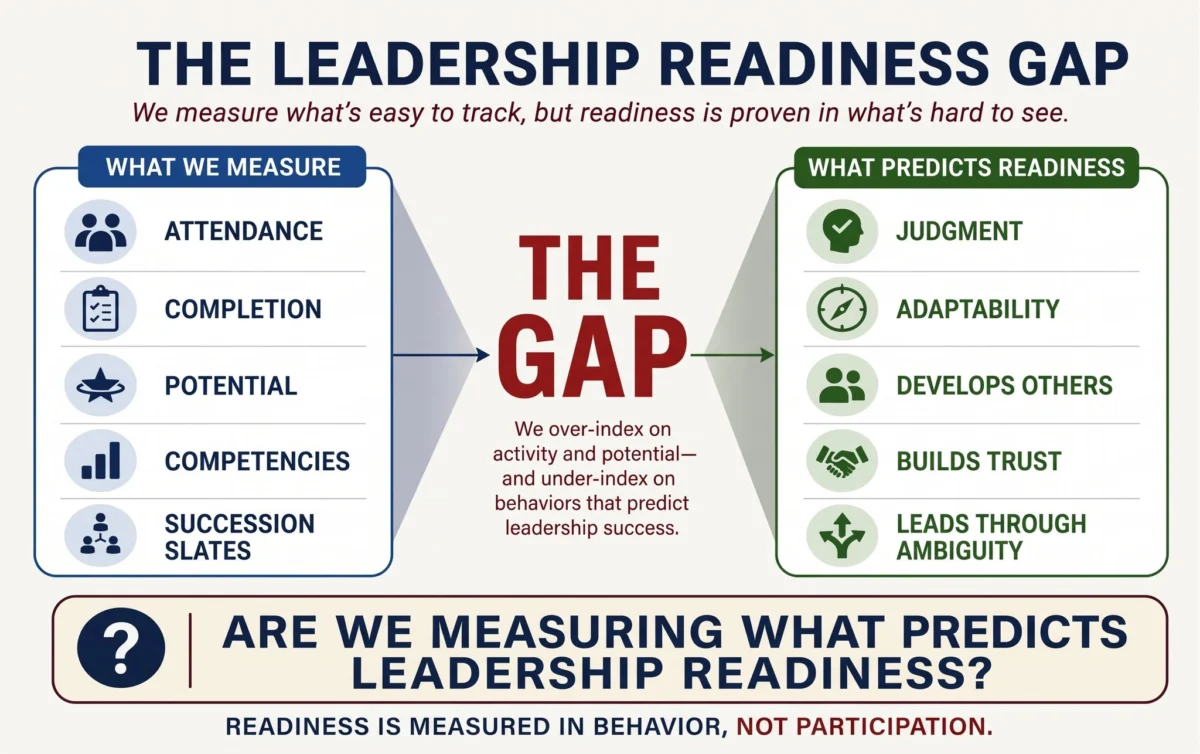
Potential is a prediction; it is an assessment of what an individual might become given the right conditions. Readiness, however, is a measurement of what an individual can demonstrate today. Many organizations have mastered the art of identifying potential—spotting the ambitious, the high-performing, and the credible—but they have largely failed to bridge the gap between that potential and the complex, contextual demands of the next leadership tier.
When a high-potential individual is promoted into a role they are not yet "ready" for, the results are rarely neutral. Often, the promotion acts as an accelerant for failure rather than a catalyst for growth. The individual, previously lauded for their ability to solve technical problems, finds themselves paralyzed by the need to influence through others or navigate organizational ambiguity. The ripple effect is profound: team morale dips, performance targets are missed, and the very individual who once showed promise begins to lose the confidence that earned them the promotion in the first place.
Chronology of a Failed Transition
To understand why this happens, we must look at the lifecycle of a typical "high-potential" track.
- Identification: An employee displays strong technical skills and a high drive for results. They are tagged as "HiPo" (High Potential).
- Programmatic Intervention: The organization enrolls the individual in a standard leadership development course—often a multi-day seminar or a cohort-based program.
- The Static Gap: While the individual is in the program, the organization assumes progress. They track "hours completed" or "competency modules finished."
- The Trigger Event: A critical leadership role opens. Because the person is a "HiPo" and has "completed the program," they are fast-tracked into the role.
- The Performance Cliff: The new leader discovers that the skills required for the promotion (e.g., strategic foresight, political navigation, crisis management) were never actually practiced in their development program.
- The Systemic Blame: When the leader struggles, the organization often blames the individual’s lack of grit or capability, ignoring the fact that the system itself failed to provide the necessary "lived performance" opportunities to build actual readiness.
Supporting Data: A Global Crisis of Confidence
The struggle to cultivate a ready bench is not an isolated phenomenon; it is a systemic global challenge. According to DDI’s Global Leadership Forecast 2025, a staggering 80 percent of organizations report a lack of confidence in their leadership pipelines.
This statistic is damning. If global corporations are spending billions on leadership training, why is the return on investment in terms of bench strength so low? The data suggests that the issue is not the quantity of training, but the quality of application. Organizations are investing in formal education at the expense of experiential learning. They are measuring participation metrics—attendance, completion, and satisfaction scores—rather than behavioral shifts or measurable improvements in team outcomes.
Three Shifts in Thinking
To move from a cycle of potential-based promotions to a reality-based readiness system, organizations must undergo three fundamental shifts.
1. Shifting from Potential to Proven Readiness
Potential tells us what someone might become; readiness tells us what they can consistently demonstrate today. A promotion should never be the first time an employee practices the skills required for a role. Instead, the organization should identify the specific "readiness gaps" of an individual and create low-stakes, high-impact environments for them to practice those specific behaviors before the title change occurs. If a manager needs to learn how to lead through ambiguity, they should be given a cross-functional project that is intentionally ambiguous before they are put in charge of a department.
2. Shifting from Programs to Systems
Leadership development must evolve from a series of "events" into a continuous, iterative system. A robust system follows a circular path: Succession Identification → Readiness Gap Analysis → Targeted Experiences → Observation and Feedback → Reassessment.
This creates a cycle of "lived performance." By treating development as an ongoing loop rather than a one-time event, the organization ensures that leaders are not just learning theory, but are actively proving their readiness in real-world contexts.
3. Shifting from Activity to Impact
We must move beyond the "learning hours" dashboard. The most effective question a Talent Development department can ask is not "How many people attended?" but "What value are they adding?"
Drawing on the mindset championed by leaders like Dr. Keith Keating, organizations should evaluate their development initiatives through a four-stage progression:
- Activity: Did they attend?
- Capability: Did they learn the skill?
- Behavior: Are they applying the skill differently on Monday morning?
- Impact: Is the business, the team, or the bottom line better because of it?
Implications for the Modern Enterprise
The implications of failing to make these shifts are severe. In an era defined by rapid technological change and market volatility, an organization’s ability to pivot depends entirely on the readiness of its leadership bench.
When a company relies on "potential" to fill critical gaps, it introduces high levels of operational risk. Conversely, an organization that builds a "readiness culture" gains a competitive advantage. It fosters a workforce that is not only prepared for the next promotion but is also more resilient and adaptable to the shifts in the business environment.
Furthermore, this shift has significant implications for how we view accountability. Currently, when a leadership transition fails, the blame is placed squarely on the shoulders of the individual. If, however, we adopt a systemic approach, the organization must hold itself accountable. If an employee is labeled "high potential" and fails, the system must interrogate why it failed to provide the necessary experience to bridge the readiness gap.
Conclusion: The Path Forward
The path to a stronger succession pipeline is not found in a more sophisticated talent management software or a more expensive leadership retreat. It is found in the daily rigor of observation, feedback, and deliberate practice.
Organizations must stop treating succession planning as a biennial administrative task and start treating it as a daily operational strategy. The question is no longer "Who is next?" The question that will define the success of the modern organization is: "Who is actually ready for what comes next, and what evidence do we have to prove it?"
By focusing on readiness, we do more than just fill seats; we cultivate a generation of leaders capable of navigating the complexities of the future. The era of the "potential-only" promotion is over. The era of the "ready-now" leader is here.