The landscape of German retail is undergoing a structural transformation, with Amazon positioned at the epicenter of this seismic shift. According to a comprehensive new study conducted by the Institut für Handelsforschung (IFH KÖLN) in collaboration with General Evidence, Amazon has solidified its status as the undisputed heavyweight of the German e-commerce sector. With a staggering 63% market share and a reach that extends far beyond digital storefronts into the heart of physical retail, Amazon’s influence on the German economy is both pervasive and profound.
Main Facts: A Digital Empire
The data paints a clear picture of consolidation. Last year, sales generated via Amazon in Germany soared to 69.1 billion euros—a year-over-year increase of 3.2 billion euros, or roughly 5%. This growth is not merely a result of Amazon’s own inventory sales; rather, it is fueled by a massive ecosystem of third-party selling partners.
The study reveals that selling partners are the engine room of the platform, accounting for 46.1% of total online retail spending in Germany. By comparison, Amazon’s own direct retail operations account for 17.2%. Together, this hybrid model dominates 63% of the online retail market. Perhaps most telling of the platform’s cultural integration is the consumer penetration: 97% of German online shoppers report having purchased from Amazon, and 59% of the population are now committed Prime members.
Chronology of Consolidation: From Bookstore to Market Infrastructure
To understand how Amazon reached this position of near-total dominance, one must look at the timeline of its expansion in Germany.
- The Early Years (Late 1990s – 2000s): Amazon entered Germany as a niche bookseller. Its rapid adoption of logistics-heavy infrastructure and the introduction of the marketplace model allowed it to scale faster than traditional German retailers like Otto or Quelle, which were still grappling with the transition from catalog to web.
- The Prime Revolution (2010s): The launch of Amazon Prime fundamentally changed consumer behavior in Germany. By decoupling shipping costs from individual transactions, Amazon locked in a loyal customer base that prioritized convenience over price-comparison hunting.
- The Marketplace Takeover: By opening its digital gates to small and medium-sized enterprises (SMEs), Amazon effectively became the "operating system" for German retail. Instead of competing with retailers, it began hosting them, taking a commission on every sale while controlling the data flow.
- The Current Era (2020s): Following the pandemic-driven surge in e-commerce, Amazon has doubled down on its logistics footprint. Continued investment in fulfillment centers across Germany has made their delivery speed a benchmark that no domestic competitor has yet managed to replicate consistently.
Supporting Data: By the Numbers
The IFH KÖLN report provides granular data that highlights the disparity between Amazon and its competitors.
The Breakdown of Online Spending
- Amazon (Total): 63%
- Amazon Marketplace Sellers: 46.1%
- Amazon Direct Sales: 17.2%
- Remaining Market: 37%
Cross-Channel Impact
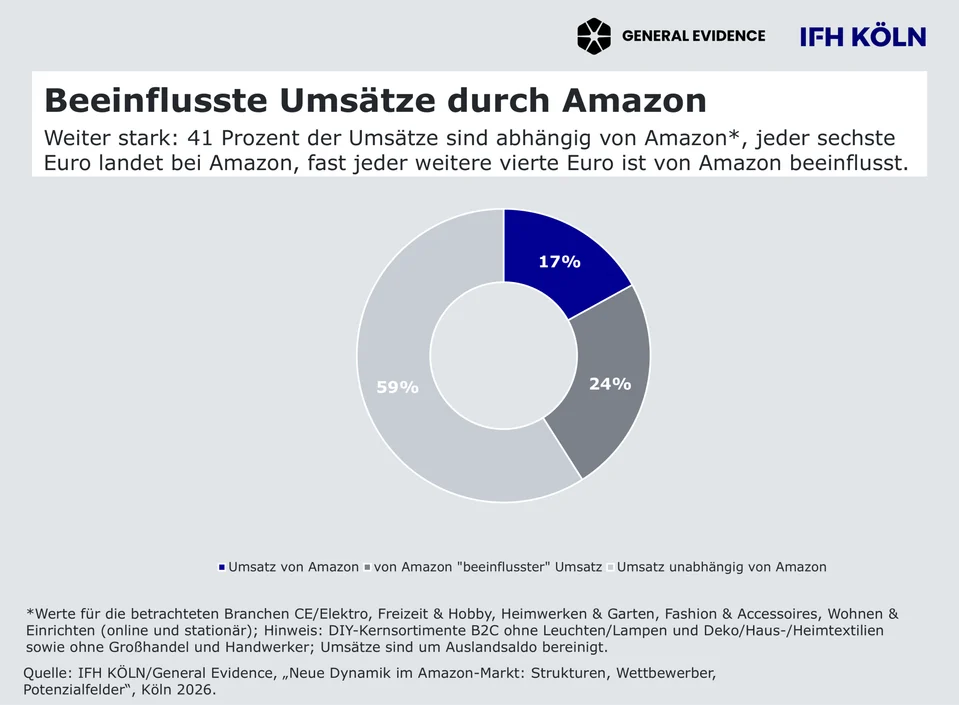
Amazon’s influence is not confined to the screen. The study concludes that the company accounts for 17% of all retail spending (online and offline) across the categories analyzed. Furthermore, Amazon exerts an "indirect influence" on an additional 24% of spending. This means that even when a consumer buys a product in a brick-and-mortar store, they likely discovered it, researched it, or compared its price on Amazon first. This "ROPO" (Research Online, Purchase Offline) effect cements Amazon as the primary gatekeeper of the German consumer journey.
Competitive Landscapes: The Rise of the Challengers
While Amazon remains the king, the study notes a "new dynamic" in the German market. The rapid ascent of Chinese platforms like Shein and Temu, alongside the resilient performance of domestic giants like Otto and Zalando, suggests that the market is not entirely stagnant.
The Chinese Factor
Shein and Temu recorded a combined growth of approximately 1 billion euros last year. While this is less than Amazon’s 3.2 billion euro increase in absolute terms, the growth rate is significant. The report highlights that one in eight Amazon shoppers in Germany is now diverting some of their purchasing volume to these platforms.
The primary driver for this shift is price sensitivity. In a volatile economic climate, German consumers are increasingly willing to sacrifice delivery speed and brand trust for the aggressive discounts offered by Temu. However, the researchers are quick to note that when it comes to the "trifecta" of e-commerce—product range, ease of ordering, and delivery reliability—Amazon remains the clear market leader.
Domestic Resilience
Otto and Zalando, the stalwarts of German e-commerce, saw their combined sales increase by 1.4 billion euros. This indicates that while Amazon is the dominant infrastructure provider, specialized retailers that can offer curated experiences, sustainable supply chains, or specific fashion expertise retain a vital role in the ecosystem.
Official Perspectives and Industry Implications
The implications of this data for the German retail sector are immense. Industry experts and analysts at IFH KÖLN suggest that the "Amazonization" of retail is effectively complete.
The Regulatory and Economic Implication
As Amazon’s influence spans 41% of total retail spending in its categories, the company is increasingly viewed not just as a retailer, but as critical market infrastructure. This raises significant questions for German regulators regarding competition law. If a company influences nearly half of all retail activity, are traditional anti-trust measures sufficient?
"Amazon has evolved into the central nervous system of German commerce," says one analyst associated with the research. "The danger is not just that they sell products, but that they control the visibility of all other products. If a business is not visible on Amazon, it is effectively invisible to the average German consumer."
The Strategic Shift
For physical retailers, the takeaway is clear: survival requires a strategy that complements, rather than competes with, Amazon’s reach. Many SMEs are choosing to use Amazon as a distribution channel while focusing their own branding efforts on "Direct-to-Consumer" (DTC) channels to maintain customer ownership. The data from the IFH KÖLN study serves as a wake-up call for retailers who have yet to integrate their digital and physical presence into a cohesive, omnichannel strategy.
Future Outlook: The Battle for the Consumer
Looking ahead, the competition between Amazon and emerging players will likely center on two battlegrounds: logistics efficiency and value-for-money perception.
Amazon’s massive investment in its German logistics network is a defensive moat designed to keep the convenience gap wide. By ensuring that "Prime delivery" remains the gold standard, Amazon makes it difficult for platforms like Temu to convert the "one in eight" shoppers into permanent, high-volume customers.
However, the shift toward Chinese platforms also signals a changing demographic among German shoppers. As younger, budget-conscious consumers enter the market, the definition of "best-in-class" retail may shift from "fastest delivery" to "lowest price."
Conclusion
The IFH KÖLN and General Evidence study confirms that Amazon is the heartbeat of German retail. With 63% of the online market and a deep, systemic impact on physical shopping habits, its dominance is unlikely to be challenged by any single entity in the near future. While competitors like Otto, Zalando, and the emerging Chinese giants are carving out meaningful segments, the sheer scale of Amazon’s marketplace—powered by thousands of German selling partners—creates a gravitational pull that is difficult to escape. For the German retail industry, the path forward involves acknowledging this reality and finding niche ways to thrive in the shadow of the giant.