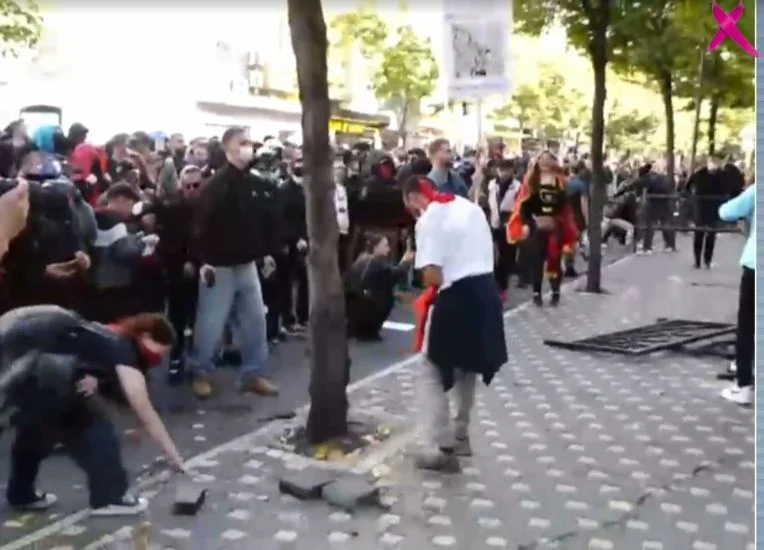
Tirana, Albania – October 15, 2026 – 17:53 – A large-scale protest in the heart of Tirana escalated into violent confrontations this afternoon, resulting in multiple injuries among both law enforcement officers and civilian demonstrators. The University Trauma Hospital (Spitalin Universitar të Traumës) has confirmed the admission of two police officers and four protesters, all receiving urgent medical attention. One police officer is currently undergoing critical neurosurgical intervention for a severe head injury, while another protester remains under intensive medical monitoring.
The clashes, which erupted during a demonstration against a controversial government policy, brought the capital to a standstill for several hours. Eyewitness accounts and preliminary reports suggest a breakdown in crowd control, leading to chaotic scenes as police attempted to disperse the agitated crowd. The incident has immediately ignited a fierce public debate regarding the use of force by authorities and the right to peaceful assembly, promising to have significant political and social repercussions across Albania.
Main Facts: A Day of Confrontation and Casualties
The tranquility of Tirana was shattered today as a planned protest, initially peaceful, devolved into scenes of disarray and violence. Medical facilities across the capital were put on alert, particularly the University Trauma Hospital, which became the primary receiving centre for those wounded in the skirmishes.
Casualties Among Law Enforcement
Among the most critically injured is Police Officer F.R., who was transported from Shkodra to the University Trauma Hospital. Sources within the hospital confirm that Officer F.R. is currently undergoing a complex surgical procedure for a severe head injury. The nature of the injury suggests blunt force trauma, potentially from a projectile or a fall during the chaos. His condition is described as serious, and medical staff are working tirelessly to stabilize him. The officer’s transfer from Shkodra indicates he may have been part of a reinforcement contingent deployed to manage the protest, highlighting the widespread mobilization of law enforcement.
Another officer, identified by the initials D.K., is also under medical care at the Neuro-surgery department of the University Trauma Hospital. While his condition is reported as stable and good, he is being kept for continuous monitoring, a standard precaution for head-related trauma to rule out any delayed complications such as concussions or intracranial hematomas. Both officers are receiving full support from their respective departments and the Ministry of Interior, who have expressed grave concern for their well-being.
Injured Protesters Under Medical Supervision
The University Trauma Hospital also confirmed that four protesters are currently receiving medical attention. Initial assessments indicate that these individuals are in stable condition and are expected to make a full recovery. Their injuries are largely attributed to the general tumult of the crowd, including minor contusions, abrasions, and potential respiratory issues from tear gas exposure, though specific details are yet to be released.
Of particular concern is protester E.P., who, while reported to be conscious and in good health, is under intensive monitoring. This level of observation often signifies a need to closely watch for developing symptoms that might not be immediately apparent, such as the effects of shock, minor concussions, or internal bruising. The medical team is exercising caution to ensure no underlying issues are overlooked.
Crucially, the Mother Teresa University Hospital Center (QSUT), Albania’s largest medical complex, reported no injured individuals currently under their care, indicating that the immediate medical response was largely concentrated at the University Trauma Hospital, which specializes in acute injuries. This suggests a pre-planned medical contingency for potential protest-related incidents, or a rapid triage system directing patients to the most appropriate facility.
The rapid influx of patients at the University Trauma Hospital activated emergency protocols, with additional medical staff called in to assist. The hospital administration has assured the public that all necessary resources are being deployed to provide the highest standard of care for all injured individuals, regardless of their affiliation.
Chronology of Events: From Assembly to Anarchy
The path to today’s violence was paved by weeks of simmering discontent over the "National Urban Revitalization Act" (NURA), a government initiative perceived by many as a thinly veiled attempt to gentrify historical districts and displace low-income residents for large-scale development projects.
Weeks of Mounting Tensions
Early October 2026: The government, led by Prime Minister Albin Gashi, pushes forward with NURA despite widespread public outcry. Opposition parties, civil society groups, and grassroots movements accuse the administration of corruption and disregard for social welfare. Several smaller, localized protests occur in specific neighborhoods targeted by NURA.
October 10, 2026: A coalition of opposition parties and activist groups, including "Citizens for Justice" and "Defend Our Homes," announces a major nationwide protest for October 15th, calling for the immediate repeal of NURA and the resignation of key ministers. Social media campaigns gain significant traction, mobilizing thousands.
October 13, 2026: The Ministry of Interior issues a statement urging protesters to maintain order and respect designated protest routes, warning against any acts of violence or vandalism. Police presence is noticeably increased in central Tirana.
The Day of the Protest: October 15, 2026
10:00 AM: Protesters begin to gather at Skanderbeg Square, the designated starting point. The atmosphere is initially charged but peaceful, with chants, banners, and speeches denouncing NURA and the government. Families, students, and elderly citizens are among the diverse crowd.
12:00 PM: The crowd swells to an estimated 10,000-15,000 participants, stretching along the main boulevards. Protest organizers attempt to lead a march towards the Prime Minister’s Office, deviating slightly from the agreed-upon route. Police lines, heavily fortified with riot gear, are already established around government buildings and key institutions.
2:30 PM: The first signs of escalation emerge as a smaller, more radicalized faction within the protest attempts to breach a police barricade near the Ministry of Finance. Objects, primarily plastic bottles and small stones, are reportedly thrown at the police.
3:00 PM: Police deploy tear gas and water cannons in an attempt to push back the advancing crowd and restore order. The sudden deployment of crowd control measures creates panic and confusion, leading to a stampede in certain sections. This is when the majority of injuries are believed to have occurred as protesters dispersed rapidly or clashed directly with police. Eyewitnesses describe scenes of chaos, with people falling, being trampled, and some actively engaging with police lines.
3:45 PM: A specific confrontation occurs near the Parliament building where a group of protesters attempts to remove a protective barrier. It is during this intense struggle that Police Officer F.R. is believed to have sustained his critical head injury, possibly from a heavy object or a fall directly onto the hard pavement amidst the melee. Officer D.K.’s injury, though less severe, is also thought to have occurred in a similar incident as police tried to contain the breach.
4:00 PM – 5:00 PM: The clashes subside as police reinforcements manage to push the remaining protesters back, eventually dispersing the main crowd. Ambulances and emergency medical teams, which had been on standby, move in to tend to the injured. Both police officers and civilians are rapidly triaged and transported to the University Trauma Hospital.
5:30 PM: The streets around the protest area are largely cleared, but the aftermath is visible – scattered debris, broken barriers, and a lingering smell of tear gas. Police units remain on high alert.
5:53 PM: News outlets begin reporting on the number of injured, confirming the severity of the situation. Medical updates from the University Trauma Hospital start to emerge, detailing the conditions of those admitted.
Supporting Data and Context
The clashes today are not an isolated incident but rather indicative of a growing trend of heightened political tensions and occasional confrontations during public demonstrations in Albania. While the right to peaceful protest is enshrined in the Albanian constitution, the line between peaceful assembly and public disorder often becomes blurred, leading to unfortunate outcomes.

Scale of the Protest and Police Response
Preliminary estimates place the number of participants in today’s protest between 10,000 and 15,000 people, making it one of the largest demonstrations in Tirana in recent years. The scale of mobilization reflects the deep public dissatisfaction with the "National Urban Revitalization Act" and broader governance issues.
In response, the Ministry of Interior deployed an estimated 1,500 police officers, including specialized riot police units, from Tirana and surrounding prefectures, such as Shkodra, to manage the crowd and secure government institutions. This significant deployment underscores the authorities’ anticipation of potential unrest. Crowd control measures employed included tear gas, water cannons, and batons.
Historical Context of Protests in Albania
Albania has a history of passionate, sometimes volatile, protests, particularly during periods of political transition or in response to controversial government decisions. Data from independent human rights organizations indicate that, over the past decade, an average of 3-5 major protests annually in Albania have resulted in minor to moderate injuries to participants or law enforcement officers. Serious injuries, like the head trauma sustained by Officer F.R., are less frequent but underscore the inherent risks when demonstrations escalate.
In 2022, a protest against fuel price increases also saw clashes, leading to several arrests and minor injuries. Similarly, demonstrations related to electoral integrity in previous years have occasionally spiraled into confrontations. The pattern suggests a need for re-evaluation of both protest organization strategies and police crowd management tactics to prevent further casualties.
Medical Preparedness
The rapid response of the University Trauma Hospital highlights a level of preparedness for mass casualty incidents, which is commendable. The hospital’s capacity, with its specialized neurosurgery department, proved crucial in handling the immediate medical needs arising from the protest. However, the fact that such a level of readiness is often necessary for public demonstrations raises questions about the overall climate of public discourse and protest culture in the country. The distinction between the Trauma Hospital and QSUT’s intake also points to an effective, albeit strained, emergency medical service network.
Official Responses and Calls for Calm
The aftermath of the clashes has triggered a flurry of official statements, with various stakeholders condemning the violence and calling for accountability and calm.
Ministry of Interior and Police Leadership
The Ministry of Interior released a stern statement late this afternoon, condemning "acts of wanton violence and vandalism against state institutions and law enforcement officers." Minister of Interior, Bledi Shehu, addressing the media, stated, "Our officers acted with utmost professionalism and restraint in the face of extreme provocation. Their duty is to protect public order and safety. We mourn the injuries sustained by our brave officers and will ensure they receive the best possible care. Any individual found to have engaged in violence will be brought to justice."
Police General Director, Arben Goga, added, "We have initiated an internal investigation into the events of today to assess all aspects of the operation. While we uphold the right to peaceful protest, we will not tolerate criminal behavior or attacks on our personnel. We extend our wishes for a swift recovery to all injured, including the citizens." He emphasized that video evidence from police body cameras and surveillance footage would be meticulously reviewed.
Government’s Stance
Prime Minister Albin Gashi issued a televised address, expressing "deep regret" for the injuries sustained by both police and citizens. "Violence has no place in our democratic society," Gashi declared. "We are a nation of dialogue, not destruction. While we respect the right of every citizen to express dissent, this must be done within the bounds of the law. The government remains open to constructive dialogue on the ‘National Urban Revitalization Act’ but will not capitulate to intimidation or anarchy. We wish a speedy recovery to all affected." He also called for political leaders to act responsibly and avoid inflammatory rhetoric.
Opposition and Protest Organizers
Opposition leader, Elira Puto, of the Democratic Revival Party, vehemently condemned what she described as "brutal and disproportionate police violence against peaceful protesters." She stated, "Today’s events are a dark stain on our democracy. The government has once again shown its true authoritarian face, choosing batons and tear gas over listening to its own people. We demand an immediate, independent investigation into police conduct and the resignation of the Minister of Interior. Our solidarity is with all injured citizens, and we hold the government directly responsible for this tragedy."
Representatives from "Citizens for Justice," one of the key organizing groups, echoed these sentiments. Spokesperson Genti Mara called for further protests, asserting, "We will not be silenced. The blood spilled today will only strengthen our resolve. We call on all Albanians to stand against this tyrannical government and its oppressive policies." He urged calm among protesters but reiterated their commitment to continuing the fight against NURA.
Human Rights Organizations
Several local and international human rights organizations have swiftly reacted, calling for a thorough and impartial investigation into the events. The Albanian Helsinki Committee issued a statement urging authorities to respect the principles of necessity and proportionality in the use of force. "It is imperative that an independent body investigates all claims of excessive force by law enforcement, as well as any acts of violence committed by protesters," read their statement. "Transparency and accountability are paramount to maintaining public trust and upholding human rights." Amnesty International’s regional office also called for immediate steps to de-escalate tensions and ensure the rights to freedom of assembly and expression are protected.
Implications: A Nation at a Crossroads
The violent clashes in Tirana are poised to have far-reaching implications, potentially reshaping Albania’s political landscape, social cohesion, and international standing.
Political Fallout
The immediate political fallout is expected to be significant. The opposition will undoubtedly capitalize on the incident, using the images of injured citizens and police to bolster their narrative of government heavy-handedness and incompetence. Calls for resignations, particularly of the Minister of Interior, are likely to intensify. This could lead to a vote of no confidence or increased pressure on the government, potentially forcing a reshuffle or, in an extreme scenario, snap elections. The Prime Minister’s ability to maintain control and navigate this crisis will be a critical test of his leadership. The "National Urban Revitalization Act" itself is now under even greater scrutiny and may face legislative challenges or be temporarily suspended to quell public anger.
Erosion of Public Trust and Social Divisions
The sight of citizens clashing violently with police, often seen as symbols of state authority, can severely erode public trust in institutions. For many, the incident will reinforce perceptions of a government detached from its people and a police force prone to excessive force. Conversely, some segments of society may view the police as victims of unprovoked aggression, deepening existing social and political divides. This polarization can make constructive dialogue more difficult and fuel further cycles of protest and repression. The injured police officers become symbols of state authority under attack, while injured protesters represent citizens whose rights were allegedly violated.
Legal and Accountability Challenges
The promise of investigations from both the police and human rights organizations signals a complex legal battle ahead. Questions of accountability will arise for both sides: whether police protocols were followed, if excessive force was used, and conversely, whether certain protesters engaged in illegal acts of violence or vandalism. The outcomes of these investigations will be crucial in determining public perception of justice and fairness. Should there be a perception of impunity for either side, it could further destabilize the situation. Arrests are expected in the coming days as authorities review evidence.
Impact on Freedom of Assembly
The incident raises serious concerns about the future of freedom of assembly in Albania. While authorities emphasize the importance of order, critics argue that aggressive crowd control tactics can stifle legitimate dissent. The events of today might deter some from participating in future protests, fearing for their safety, while others might become more radicalized. Finding a balance between maintaining public order and protecting fundamental rights will be a critical challenge for Albanian authorities moving forward.
International Scrutiny
Albania, as a candidate country for European Union membership, is under constant international scrutiny regarding its adherence to democratic principles, human rights, and rule of law. Violent clashes during protests will undoubtedly draw attention from the EU, the Council of Europe, and other international bodies. Statements expressing concern or calls for independent investigations from these organizations could put additional pressure on the Albanian government to address the situation transparently and uphold democratic standards.
The events of October 15, 2026, mark a significant moment in Albania’s recent history, highlighting deep-seated societal tensions and posing critical questions about governance, public order, and the future of democratic expression in the country. The path to healing, both physically and socially, promises to be long and arduous.