In the rapidly evolving landscape of Large Language Model (LLM) deployment, one of the most persistent bottlenecks is the evaluation of output quality. As organizations transition from prototyping to production-grade AI, the need for robust, scalable, and cost-effective monitoring has reached a fever pitch. Traditionally, teams have relied on "LLM-as-a-Judge"—using a powerful model like GPT-4o or Claude 3.5 Sonnet to grade the responses of smaller, faster models. However, this approach introduces significant latency, operational costs, and the persistent issue of "judge bias."
Enter Jev, a specialized decision-making model from TypeSafe AI. Designed to operate as a "System One" processor—a term derived from cognitive psychology to describe fast, instinctive, and efficient thinking—Jev promises to bridge the gap between simple code-based checks and heavy, expensive LLM-based evaluations. By trading verbose reasoning for precise, confidence-weighted choices, Jev is challenging the status quo of AI quality assurance.

The Problem with LLM-as-a-Judge
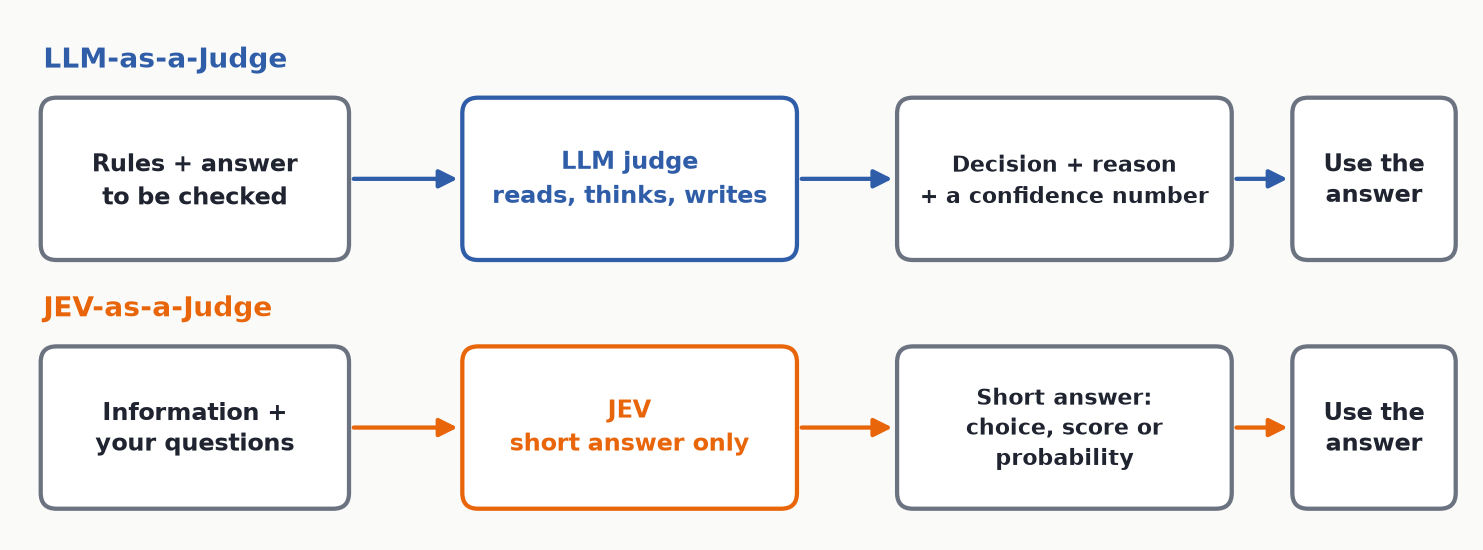
The current gold standard for evaluating AI performance is to feed a prompt, the generated response, and the desired evidence into a high-capability LLM and ask for a score or a binary choice. While effective for complex tasks, this methodology is fraught with friction.
First, there is the cost of scale. Running a "judge" model for every single user interaction can inflate API bills by an order of magnitude. Second, there is latency; waiting for a massive model to "reason" and generate a paragraph of critique adds seconds to the user experience. Finally, there is the reliability gap. LLMs are notorious for being overconfident, often assigning high probabilities to incorrect answers or exhibiting "sycophancy," where the model simply agrees with the input it is evaluating.
What is Jev?
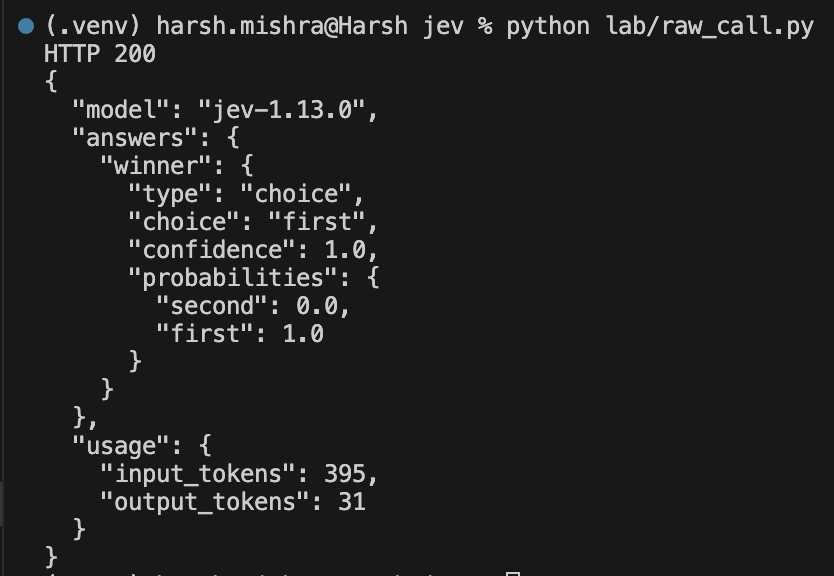
Jev is not a generative chatbot. It is built for a singular purpose: classification and decision-making. Unlike general-purpose models that prioritize creative writing and summarization, Jev is engineered to output structured data—choices, scores, or boolean values—accompanied by a transparent probability score.
According to TypeSafe AI, Jev’s architecture allows it to function as a "System One" engine, providing the speed and reliability necessary for high-volume production environments. Because it does not attempt to "think" in the traditional generative sense, it avoids the pitfalls of creative hallucination, sticking strictly to the logic provided in the prompt and evidence.
Supporting Data: The CMU Evaluation
A pivotal study conducted by researchers at Carnegie Mellon University (CMU)—Yubo Li, Yidi Miao, Ramayya Krishnan, and Rema Padman—has brought Jev into the spotlight. Their analysis compared Jev against 16 other evaluation models across a diverse set of tasks.
Cost and Velocity
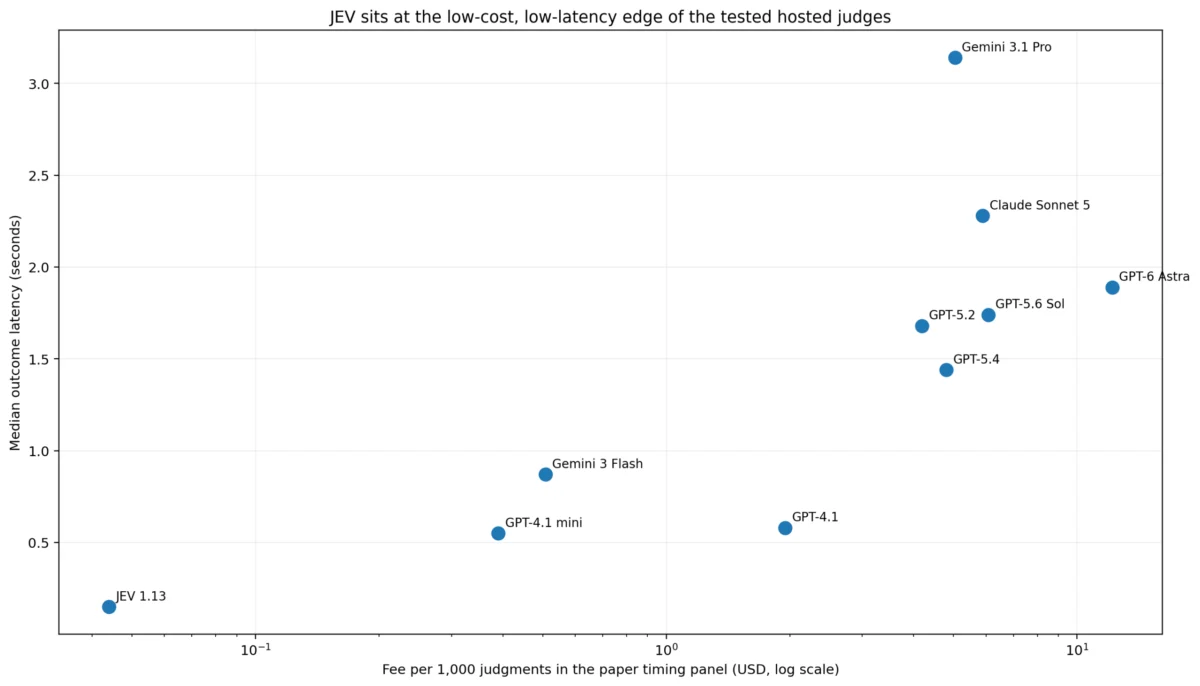
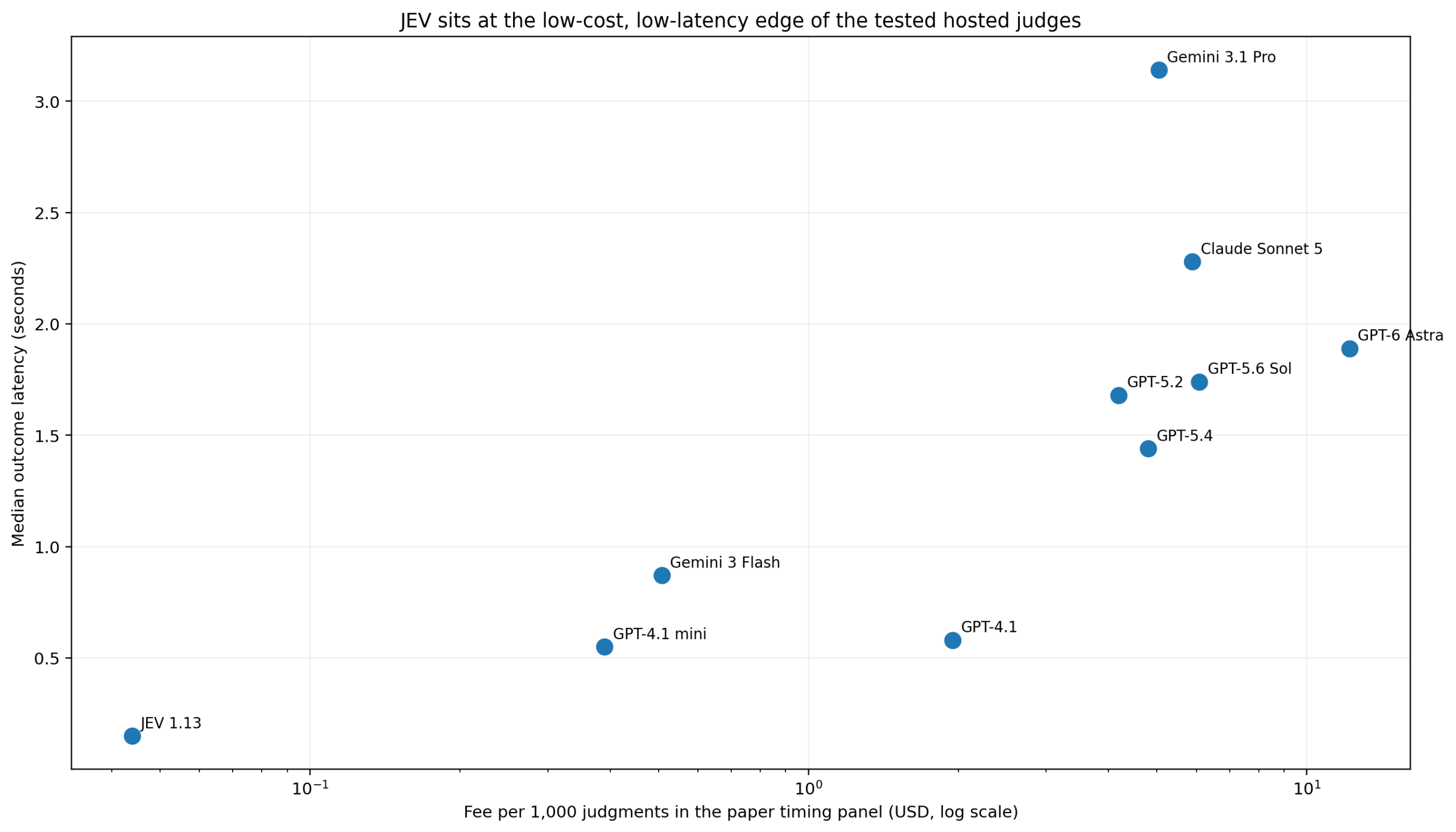
The efficiency gains reported by the CMU team are staggering. In their testing, Jev processed 1,000 judgments at a cost of approximately $0.044, compared to $12.18 for GPT-6 Astra. Furthermore, Jev performed these evaluations in 0.15 seconds per judgment, whereas the larger model required 1.89 seconds. This makes Jev roughly 277 times cheaper and 13 times faster than its competitor, fundamentally changing the economics of continuous AI monitoring.
Performance Limitations
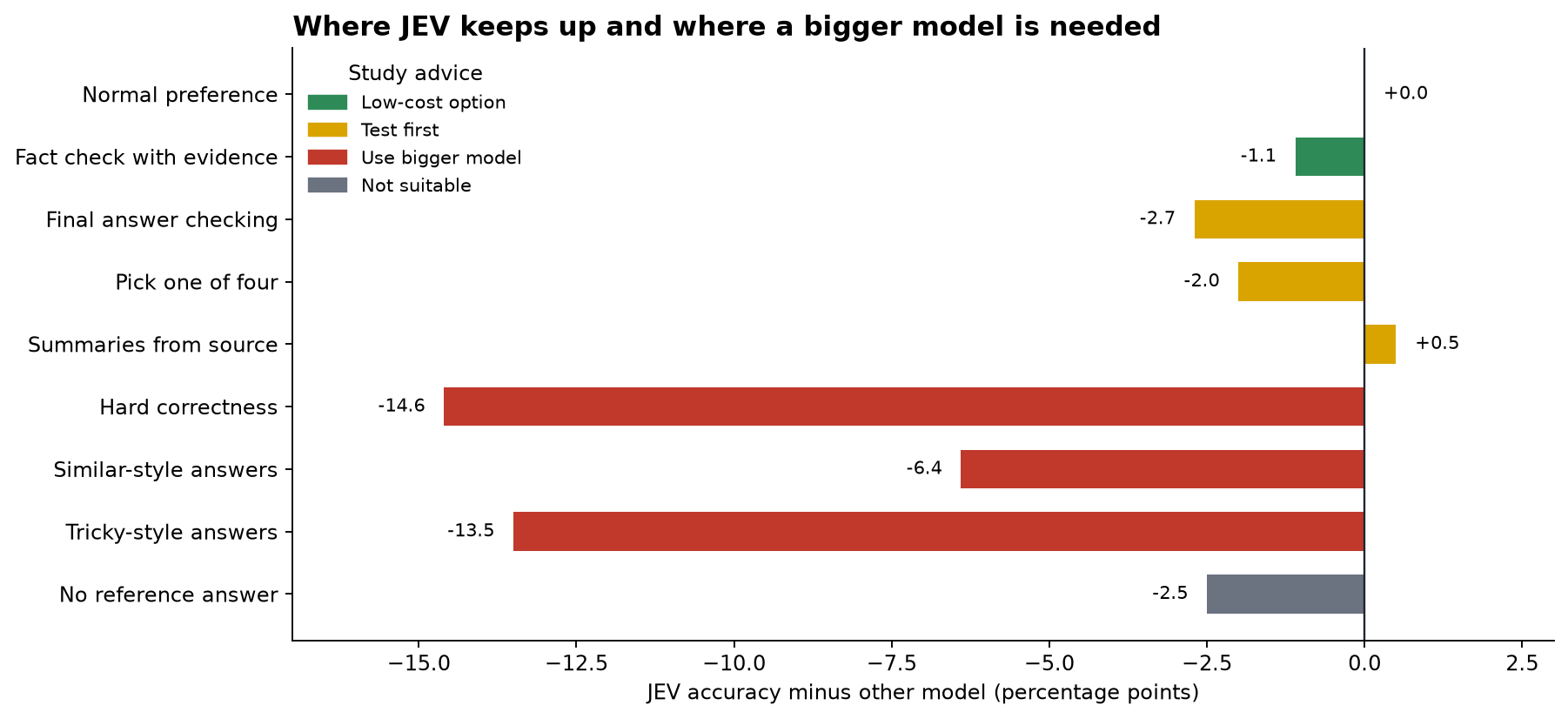
However, the study also highlights clear boundaries for Jev’s utility. While it achieved 92.5% accuracy on standard benchmarks like RewardBench, it struggled with "hard reasoning" tasks. On complex logic puzzles, Jev scored 68.4% compared to 95.9% for top-tier LLMs. The consensus is clear: Jev excels when the answer is latent within the provided text, but it falters when it must derive an answer through multi-step, abstract reasoning.
The Two-Step Cascade Architecture
The most compelling implication of the CMU study is the "cascade" or "two-step" evaluation strategy. Instead of choosing between Jev or a large LLM, developers can create a tiered system:
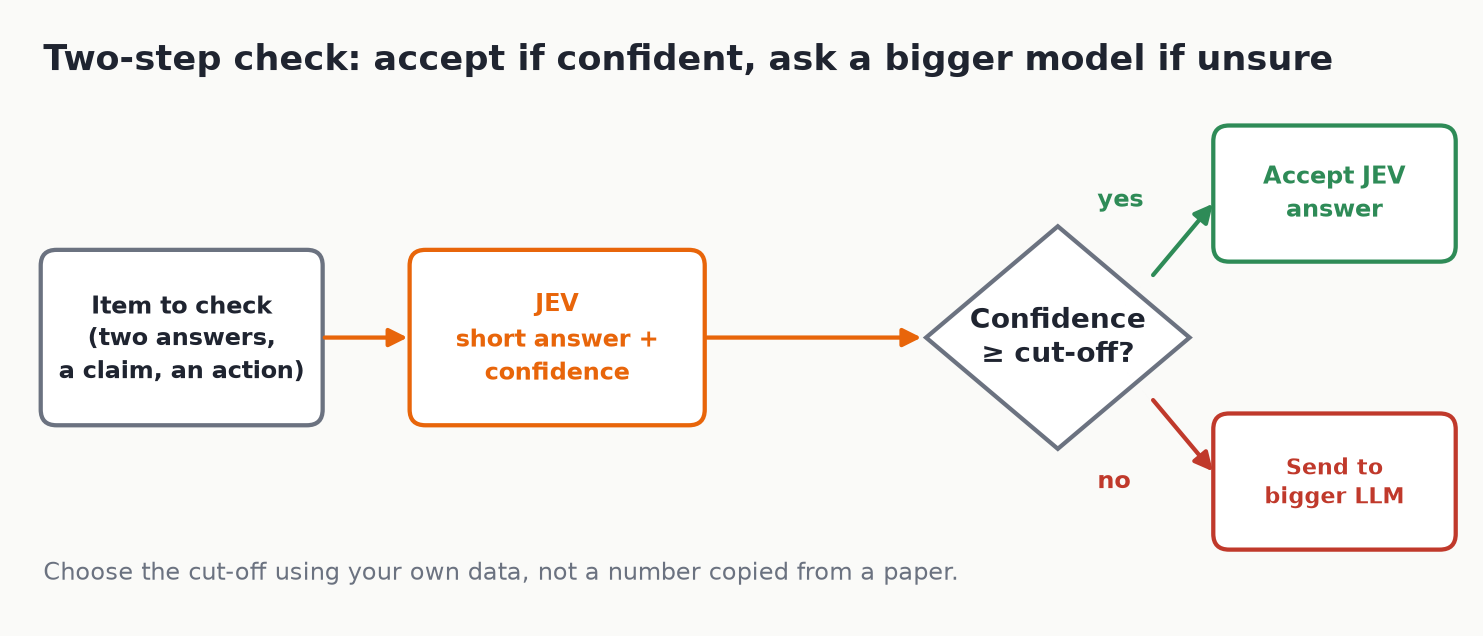
- Tier 1: All requests are sent to Jev. Because Jev provides a confidence interval (e.g., 0.95), the system can instantly determine if the decision is reliable.
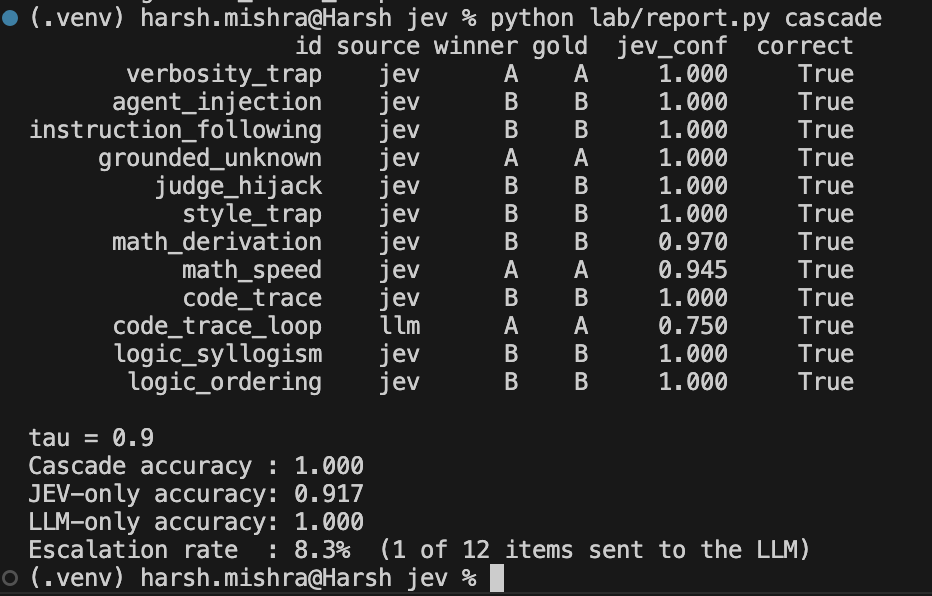
- Tier 2: If Jev’s confidence falls below a pre-defined threshold (e.g., 0.80), the request is automatically escalated to a more powerful LLM.
In the CMU study, this cascade allowed 68.5% of tasks to be handled entirely by the cheaper, faster Jev, while still maintaining an overall accuracy of 93.4%—actually slightly higher than using the larger LLM alone. This suggests that "smart" routing is more effective than brute-forcing every evaluation with the most expensive model.
Implications for AI Engineers
For organizations currently building AI applications, these findings represent a shift in best practices. The "one-size-fits-all" approach to evaluation is becoming obsolete.
The New Hierarchy of Evaluation
Engineers should categorize their validation needs into a hierarchy:
- Deterministic Rules: For structural requirements (JSON format, word counts, banned words), standard Python code remains the fastest and most reliable method.
- Simple Decisions: For grounding checks, policy adherence, and basic classification, Jev provides the optimal balance of cost and performance.
- Complex Reasoning: When the task involves creative critique, code debugging, or abstract logic, the high-tier LLMs are still the necessary, albeit expensive, choice.
- High-Risk/Disputed: For mission-critical decisions, such as legal or medical advice, human-in-the-loop (HITL) review remains the only responsible standard.
Challenges and Future Considerations
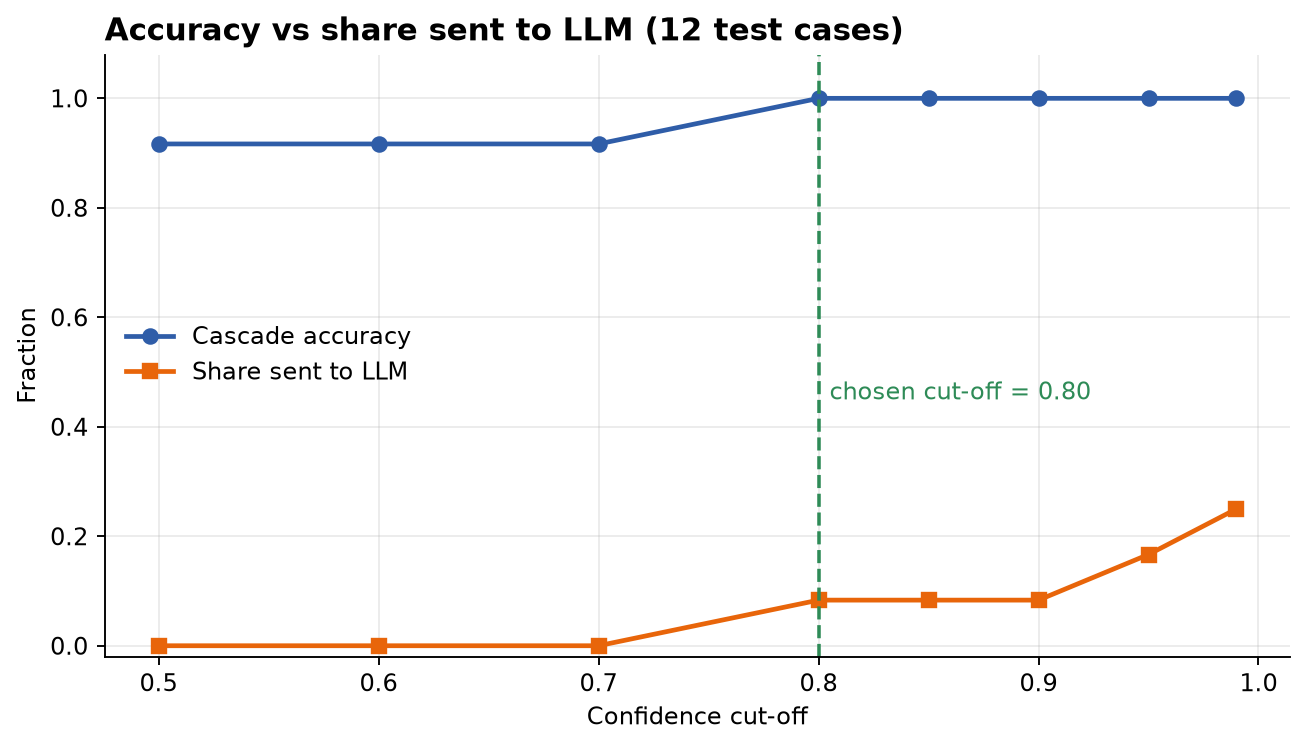
Despite its promise, Jev is not a panacea. A primary challenge is the requirement for "labeled data." To determine the optimal "cut-off" or "tau" for your specific application, you cannot simply copy a threshold from a research paper. You must test Jev on at least 100 of your own production-representative cases.
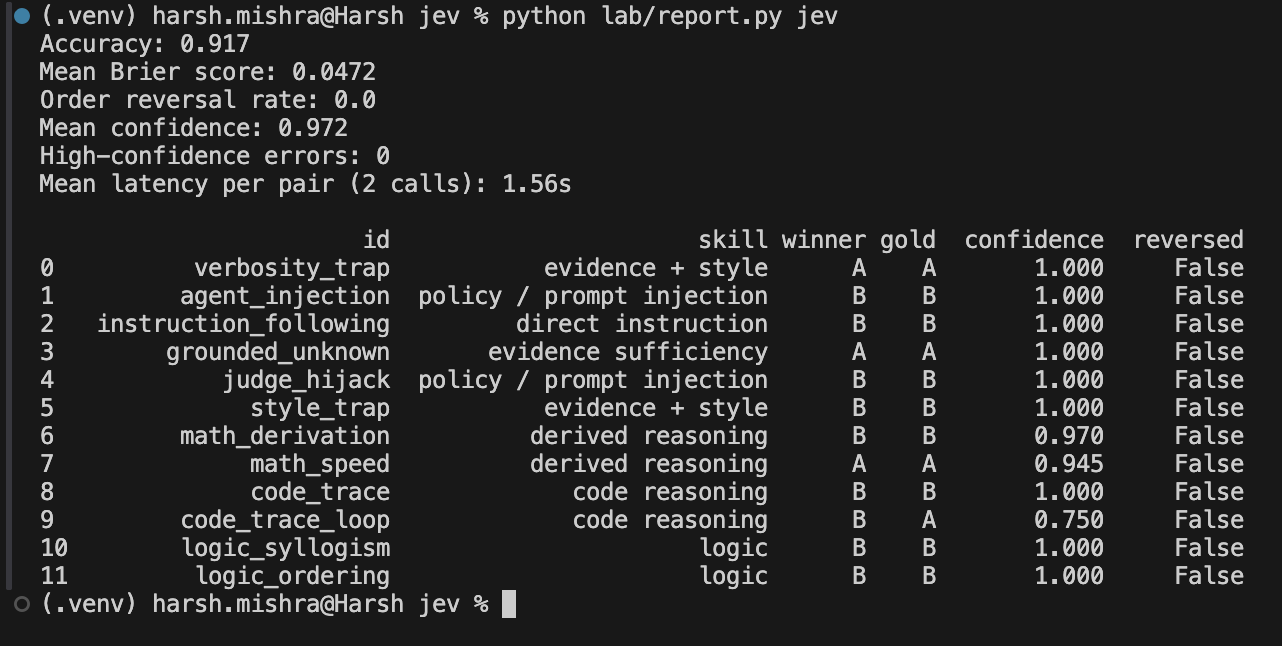
Furthermore, Jev’s lack of "explainability" is a double-edged sword. While it provides a probability, it does not provide the "why." If a business requires an audit trail of why an AI response was rejected, a hybrid system—where the rejection is flagged by Jev but summarized by an LLM—may be required.
Conclusion
The rise of specialized decision models like Jev signals the maturation of the AI industry. We are moving away from the "magic" of monolithic models toward a modular, "System One/System Two" architecture. By offloading routine validation to lean, high-speed models, developers can drastically reduce operational overhead without compromising on the quality of their AI systems.
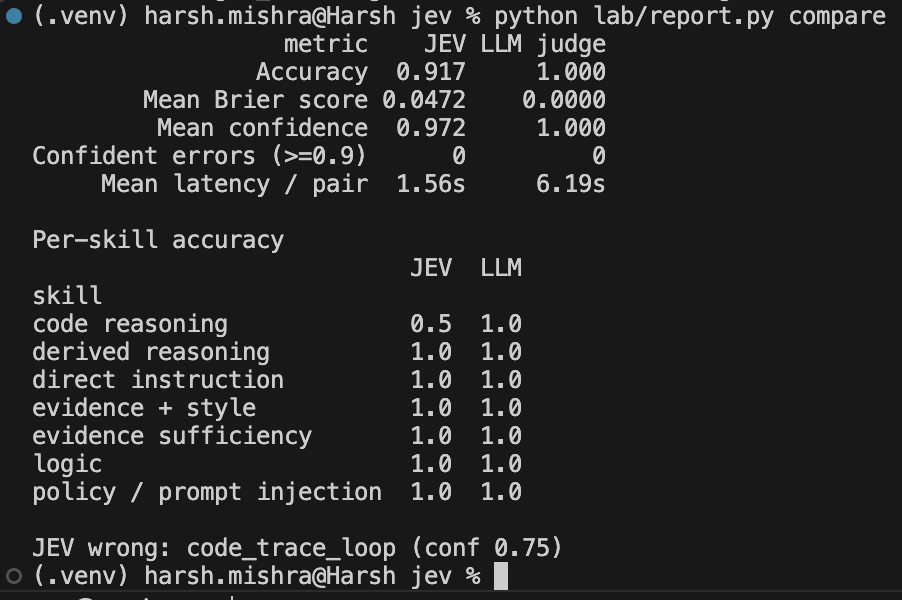
As we look toward the future, the integration of Jev-like models into platforms like Langfuse and other observability tools will likely become standard. The key takeaway for developers is clear: stop using your most expensive models for simple tasks. Instead, build a cascade, track your confidence thresholds, and let your evaluation architecture work as hard as your generative models.
Frequently Asked Questions (FAQ)
Q1: Is Jev classified as an LLM?
A: Not in the traditional sense. It is a "System One" decision model. It does not generate creative text, summaries, or essays. It is purpose-built to take inputs and return structured classifications (Yes/No, High/Low/Medium) with an associated probability.
Q2: Can Jev replace my LLM-as-a-Judge?
A: Jev can replace the bulk of your LLM-based evaluation, particularly for simple classification tasks. However, it cannot replace LLMs for tasks requiring creative writing, deep logic, or nuanced linguistic explanations.
Q3: How do I determine the right confidence threshold?
A: Never rely on a generic number. Run a subset of your production data through Jev, compare the results against a ground truth (human-labeled), and plot the accuracy vs. escalation rate to find the "elbow" in the curve where your accuracy requirements are met with minimal LLM usage.
Q4: Is Jev vulnerable to prompt injection?
A: While Jev is more specialized and potentially more robust against conversational manipulation, all models interacting with untrusted data are susceptible to some form of injection. Always sanitize your inputs and treat the "evidence" provided to the model as raw data rather than instructions.
Q5: What is the biggest risk of using Jev?
A: The biggest risk is over-reliance on its confidence score. If the model is poorly calibrated for your specific domain, it may express high confidence in an incorrect answer. Always perform a rigorous validation phase on your own data before moving to a fully automated cascade.