By Financial Analysis Desk
January 8, 2026
The U.S. labor market, which has remained a cornerstone of economic stability throughout the early stages of 2026, saw a marginal uptick in initial unemployment filings for the week ending January 3. According to the latest data released by the Department of Labor (DOL) on Thursday morning, seasonally adjusted initial jobless claims reached 208,000, reflecting a modest increase of 8,000 from the previous week’s revised figures.
While any increase in unemployment filings is scrutinized by investors and policymakers alike, economists are pointing to the broader trend—the four-week moving average—as a more accurate barometer of labor market health. That metric has continued to trend downward, signaling that despite the weekly volatility, the domestic workforce remains characterized by high retention and sustained hiring demand.
Main Facts: A Brief Ascent in Filings
The Department of Labor’s report provides a snapshot of an economy navigating the transition from the holiday season into the new year. The headline figure of 208,000 claims sits slightly above the consensus estimate projected by market analysts, who had anticipated a more muted response following the turn of the year.
Beyond the raw headline number, the report underscored the necessity of accounting for historical data revisions. The previous week’s figures, originally reported at 199,000, were revised upward by 1,000 to 200,000. These routine adjustments are common in the DOL’s methodology as more complete state-level data flows into the federal aggregate. Despite this slight upward revision and the weekly jump, the labor market continues to operate within a range that analysts consider indicative of a tight, healthy, and highly functional employment environment.
Chronology of Recent Labor Trends
To understand the significance of the 208,000 figure, one must look at the trajectory of the preceding months. Since the beginning of the fourth quarter of 2025, initial jobless claims have demonstrated remarkable consistency, rarely deviating far from the 200,000–220,000 band.
- Late November 2025: Initial claims hovered near the 210,000 mark, reflecting typical seasonal adjustments during the pre-holiday shopping surge.
- December 2025: Weekly filings dipped into the sub-200,000 range for brief periods, a rarity that highlighted the aggressive hiring practices of major industries during the end-of-year cycle.
- January 3, 2026: The current reporting period marks the first full week of the new year. Historically, this week is prone to volatility as businesses recalibrate their staffing needs following the holiday peak.
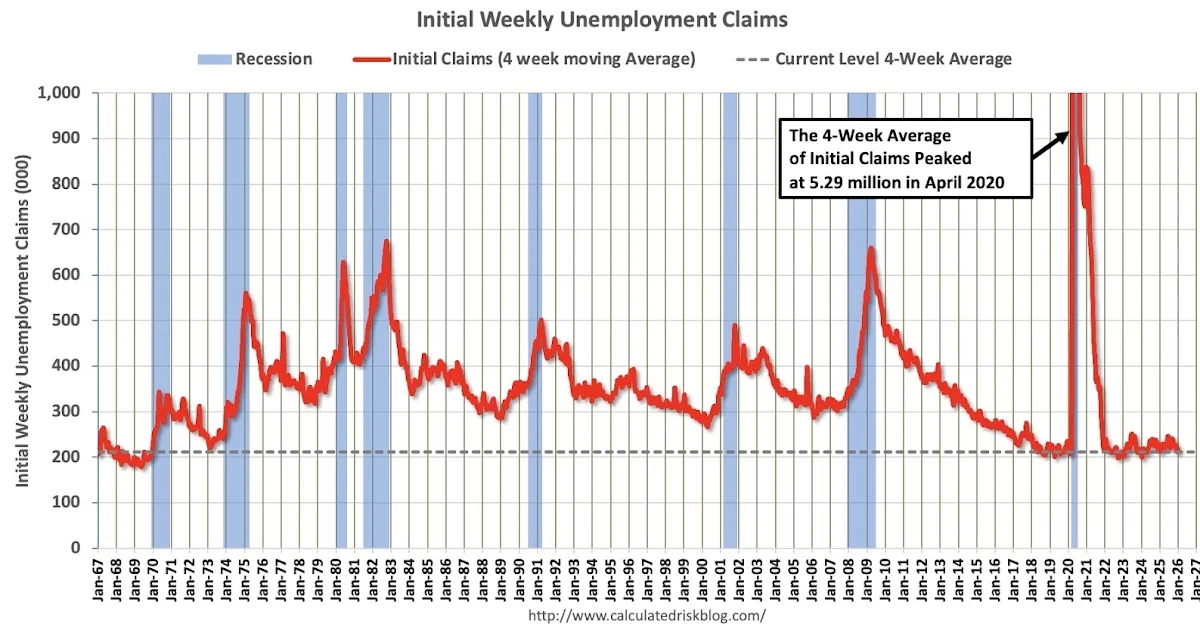
The four-week moving average, which smooths out these weekly fluctuations, serves as the most critical point of comparison. As of January 3, this average dropped to 211,750—a decrease of 7,250 from the revised average of the previous week. Notably, this represents the lowest level for the four-week average since April 27, 2024, when the metric stood at 210,250. This downward slope indicates that the underlying trend remains one of tightening labor conditions rather than widespread economic softening.
Supporting Data: Visualizing the Labor Landscape
The structural health of the labor market is perhaps best illustrated by long-term datasets. Historical trends dating back to 1971 show that current unemployment claim levels remain well below the historical averages that typically precede a significant economic recession.
The accompanying data visualization (see Figure 1, depicting the four-week moving average since 1971) highlights the dashed line of the current average. Observers will note that the post-2024 recovery phase has been characterized by a steady descent toward pre-pandemic norms. By filtering out the noise of seasonal layoffs—often seen in retail, construction, and hospitality during the winter months—the data suggests that employers are holding onto their existing staff with high conviction.
Furthermore, the revised average of 219,000 for the week prior to this report (up 250 from the initial estimate) reinforces that the downward trend is consistent and not merely a byproduct of statistical anomalies. When the four-week average falls, it serves as a lagging indicator of a strong preceding period of retention, suggesting that businesses are confident in their long-term growth prospects despite higher interest rates and a shifting global economic climate.
Official Responses and Economic Commentary
The Department of Labor’s report is frequently utilized by the Federal Reserve’s Board of Governors to gauge the "slack" in the labor market. While the Federal Reserve has remained focused on balancing inflation targets with maximum employment, the current data offers a degree of comfort.

"The labor market is not showing signs of breaking," noted one senior economist at a major brokerage firm following the release. "When we see numbers in the low 200,000s, it implies that businesses are not engaging in widespread layoffs. Instead, they are being highly selective in their hiring, which is exactly the kind of equilibrium the central bank hopes to see."
While the consensus estimate was slightly missed, the delta is considered well within the margin of statistical error. Policymakers are unlikely to pivot based on a single week’s report, but they will be looking closely at the next two months of data to determine if the January 3 spike is a precursor to a seasonal trend or an isolated event driven by end-of-year contract expirations.
Implications for the Broader Economy
The implications of these figures are far-reaching, affecting everything from consumer sentiment to monetary policy expectations.
1. Consumer Spending and Confidence
Low unemployment claims act as a firewall for consumer spending. When workers feel secure in their positions, they are more likely to engage in discretionary spending, which accounts for a significant portion of the U.S. Gross Domestic Product (GDP). As long as initial claims remain below the 250,000 threshold, economists generally expect household balance sheets to remain resilient.
2. Monetary Policy and Interest Rates
The Federal Reserve has maintained a "wait-and-see" approach to interest rate adjustments. The current strength of the labor market gives the Fed the "luxury of time." If the labor market were to cool rapidly, the central bank might be pressured to lower borrowing costs. Conversely, if the labor market stays too tight—contributing to wage-push inflation—the Fed may feel compelled to keep rates higher for longer. The 208,000 figure provides a "Goldilocks" scenario: it is high enough to show that the market is not overheating, but low enough to prevent panic regarding a recession.
3. Corporate Strategy
For corporations, the current data confirms that the talent war is not over. With unemployment claims remaining low, firms continue to face competition for skilled labor. This forces companies to prioritize retention strategies and productivity-enhancing investments, such as AI and automation, rather than relying on rapid headcount expansion.
4. Sector-Specific Observations
While the aggregate number is stable, analysts are watching specific sectors. Construction and manufacturing, which are traditionally interest-rate sensitive, are showing resilience that defies the tighter credit conditions of the last 18 months. If the current unemployment trend holds, these sectors are likely to see continued capital investment in the coming quarters.
Conclusion: Looking Ahead
As we move deeper into the first quarter of 2026, the focus will shift to the upcoming monthly jobs reports. While weekly claims provide a vital, high-frequency signal, the broader labor market picture—including job openings, quit rates, and wage growth—will provide the necessary context to determine if this 8,000-claim increase is a blip or the beginning of a larger shift.
For now, the American worker remains in a position of relative strength. The decline in the four-week moving average to 211,750 is a testament to the durability of the current economic cycle. As the Federal Reserve prepares for its next series of policy meetings, the data released today provides a reassuring sign that, despite the inevitable fluctuations of a complex global economy, the foundational pillar of the U.S. economy—the labor market—remains fundamentally sound.
Investors and analysts alike will continue to monitor the DOL’s weekly releases, keeping a watchful eye on any deviation from the current, stable trajectory. For the present, however, the report serves as a reminder that the U.S. economy is navigating the early months of 2026 with a steady hand.