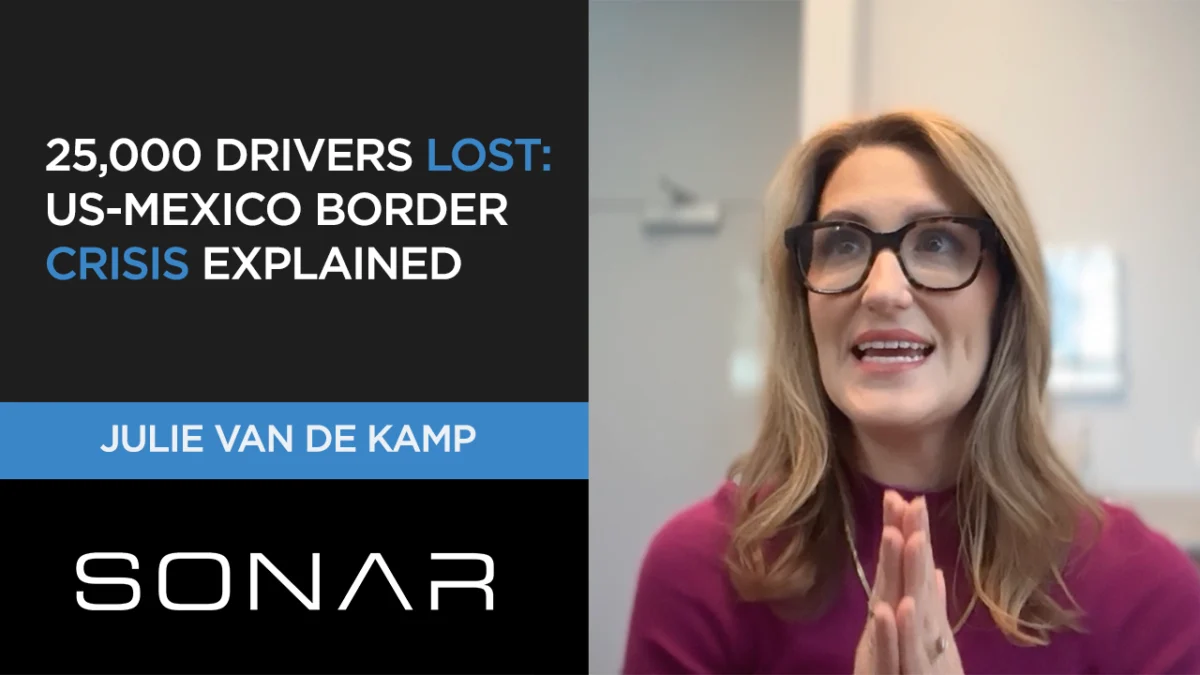
The North American supply chain is currently navigating a period of profound volatility, characterized by a fundamental misalignment between available transport capacity and logistical demand. According to recent data from FreightWaves SONAR, cross-border freight—the lifeblood of trade between the United States, Mexico, and Canada—is facing an unprecedented squeeze. Driven by a combination of regulatory actions in the south and structural freight imbalances in the north, shippers and logistics providers are grappling with rapidly escalating costs and a capacity landscape that experts warn will remain constrained through at least 2027.
At the heart of the southern border crisis is the revocation of approximately 25,000 visas for Mexican truck drivers. This administrative action has effectively crippled the labor pool necessary to facilitate southbound and northbound trade, leading to a surge in tender rejections and a sharp appreciation in spot market rates. Meanwhile, the northern border faces a distinct, albeit equally disruptive, challenge: a chronic lack of balanced freight, which forces carriers to demand premium pricing for under-utilized return trips.
The Southern Front: Visa Revocations and the Capacity Squeeze
The current tension at the U.S.-Mexico border is not a result of a sudden, unforeseen surge in consumer demand. Rather, it is a classic supply-side constriction. FreightWaves analysts have identified that the "Mexico Contract Volume Index" has remained relatively stable, recovering from a seasonal dip in January without showing signs of an exponential spike. Yet, despite steady volumes, the market is breaking.
The El Paso Epicenter
The impact of the driver shortage is most visible in key border hubs. El Paso, Texas, has emerged as the most acute pressure point. According to SONAR data, tender rejections in El Paso soared to approximately 24-25% in early July. While the market has seen minor fluctuations, rejection rates remain stubbornly high, hovering near the 20% mark.
For logistics managers, these figures are not merely statistical anomalies; they represent a functional breakdown in traditional procurement. When one in every five loads tendered to a carrier is rejected, the resulting "cascading effect" forces shippers to pivot to the spot market, where pricing power has shifted decisively into the hands of the carriers.
Comparative Regional Analysis
The strain is not limited to El Paso. Other major gateways are feeling the heat:
- San Diego/Otay Mesa: Rejection rates have spiked to approximately 10%, a significant jump from the 3.9% observed just a year ago.
- Laredo: Often considered the barometer for U.S.-Mexico trade, Laredo experienced a brief reprieve in early October, with rejections dropping to 6.07% on October 3. However, this was short-lived, with rates rebounding to 7.78% by October 10.
When contextualized against the national tender rejection rate—which climbed from 5.7% to 13.8% over the same period—it becomes clear that while the entire U.S. freight market is tightening, the border regions are experiencing a disproportionate and outsized shock.
Chronology of the Crisis: A Persistent Path to 2027
Industry analysts have spent months observing the deterioration of cross-border throughput. The timeline of this crisis is rooted in early 2026, when administrative shifts regarding labor cross-border permissions began to impact staffing levels.
- Q1 2026: Initial reports of difficulty in renewing driver visas surfaced, leading to a gradual attrition of the cross-border workforce.
- Q2 2026: As the backlog of administrative processing grew, the 25,000-visa revocation threshold was breached, creating a tangible "cliff" in available capacity.
- Q3 2026: Spot rates began to diverge from contract rates. By July, the "El Paso Spike" became the industry standard for measuring border inefficiency.
- Q4 2026 (Current): Sustained high rejection rates have forced a recalibration of long-term planning. Current projections suggest that the infrastructure and administrative barriers to replacing these 25,000 drivers will prevent a return to pre-2026 normalcy until at least 2027.
Julie Van de Kamp, a lead analyst presenting at the recent FreightWaves broadcast, emphasized that this is a structural issue, not a fleeting market condition. "For that Mexican border, a lot of this revolves around lack of driver availability and visa revocations," she noted. Her analysis suggests that the industry must prepare for a multi-year horizon of limited flexibility.
Data-Driven Insights: Cost Inflation on Key Corridors
The economic implications for shippers are stark. When capacity is tight, the spot market acts as a lightning rod for cost increases. Data comparing current spot rates to year-over-year figures illustrates a clear trend of double-digit inflation:
- San Diego-to-Phoenix: Costs have surged by a staggering 57% year-over-year.
- Laredo-to-Dallas: Shippers are paying 43% more for this critical link.
- Laredo-to-Chicago: Costs have increased by 35%, reflecting the difficulty of finding long-haul coverage in a constrained market.
- El Paso-to-Dallas: A 28% increase confirms that even short-haul cross-border movements are becoming prohibitively expensive.
These increases are not driven by increased total volume, but rather by the necessity of paying a premium to secure the limited number of qualified, visa-compliant drivers remaining in the pool.
The Northern Border: The Imbalance Paradox
While the southern border struggles with a labor supply crisis, the U.S.-Canada border is grappling with a logistical imbalance. Canadian exports to the U.S. remain firm, ensuring that there is plenty of freight moving southward. However, the northbound return lanes—the "backhaul"—are consistently weak.
The Backhaul Problem
For a carrier, a profitable route is a round-trip. When there is no cargo to haul back into Canada, the cost of the entire journey must be absorbed by the southbound leg. As a result, carriers are increasingly unwilling to take loads into specific U.S. markets that lack strong outbound Canadian potential, or they are demanding premium "repositioning" pay.
Sector-Specific Impacts
The refrigerated sector is feeling this pressure most acutely. Because cold-chain logistics require specialized equipment and tighter timelines, the inability to find backhaul freight often leads to spoiled goods or significantly higher spot costs. Recent data shows that Canadian rejection rates have climbed from 4% to 5.5% year-over-year, and analysts anticipate this will continue to rise through the end of the year.
Official and Industry Responses
Industry leaders are calling for urgent dialogue between the U.S. Department of Transportation (DOT), the Department of Homeland Security (DHS), and their Mexican counterparts to streamline the visa renewal process. However, the political complexity of border policy suggests that a swift legislative or administrative fix is unlikely.
Shippers are responding by diversifying their carrier base and shifting toward longer-term contracts to lock in capacity, though many carriers are hesitant to sign new contracts at pre-crisis prices. The consensus among those attending the upcoming Brokerage Compliance Symposium and Future of Freight Festival is that the "wait and see" approach is no longer viable. Companies are now looking into re-routing, intermodal alternatives, and, in some cases, nearshoring production to reduce reliance on long-haul cross-border trucking.
Long-Term Implications for the Supply Chain
The current situation represents a fundamental shift in the North American logistics paradigm. For decades, the "just-in-time" model relied on the assumption that cross-border capacity was essentially infinite and inexpensive. The current crisis exposes the fragility of that assumption.
1. Pricing Strategy Shifts
Shippers must prepare for a permanent increase in their "border tax"—the premium required to operate in high-friction zones. Budgeting cycles for 2027 should account for higher spot market exposure and the potential for contract rate resets that reflect the new cost of labor.
2. Operational Resilience
The reliance on a narrow pool of cross-border operators is a systemic risk. Forward-thinking companies are currently investing in supply chain visibility tools that allow for real-time rerouting when border wait times exceed thresholds.
3. The Human Element
The visa revocation crisis serves as a reminder that the global supply chain is, at its core, a human-capital industry. Regulatory policies that impact individual drivers have a direct, measurable, and profound effect on the cost of goods sold.
Conclusion: Preparing for a New Reality
As we look toward the 2026/2027 transition, the message for the logistics industry is clear: the volatility observed at the borders is not a temporary storm, but a new climatic condition. Whether it is the labor-driven scarcity in the south or the volume-imbalance in the north, the result is a market where the cost of moving goods will remain elevated.
The industry must now focus on efficiency, technological integration, and smarter procurement. With major industry events like the Future of Freight Festival approaching, the primary topic of conversation will undoubtedly be how to navigate this era of constraint. For the stakeholders involved, the ability to adapt to these new realities—rather than waiting for a return to the past—will determine which companies thrive and which fail in the evolving North American freight landscape.