Introduction: The Agentic Paradigm Shift
The landscape of artificial intelligence is undergoing a profound metamorphosis. We have moved beyond the era of the "chatbox"—a static, conversational interface—into the era of "Agentic AI." These systems are not merely predicting the next token; they are autonomously planning, utilizing complex toolsets, and iterating toward multi-step goals with minimal human oversight.
Today, agentic systems are being woven into the fabric of production infrastructure. From automated code review pipelines and sophisticated research assistants to complex customer operations platforms, companies of all sizes are rushing to deploy agents. However, a stark reality remains: the chasm between a compelling, one-off demo and a reliable, production-grade autonomous system is vast. Bridging this gap requires a transition from simple prompt engineering to rigorous software architecture involving state management, failure recovery, sandboxed execution, and trajectory evaluation.
The Chronology of Complexity: A Four-Stage Evolution
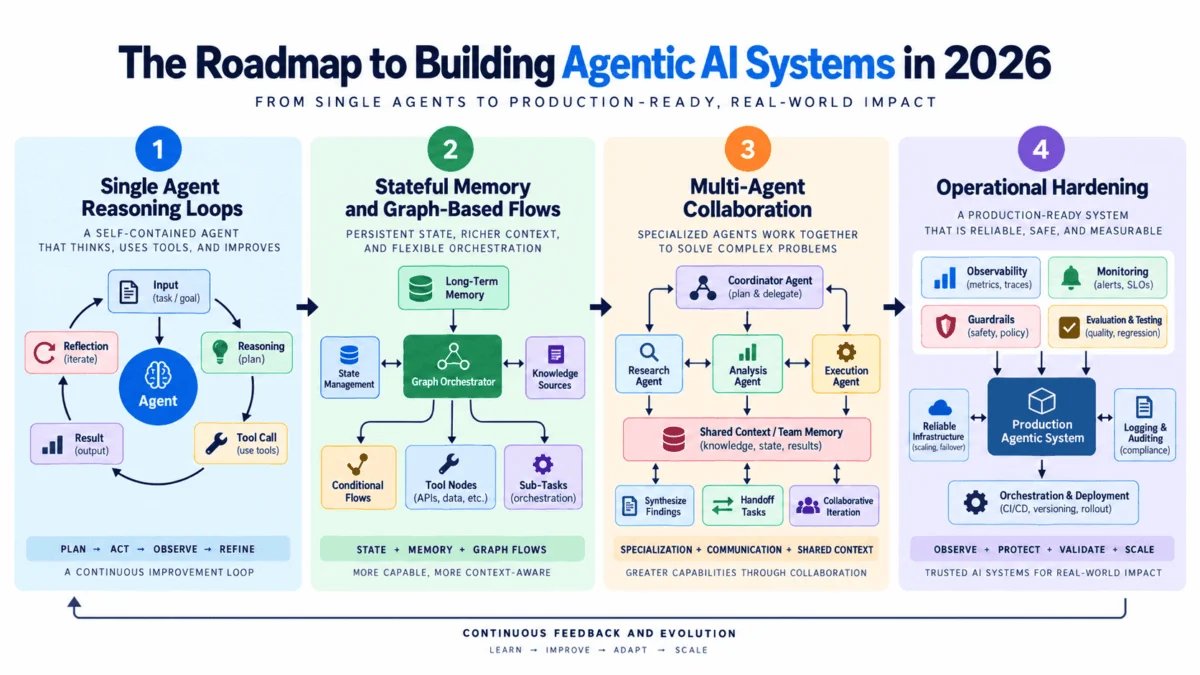
To successfully deploy Agentic AI, developers must adhere to a structured, four-level maturation process. This roadmap provides the architectural framework necessary to transition from individual cognitive models to resilient, multi-agent ecosystems.
Step 1: The Anatomy of an Agent and Cognitive Architectures
At its core, an "agent" is a system capable of perceiving its environment, selecting a course of action, executing that action via external tools, and evaluating the result to inform its next move. This feedback loop is the fundamental differentiator between a standard Large Language Model (LLM) and an agent.
- Structured Interaction: Modern agents rely on function calling protocols. By leveraging tools like Pydantic or TypeChat, developers can enforce strict output validation, ensuring that a model’s attempt to query a database or run a script does not result in malformed code that crashes the entire pipeline.
- Context Management: Dynamic context assembly is the silent killer of agent performance. As agents iterate, token consumption spikes. Efficient systems must master the art of "context window hygiene"—deciding what data is retained, what is summarized, and what is offloaded to vector-based memory.
Step 2: Stateful Memory and Graph-Based Control Flows
The primary failure point of early agents is their lack of persistence. A system that "forgets" the context between steps is inherently brittle.
- The Power of Graphs: Linear execution chains (A -> B -> C) are insufficient for real-world tasks. Modern frameworks like LangGraph treat execution as a directed acyclic graph (DAG) or a cyclical state machine. This allows agents to branch, backtrack, or loop based on environmental feedback.
- Checkpointing: Production-grade agents must feature state persistence. By checkpointing at every step, developers enable essential capabilities such as human-in-the-loop approval gates, automated rollbacks during failure, and forensic debugging of complex, multi-step execution paths.
Step 3: Multi-Agent Collaboration and Protocol Design
As tasks grow in scope, the "single-agent" model often hits a ceiling. The solution is the creation of specialized teams.
- Topological Design: Whether adopting a hierarchical manager-worker structure or a decentralized collaborative mesh, the team architecture must be deliberate.
- Communication Standards: Inter-agent communication is often the most underappreciated layer of the stack. By implementing structured message schemas—standardized protocols for task handoffs and status reporting—teams can mitigate the "telephone game" effect where errors compound as data moves between specialized agents. Emerging standards like the Model Context Protocol (MCP) are currently setting the stage for cross-vendor interoperability.
Step 4: Operational Hardening, Sandboxing, and Observability
The final stage is moving from "it works" to "it is reliable."
- Runaway Loop Mitigation: Unchecked agents can consume infinite tokens or execute endless loops. Implementing circuit breakers—hard limits on recursion depth and token expenditure—is non-negotiable.
- Sandboxing: When an agent writes and executes code, the security implications are significant. Isolated environments, such as Docker containers or cloud-based sandboxes (e.g., e2b), are required to prevent malicious or accidental system compromise.
- Trajectory-Level Evaluation: The industry is moving away from judging agents by their "final answer" and toward judging them by their "trajectory." By utilizing tools like LangSmith or Arize Phoenix, developers can trace every step, allowing them to pinpoint precisely where an agent deviated from the intended reasoning path.
Supporting Data and Technical Implementation
The transition to agentic systems is supported by a growing library of open-source and proprietary frameworks designed to solve specific bottlenecks.
Core Tooling Comparison
| Feature | Traditional LLM Apps | Production Agentic Systems |
|---|---|---|
| Execution | Linear / API call | Graph-based / Cyclic |
| Memory | Stateless / Buffer | Episodic / Persistent |
| Safety | Prompt Guardrails | Sandboxed Runtime |
| Observability | Token count / Latency | Trajectory Tracing |
The industry has converged on the importance of Type-Safe Tooling. As shown in the following snippet, enforcing schemas before execution is a critical defense:
from pydantic import BaseModel
from typing import Literal

class CodeToolCall(BaseModel):
    tool: Literal["run_python"]
    code: str
    timeout_seconds: int = 30

# Validation prevents cascading downstream failures
raw_output = '"tool": "run_python", "code": "print(1+1)"'
call = CodeToolCall(**json.loads(raw_output))
Official Industry Perspectives
Leading researchers and systems architects emphasize that the shift to Agentic AI represents a fundamental change in the "responsibility profile" of software engineering.
"Agents are not just tools; they are autonomous actors," notes Vinod Chugani, a leading educator in the field. "When you deploy an agent, you are essentially managing an intern that never sleeps. If you don’t provide that ‘intern’ with a strict handbook, clear protocols, and a way to report its own mistakes, you aren’t building a system—you are building a liability."
The consensus among major platforms—including Anthropic (with the introduction of MCP) and Microsoft (via the AutoGen framework)—is that standardization is the next major hurdle. Without a common language for agents to talk to one another and to external tools, the ecosystem will remain fragmented and difficult to scale.
Implications: The Future of Autonomous Operations
The shift toward agentic systems has several far-reaching implications for the enterprise:
- Shift in Engineering Skillsets: The role of the "Prompt Engineer" is fading, replaced by the "Agent Architect." Success now depends on systems-level thinking, state machine design, and observability engineering rather than just clever prompting.
- Economic Efficiency: While the initial cost of building an agentic system is higher than a standard chatbot, the long-term ROI is found in the reduction of human intervention in routine, multi-step business processes.
- Safety and Security as a Competitive Advantage: In the near future, the reliability of an agent will become its most valued feature. Companies that master sandboxing and rigorous evaluation will be the ones that safely deploy agents in high-stakes environments like finance, healthcare, and critical infrastructure.
Final Thoughts
Agentic AI is moving from the fringe to the core. This roadmap serves as a blueprint for those looking to build systems that don’t just "talk," but "do."
Building these systems is an exercise in managing complexity. By focusing on structured validation, stateful memory, clear communication protocols, and observability, developers can create AI that is not only powerful but, more importantly, predictable and reliable. The investment in hardening at each layer of this roadmap compounds directly into the robustness of the final production system. The future of software is autonomous, but it will be built on the same foundations of engineering excellence that have always defined the industry.