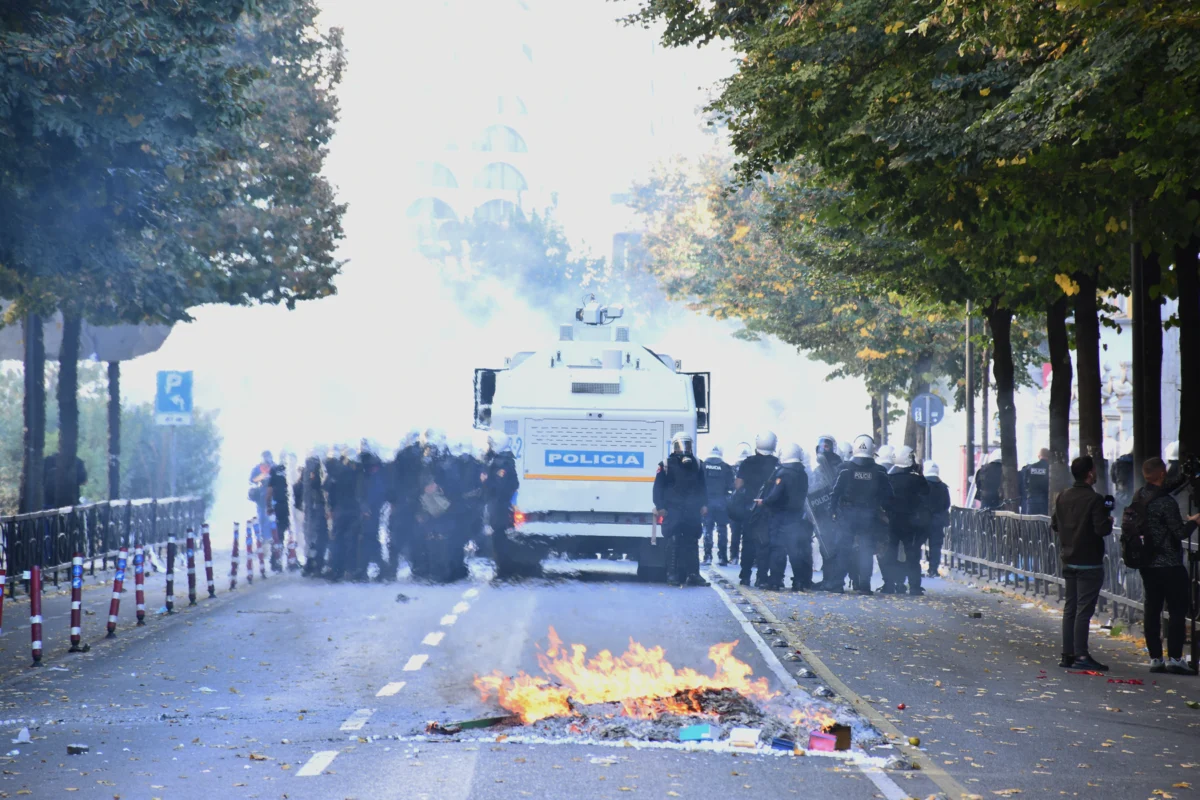
TIRANA, ALBANIA – October 26, 2026 – A demonstration by students and young people outside the Ministry of Education in Tirana escalated into clashes with law enforcement on Thursday, resulting in the use of water cannons and tear gas by police. The protest, initially a call for improved educational conditions, devolved into a scene of confrontation as a segment of the demonstrators reportedly hurled objects at the ministry building and damaged its perimeter. Authorities reported that 16 individuals were detained during the unrest.
The protest, which began around 2:00 PM, had aimed to unite students from across the country in a unified voice demanding better educational standards and expressing broader discontent with the current government. Slogans against Prime Minister Edi Rama’s administration echoed through the streets, reflecting deep-seated frustrations that extend beyond the academic sphere.
The image of a state police water cannon vehicle, flanked by officers in riot gear, pushing back protestors from Durrësi Street towards Skanderbeg Square, encapsulates the volatile atmosphere that gripped the capital. This incident is the latest in a series of escalating protests that have gripped Albania for months, highlighting a growing public unease with socio-economic conditions and governmental policies.
The Unfolding of the Confrontation: A Chronology of Events
The protest commenced as planned at 14:00, with a broad appeal for student participation from across Albania. Initially, the gathering was characterized by vocal but largely peaceful demands for improved educational infrastructure, resources, and a more responsive academic system. Participants carried signs and chanted slogans reflecting their dissatisfaction with the perceived lack of investment in higher education and the challenges faced by young people in accessing quality learning opportunities.
However, the mood began to shift as the demonstration progressed. Reports indicate that a faction of the protestors, perhaps fueled by a growing sense of frustration or strategic intent, began to direct their actions towards the Ministry of Education building itself. The first signs of escalation involved the throwing of projectiles, with eggs being reportedly hurled at the facade of the ministry. This was followed by more forceful actions, including the dismantling of railings and the dislodging of sidewalk paving stones, which were then allegedly used to strike the building’s windows.
In response to the escalating aggression and the damage to public property, the Albanian State Police deployed their specialized units. The use of a water cannon vehicle, a tool designed for crowd dispersal, marked a significant turn in the confrontation. This was accompanied by the deployment of tear gas, aimed at breaking up the more volatile elements of the crowd and restoring order.
During the police intervention, officers were observed pushing a section of the crowd along Durrësi Street, away from the ministry and in the direction of Skanderbeg Square, a central hub for public gatherings in Tirana. Media footage captured moments of intense physical engagement, including instances where police officers were seen dragging a protestor and using batons. The detentions, numbering 16 according to official police statements, underscore the severity of the law enforcement response.
Underlying Grievances: Beyond the Classroom Walls
The immediate catalyst for Thursday’s protest may have been centered on educational grievances, but the underlying causes are far more complex and deeply rooted in Albania’s current socio-economic and political landscape. The slogans chanted by the protestors, such as "We want conditions, we want knowledge, not government lies," reveal a broader disillusionment. This sentiment points to significant economic hardships and a pervasive sense of hopelessness among the youth, contributing to a worrying trend of emigration from Albania.
The protestors articulated concerns about the economic struggles faced by Albanian citizens and the perceived lack of future prospects within the country, which they believe is driving young, educated individuals to seek opportunities abroad. This "brain drain" is a persistent challenge for Albania, and the current generation of students and young professionals appear to be expressing their frustration with a system they feel is failing to provide them with a viable future.
The demand for "conditions" and "knowledge" goes beyond mere infrastructure improvements. It encompasses a call for a more equitable and effective education system that equips graduates with the skills and opportunities needed to thrive. The perception that the government is not adequately addressing these fundamental needs appears to be a significant driver of the current wave of dissent.
A Broader Context of Discontent: The Echoes of Past Protests
Thursday’s student demonstration is not an isolated incident but rather a continuation and, in some ways, an amplification of a larger wave of public discontent that has been building in Tirana for over four months. These ongoing protests were initially sparked by opposition to a controversial tourism project in Zvërnec, a protected natural area. This initial environmental concern quickly broadened to encompass wider issues of environmental protection and property rights.
The protestors, emboldened by initial engagement and the perceived lack of government responsiveness, expanded their demands significantly. What began as a localized concern evolved into a nationwide call for fundamental political change. Key demands now include the resignation of Prime Minister Edi Rama’s government and the annulment of legislative changes perceived to undermine protected areas and favor strategic investors.
The summer and autumn months in Tirana have been marked by continuous rallies and marches, with the overarching demand for the government’s departure remaining a central tenet for the majority of participants. This sustained period of public mobilization indicates a deep-seated dissatisfaction with the current political leadership and its policies, extending across various demographics and social strata. The student protest, therefore, can be seen as a powerful manifestation of this broader societal unrest, bringing a new generation to the forefront of the struggle for change.
Official Responses and the Path Forward: Awaiting Dialogue
The Albanian State Police, in their official statement, emphasized the need for order and adherence to the law. The detentions and the use of crowd dispersal tactics were presented as necessary measures to prevent further damage to property and to ensure public safety. The police spokesperson reiterated that while the right to protest is recognized, it must be exercised within legal boundaries and without resorting to violence or destruction.
The Ministry of Education, as the direct target of the protest, has yet to issue a detailed statement regarding the specific demands raised by the students. However, in the past, government officials have often acknowledged the importance of student voices and have spoken of ongoing efforts to reform and improve the education sector. The challenge, for many protestors, lies in the perceived gap between these pronouncements and tangible policy implementation.
The broader implications of these escalating tensions are significant for Albania’s political and social stability. The persistent protests, now involving a crucial demographic of students and youth, signal a growing impatience with the status quo. The government faces the dual challenge of addressing the legitimate concerns of its citizens while maintaining order and preventing further polarization.
The lack of a clear and constructive dialogue between the government and the various protest movements remains a critical issue. For the protests to de-escalate and for a path towards resolution to emerge, a willingness from all sides to engage in meaningful dialogue, to address the root causes of discontent, and to work towards concrete solutions will be paramount. The events of Thursday serve as a stark reminder that the voices of dissent, when amplified by widespread frustration, can no longer be ignored. The future trajectory of these protests, and indeed the political landscape of Albania, will likely depend on how effectively these underlying grievances are addressed in the coming weeks and months.