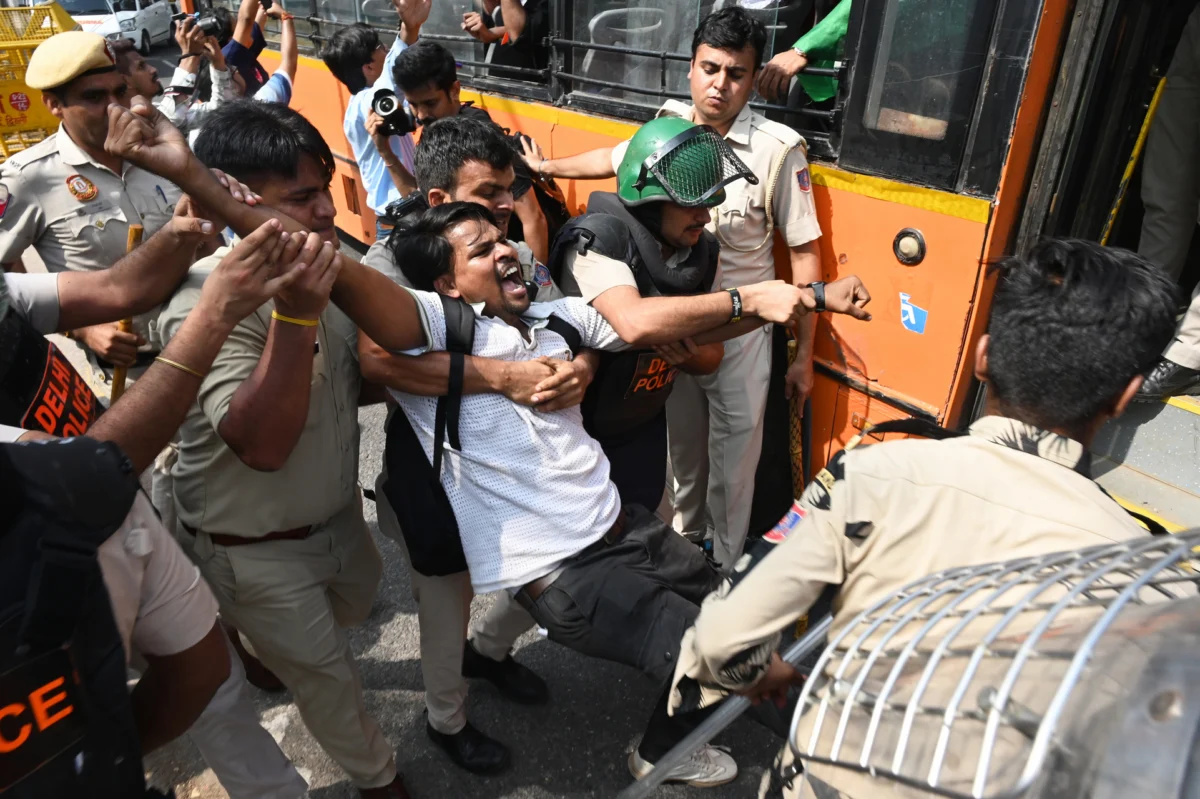
NEW DELHI — Tensions in the Indian capital reached a boiling point this week as thousands of demonstrators converged on the Supreme Court of India. The march, which defied heavy-handed security crackdowns and the shuttering of key metro stations, marks a critical escalation in a burgeoning national crisis: the sudden and opaque removal of 130 million names from the country’s electoral rolls.
The protests, which were met with draconian security measures over the weekend, signal a profound fracturing in the relationship between the citizenry and the government of Prime Minister Narendra Modi. As the political landscape shifts beneath the weight of these allegations, the international community is watching closely, questioning whether the world’s most populous democracy is undergoing a fundamental transformation in its commitment to universal suffrage.
The Crisis at a Glance: Allegations and Anxieties
The epicenter of the current unrest is a massive administrative action that has effectively stripped nearly 10% of India’s registered voters of their right to participate in the democratic process. For the protesters gathered in New Delhi, this is not merely a bureaucratic error; it is, in their words, a systematic disenfranchisement campaign.
Activists argue that the purge is disproportionately targeting India’s minority populations—specifically Muslims—who have historically formed a robust opposition bloc against the ruling Bharatiya Janata Party (BJP). The scale of the deletions is unprecedented, leading to widespread confusion, local chaos at polling centers, and a growing sense of existential dread among marginalized communities who fear that the electoral foundation of the nation is being dismantled from within.
Chronology of the Disenfranchisement Controversy
The current climate of instability did not emerge in a vacuum. It is the culmination of years of legislative maneuvering and administrative shifts that have slowly altered the Indian electoral landscape.
- 2019: The Citizenship Amendment Act (CAA): The foundation of the current fear was laid in 2019, when the BJP-led government passed the controversial Citizenship Amendment Act. The law introduced a religious criterion for citizenship, fast-tracking non-Muslim refugees from neighboring countries. Critics immediately decried the law as a violation of the secular ethos of the Indian Constitution, fearing it would be used in tandem with a National Register of Citizens (NRC) to strip Muslims of their legal status.
- Early 2026: The "Maintenance" Initiative: The government announced a nationwide drive to "clean up" voter rolls, citing the need to remove duplicate entries, deceased individuals, and those who have migrated. Officials characterized this as a routine exercise in data integrity.
- September 2026: The Data Leak: Independent researchers and election watchdogs began publishing reports highlighting statistical anomalies in the new rolls. The data suggested that millions of voters in opposition-leaning constituencies—many with high Muslim concentrations—had been removed without adequate notification or due process.
- October 2026: Escalation and Crackdown: As news of the purged rolls spread, grassroots organizations mobilized. The government responded by closing metro stations, restricting traffic, and deploying heavy police presence to prevent gatherings in New Delhi.
- October 12, 2026: The Supreme Court March: Despite the restrictions, protesters successfully organized a march to the Supreme Court, demanding a judicial audit of the electoral rolls and the immediate reinstatement of the purged voters.
Supporting Data: An Unprecedented Statistical Shift
The sheer volume of names removed—130 million—presents a massive logistical challenge to the Indian Election Commission and raises profound questions regarding the methodology of the purge.
Independent analysis conducted by civil society groups has revealed that the "cleaning" process was not geographically uniform. In states where the BJP faces significant political competition, the rates of deletion were found to be statistically higher.
- Disproportionate Impact: Data from regional civil society groups suggests that in several urban districts, nearly 15% of voters who participated in the last election cycle were marked as "ineligible" or "inactive" in the current rolls.
- Lack of Due Process: Under Indian law, a voter must be notified before their name is struck from the rolls. Investigations indicate that a significant majority of those affected reported never receiving a notice or a chance to contest their removal.
- Digital Divide: The reliance on digital portals for voters to verify their status has hindered rural populations and those with limited access to technology, effectively creating a "digital disenfranchisement" that exacerbates the political impact of the purge.
Official Responses: The Government’s Defense
The government of Prime Minister Narendra Modi has remained steadfast in its defense of the administrative changes. In a press briefing held shortly after the protests, a spokesperson for the Ministry of Law and Justice emphasized the "sanctity of the electoral process."
"The removal of these names is a technical necessity," the spokesperson stated. "We are ensuring that our electoral rolls are reflective of reality. We have millions of entries for people who have passed away or moved to different states. This is not about politics; it is about maintaining the integrity of our democracy."
The government has dismissed claims of anti-Muslim bias as "motivated propaganda" designed to destabilize the nation. They point to the fact that the cleanup is a national exercise, not confined to any specific region or demographic group. However, they have yet to address the specific allegations regarding why the purge appears to align so closely with electoral geography.
Implications: A Shifting Landscape of Power
The events in New Delhi are indicative of a broader transformation in the Indian political landscape. The BJP, under Modi, has cultivated a platform centered on Hindu nationalism (Hindutva), which has increasingly blurred the lines between the state, the party, and the religious identity of the majority.
The Erosion of Independent Institutions
The crisis has thrust the Supreme Court into the spotlight. As the final arbiter of constitutional rights, the judiciary is under immense pressure. If the Court rules in favor of the government, critics argue it will signal the final surrender of the judiciary to the executive branch. If it rules against the government, it could spark a constitutional confrontation between the branches of power.
Global Democratic Standing
India’s status as the "world’s largest democracy" is a cornerstone of its foreign policy and its standing among Western allies. Persistent allegations of voter suppression, however, threaten to isolate New Delhi on the global stage. International human rights organizations, including Amnesty International and Human Rights Watch, have begun calling for an independent international audit of the Indian electoral system.
The Future of Opposition
The protests demonstrate that while the formal political opposition in parliament remains fractured, a new, grassroots-led movement is emerging. This movement, composed of students, human rights activists, and community leaders, is less concerned with traditional party politics and more focused on the fundamental preservation of democratic norms.
Conclusion: The Path Ahead
The march to the Supreme Court is unlikely to be the final chapter in this struggle. As the government attempts to normalize the electoral roll changes, the protesters are signaling that the issue is now a core component of their platform.
The coming weeks will be critical. The Supreme Court is expected to hold preliminary hearings on the petitions filed by civil rights groups. The outcome will either validate the government’s administrative actions or initiate a massive, possibly chaotic, reversal of the purge.
For now, India stands at a crossroads. The conflict over the voter rolls is not merely a dispute over names on a list; it is a battle over the very definition of Indian citizenship and the future of its democracy. As the sun sets over the Supreme Court in New Delhi, the silence of the officials is matched only by the growing roar of a populace that refuses to be erased from the record of their own nation.