
The global venture capital landscape is undergoing a profound metamorphosis. While headlines continue to focus on the astronomical valuations of generative AI giants, a tectonic shift is occurring beneath the surface in the defense sector. This week, Munich-based AI defense powerhouse Helsing secured a staggering $1.8 billion in Series E funding, catapulting its valuation to $18 billion. This is not merely a record-breaking financial event; it is a definitive cultural and economic turning point for European technology.
For years, the European venture ecosystem was defined by a cautious, often pacifist approach to investment, with many firms strictly avoiding the defense sector due to ESG (Environmental, Social, and Governance) constraints and a deep-seated cultural aversion to weaponized AI. Today, that stigma has evaporated, replaced by a cold, pragmatic realization: sovereignty in the digital age requires technological superiority.
The Main Facts: A Landmark Transaction
Helsing’s $1.8 billion Series E marks the largest private defense-tech funding round in European history. This influx of capital brings the company’s total lifetime funding to approximately $3.3 billion, cementing its status as a cornerstone of Europe’s rearmament and digital modernization efforts.
The company specializes in AI-powered software for defense systems, ranging from predictive maintenance to autonomous sensor fusion and battlefield decision-support tools. By operating at the intersection of high-end software engineering and geopolitical necessity, Helsing has positioned itself as an essential partner for NATO-aligned governments looking to upgrade legacy hardware with cutting-edge artificial intelligence.
This funding round is particularly notable because it occurred during a broader period of market contraction. While total deal counts have plummeted to decade-lows across the global venture market, Helsing’s success demonstrates that "mission-critical" technology remains immune to the cyclical cooling that has impacted consumer software and speculative tech plays.
Chronology: The Rise of the Defense-Tech Category
The trajectory of the European defense-tech sector can be mapped across a distinct five-year arc:
- 2020–2021: The "ESG Winter." During this period, the vast majority of European institutional investors maintained strict exclusionary policies against defense contractors. Proximity to weapon systems was viewed as a severe reputational liability, and startups in the space struggled to gain institutional backing.
- 2022: The Geopolitical Awakening. The return of large-scale conventional conflict in Europe fundamentally altered the risk-reward calculus for European states and investors alike. The reliance on legacy defense contractors became a liability, and the demand for agile, software-defined defense solutions surged.
- 2023–2024: Infrastructure Development. We saw a steady increase in "dual-use" investment, where technologies applicable to both civilian and military sectors—such as advanced drones and cybersecurity—began to gain traction.
- 2025: The Year of Scaling. European defense-tech startups raised a combined $3.2 billion in 2025, representing a 37% year-over-year increase and a 300% increase compared to five years prior.
- 2026: The Mega-Round Era. With Helsing’s $1.8 billion raise, the industry has transitioned from "niche startup" status to "industrial champion" status, signaling that defense tech is now a pillar of the European economy.
Supporting Data: A Market of Extremes
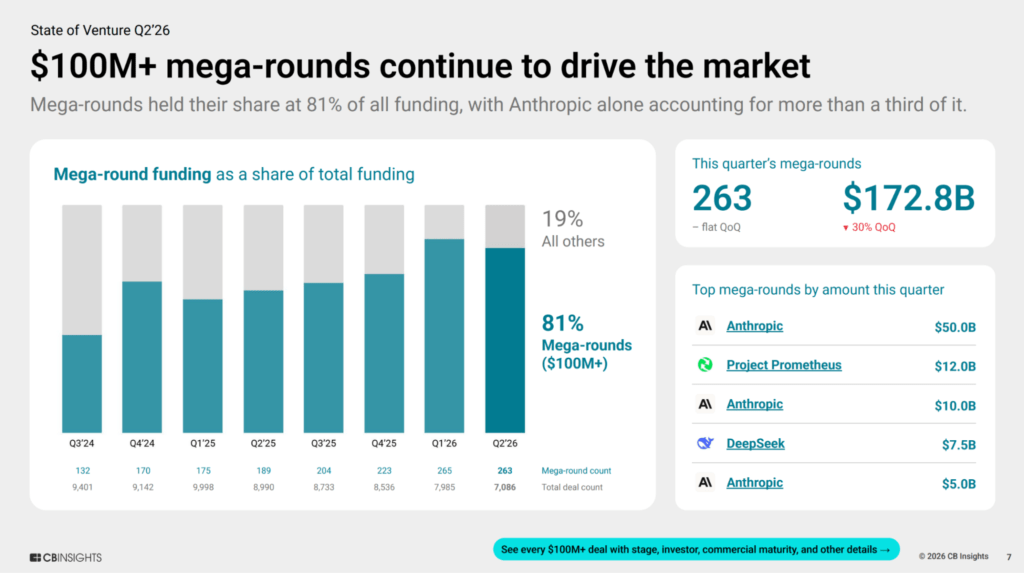
The current venture landscape is defined by extreme concentration. According to the latest data on Q2 2026 funding, total venture investment reached $212.9 billion—the second-highest quarter on record. However, this headline figure masks a deeper, more concerning reality for the broader startup ecosystem.
The Concentration Narrative
A significant portion of this liquidity is being sucked into a handful of "mega-rounds." In Q2 2026, the AI giant Anthropic alone accounted for over 33% of all global venture funding, securing $65 billion for a valuation approaching $1 trillion. When you combine this with the funding directed at other AI behemoths, it becomes clear that 81% of all venture dollars are now concentrated in a tiny fraction of companies.
For the average founder, the environment is harsh:
- Deal count: At a 10-year low.
- Exits: Have declined for two consecutive quarters.
- Capital availability: Startups outside of the "AI/Defense" mega-round category are effectively fighting over the remaining 19 cents of every dollar invested.
The lesson for the industry is stark: capital is no longer flowing toward speculative growth. It is flowing toward "sovereign-scale" companies that provide the essential infrastructure for the next decade—whether that is foundational AI models or the digital backbone of national defense.
Official Perspectives and Industry Implications
The pivot toward defense tech is not just a trend among VCs; it is a top-down mandate from government procurement offices. The primary challenge for startups like Helsing is no longer just raising money—it is navigating the labyrinthine, fragmented nature of European procurement.
The Procurement Hurdle
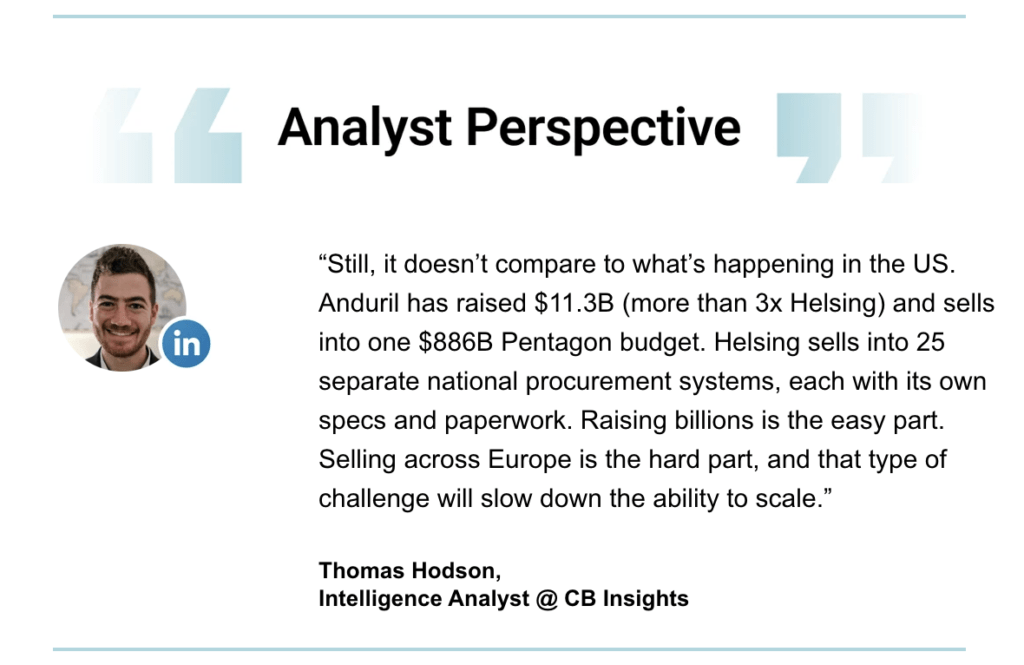
Unlike the United States, where the Department of Defense (DoD) operates under a singular, if complex, procurement umbrella, Europe is a patchwork of 27+ different systems. Scaling in Europe requires navigating a maze of national regulations, different language requirements, and varied budgetary cycles.
Analysts argue that the real "moat" for companies like Helsing isn’t just the $1.8 billion in the bank; it is the ability to integrate into these 25+ disparate procurement systems. If a startup can prove its technology works across the diverse requirements of the German, French, Polish, and Scandinavian defense ministries, it gains a competitive advantage that no amount of cash can buy.
The Future of European Sovereignty
This shift has profound implications for European tech policy. For years, Europe has been criticized for being a "regulatory superpower" rather than a "technological one." By embracing defense tech, European nations are attempting to reclaim their agency. The investment in Helsing and its peers represents a move toward:
- Technological Autonomy: Reducing reliance on U.S. or Chinese defense technology.
- Economic Resilience: Building high-value industrial clusters that create high-paying engineering jobs.
- Modernization: Replacing outdated, hardware-heavy military infrastructure with software-defined, AI-ready platforms.
Looking Ahead: The Road to 2027
As we look toward the remainder of the year and into 2027, the defense-tech sector will likely face increased scrutiny regarding the ethical deployment of AI. While the funding taps are open, the public and political discourse will undoubtedly shift toward the "black box" nature of military algorithms.
Companies like Helsing are already positioning themselves as leaders in this conversation, emphasizing that their software is designed to support human decision-makers, not replace them. However, as these companies become more integral to the defense posture of European nations, they will move from the periphery of the tech industry to the center of the political stage.
For investors, the playbook has changed. The era of betting on "growth at any cost" in the consumer internet space is over. We have entered the era of the "Sovereign Tech" investor—someone who understands that the highest-value companies of the next decade will be those that provide the digital foundation for global security.
Key Takeaways for Stakeholders:
- Focus on Integration: The success of a defense startup is increasingly tied to its ability to interoperate with legacy military hardware.
- Expect Market Consolidation: With so much capital flowing into a few winners, expect to see a wave of M&A activity where the "mega-winners" acquire smaller, niche technology players to bolster their portfolios.
- Policy is the New Product: Understanding the shifting regulatory landscape in the EU is just as important as writing code. Startups that can navigate the political nuances of European defense will be the ones that capture the next wave of government contracts.
As the dust settles on this $1.8 billion round, one thing is certain: the European defense tech sector has officially graduated from a fringe interest to the most important frontier in venture capital. The firms that can navigate the complexity of the European market will not only define the future of the continent’s security but will likely become the most valuable enterprises in the European technology ecosystem for decades to come.
For those interested in the competitive landscape, explore the Top 100 European AI, Aerospace, & Defense Startups to see which companies are challenging the incumbents and where the next major breakthroughs are likely to occur.