

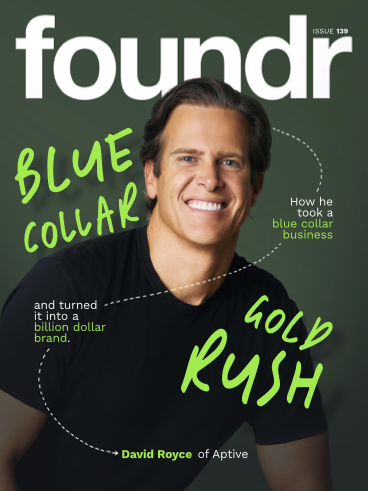
In the modern landscape of high-growth entrepreneurship, the narrative is often dominated by software-as-a-service, disruptive AI, and venture-backed tech unicorns. Yet, far from the polished boardrooms of Silicon Valley, David Royce has quietly built a billion-dollar empire in an industry that most business school graduates wouldn’t touch with a ten-foot pole: residential pest control.
Royce, the founder and chairman of Aptive Environmental, has defied conventional wisdom by turning a "dirty" business into a masterclass of scalable systems, elite sales training, and radical employee ownership. His journey from a student who struggled with undiagnosed ADHD to one of the most stealthy wealth builders in American business offers a profound lesson on the nature of opportunity, grit, and the hidden power of unsexy industries.
The Philosophy of the Unpopular
David Royce’s success is built on a singular theory: success isn’t about the industry you choose or the pedigree of your degree. It is about the willingness to perform tasks that others find unappealing—and to do them for long enough to become the absolute best in the world at them.
While his peers were chasing careers in investment banking and high-finance consulting, Royce spent his college summers knocking on doors in the heat, selling pest control services. It was an environment that many would consider beneath them, but for Royce, it was a crucible. He realized that while "image" is what society dictates, "opportunity" is what builds generational wealth.

A Chronology of Growth: From Doorsteps to Boardrooms
The Early Struggle: Persistence as a Superpower
Long before he was a CEO, Royce was a child who believed he wasn’t smart. "I struggled in school because I couldn’t focus unless I cared deeply," he recalls. It wasn’t until a sixth-grade teacher, Mrs. Luft, took a personal interest in him that he began to believe in his own capabilities.
As an adult, Royce learned that his struggle was actually ADHD—a condition he now views as a "double-edged sword." In mundane environments, it is a liability; in the high-stakes, high-intensity world of entrepreneurship, it is a superpower.
His entry into the pest control industry was accidental, triggered by a friend’s success stories. His first week on the job, however, was a disaster. He spent five days in Sacramento performing "free cardio"—knocking on doors without a single sale. While others made commissions, he made nothing. Instead of quitting, he spent the weekend in a bookstore, devouring sales manuals and building a study regimen. By the end of the summer, he was the top sales rookie in a company of 200, proving his mantra: Persistence is genius in disguise.
The Pivot: From Employee to Founder
In his final year of college, a mentor—who had just sold his own pest control business for $10 million—challenged Royce to start his own firm rather than join an investment bank. With $300,000 in savings, Royce launched his first venture. He didn’t reinvent the wheel; he optimized it. He applied his finance degree to the blue-collar model, identifying 30 key pain points in his mentor’s business and systematically fixing them.
The Scaling Phase and the Cash Flow Crisis
In his first year, Royce nearly went bankrupt—not because of a lack of sales, but because of too much success. His model required him to pay sales commissions upfront, while customer revenue arrived over the course of the year. He had projected 5,000 new customers; he closed 7,500.
This taught him a vital, often-overlooked lesson: "Revenues are vanity. Profits are sanity. But cash flow is reality." He had to negotiate with his own sales leaders, offering interest on their bonuses to buy himself the necessary time to balance the books. That scare transformed his financial strategy, turning a dangerous flaw into a permanent, ironclad structure used across four subsequent companies.
Supporting Data: Why Blue-Collar Wins
The numbers support Royce’s contrarian approach. According to data, roughly 43% of the top 0.1% of income earners in the United States—those making $2.3 million or more annually—are in "boring" blue-collar industries.
While tech trends fluctuate, fundamental needs do not. "Bugs don’t read The Wall Street Journal," Royce notes. These businesses are essential, offer recurring revenue, and are largely immune to the boom-and-bust cycles of the stock market. Furthermore, as millions of baby-boomer business owners reach retirement age, there is an unprecedented window of opportunity for operators who can implement modern systems into legacy service models.

Official Insights: The Pillars of Aptive
When asked how he managed to grow seven to ten times faster than his 20,000 competitors, Royce points to three specific strategic pillars:
- The Machine (Training): Aptive built a culture where sales reps were not just employees, but elite athletes. Competitors’ staff who moved to Aptive saw their productivity jump by 70% due to the company’s proprietary training modules.
- The Feedback Loop (Productivity): Royce’s field experience (knocking on over 60,000 doors) provided him with a "PhD" in homeowner complaints. He built a software platform that gamified the sales process, allowing for nationwide tournaments that lifted productivity by 30% on contest days.
- Ownership (Retention): Perhaps the most radical decision was the distribution of 25% of the company to employees. When the company hit $500 million in annual revenue, the resulting exit allowed many staff members to pay off mortgages and student loans. "Ownership," Royce notes, "is a far better retention tool than ping-pong tables."
Implications for Future Entrepreneurs
The Danger of the "Hero" Complex
For years, Royce was the primary engine of his companies. However, he realized that a true leader must eventually stop being the hero and start being the architect. This required the humility to step aside and let a long-time protégé take the reins as CEO. The lesson was clear: if you cannot be replaced, you haven’t built a company; you have built a dependency.
Trust, But Verify
Royce’s journey also highlights the risks of scaling too fast through external hires. When he brought in a high-profile CFO from a billion-dollar tech firm, the executive lacked the ground-level understanding of the business’s unique cash flow dynamics. The resulting forecast misses nearly derailed a multi-billion-dollar sale. The implication is clear: in service-based business, culture and operational expertise often outweigh a polished resume.
Redefining the Summit
When asked what he wants people to take from his journey, Royce reframes the very idea of success. He argues that entrepreneurship is not about the "exit" or the final bank balance. Instead, it is about the discipline, expertise, and character developed during the climb.
"If you don’t enjoy the climb, the summit is going to disappoint you," he warns. For Royce, the ultimate legacy isn’t the billion-dollar valuation of his pest control empire—it is the creation of new leaders who are now equipped to build their own empires.
Conclusion
David Royce’s trajectory serves as a potent reminder that the most significant business opportunities are rarely found in the spotlight. They are found in the overlooked, the unglamorous, and the essential. By ignoring the noise, embracing the grind, and obsessively refining the systems of a "dirty" business, Royce has demonstrated that the most sophisticated strategy is often the one that others are too proud to pursue. As we look toward the future of work, where AI may automate the office but cannot climb the roof, the model Royce built seems more relevant than ever.