As the global technology landscape navigates a period of profound capital reallocation, the second quarter of 2026 has provided a definitive roadmap for where institutional investors are placing their long-term bets. While overall deal volumes have cooled, the quality and strategic intent behind recent funding rounds suggest a market shifting from speculative growth to high-stakes, infrastructure-heavy utility.
From the clinical laboratories of AI drug discovery to the factory floors deploying wheeled humanoid robots and the experimental reactors designed to power the next generation of data centers, the narrative of 2026 is one of convergence: Artificial Intelligence is no longer just software; it is now the engine driving physical industry.
1. Digital Health: A Focus on Quality Over Quantity
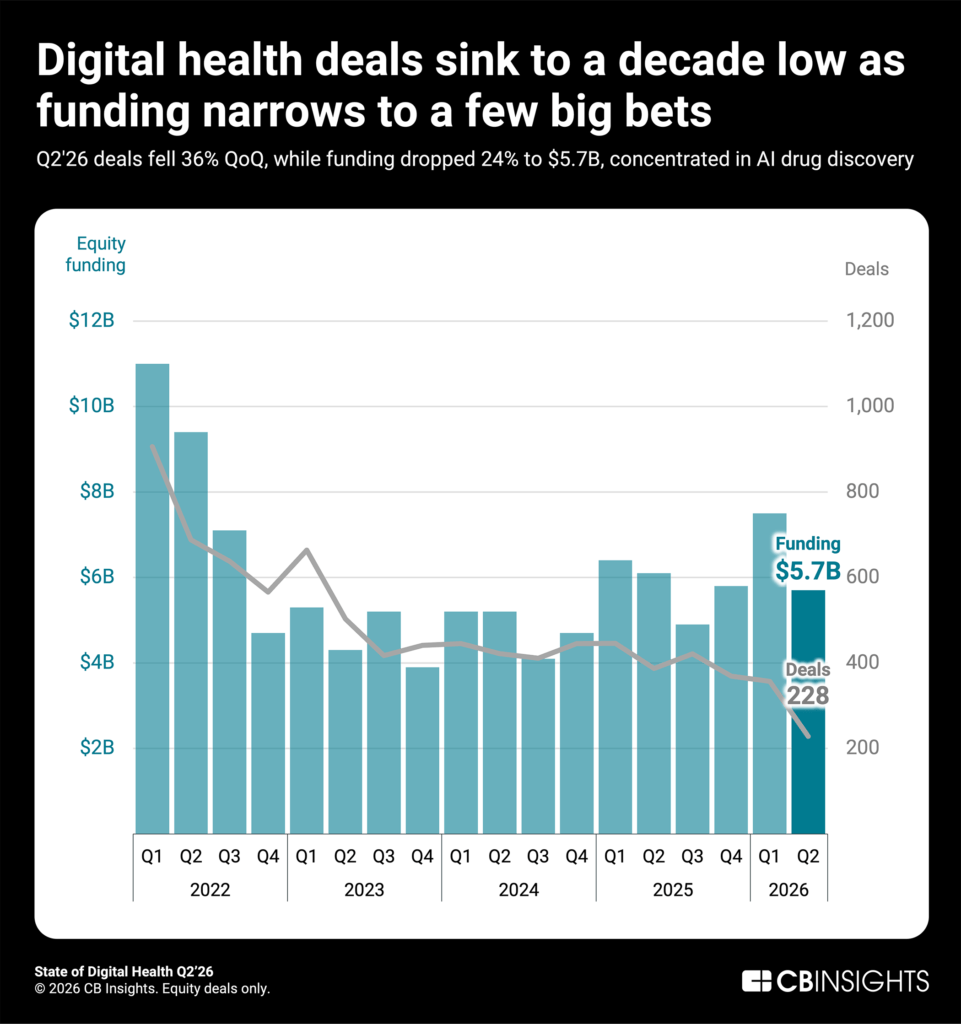
The digital health sector experienced a marked contraction in the second quarter of 2026, with deal activity plummeting 36% quarter-over-quarter. This represents the lowest volume of quarterly transactions in more than a decade. However, beneath the surface of these cooling numbers lies a more complex reality: funding is becoming more concentrated. Total capital deployed fell by 24% to $5.7 billion, but the remaining capital is being funneled into fewer, significantly larger rounds.
The Rise of AI in Pharma
The most notable trend within this contraction is the dominance of AI-driven drug discovery. Investors are increasingly bypassing broad digital health platforms in favor of high-moat, specialized companies that utilize machine learning to accelerate the pharmaceutical R&D cycle. The data indicates that the two largest funding rounds of the quarter were both secured by companies in the AI drug discovery space, signaling that institutional money views these firms as the most likely to achieve systemic impact—and, consequently, the highest ROI—within the healthcare value chain.
The shift reflects a broader maturation of the digital health market. After the "hype cycle" of the early 2020s, which saw funding spread thin across wellness apps and telehealth platforms, the current investment thesis is strictly utilitarian. The focus has moved to solving the "unsolvable" problems of biology through computational efficiency.
2. Humanoid Robotics: The Industrial "Unicorn" Milestone
The humanoid robotics sector reached a symbolic zenith this week as Humanoid, a European developer of wheeled robotic platforms, secured a $152 million Series A round, pushing its valuation to $1.35 billion. This move confirms a growing trend observed in our AI 100 research: the transition of humanoid robots from laboratory curiosities to essential industrial assets.

Strategic Partnerships as a Valuation Driver
What makes the Humanoid deal particularly instructive is the composition of its cap table. Unlike previous cycles, where venture capital firms drove valuations, the current humanoid wave is being fueled by industrial giants who are simultaneously becoming customers.
In the case of Humanoid, both Schaeffler and Bosch have stepped in as both investors and partners. The engagement goes beyond passive capital; Bosch is acting as a contract manufacturer to scale production, while Schaeffler has committed to purchasing thousands of wheeled units through 2032.
Why Equity Checks Matter
This "customer-as-investor" model serves as a vital signal of market validation. When a massive industrial firm like Schaeffler commits to long-term deployment, they are de-risking the startup for the broader market. This dynamic creates a "first-mover" advantage that transcends raw funding totals. In the race to commercial scale, the companies that align their product roadmaps with the procurement needs of the world’s largest manufacturing entities are the ones most likely to dominate the next decade.
3. The Power Paradox: Small Modular Reactors (SMRs)
Perhaps the most critical bottleneck for the ongoing AI revolution is not computing power or software optimization—it is electricity. As data centers consume an increasingly large share of the global energy supply, the grid is proving insufficient. This has triggered an aggressive, capital-intensive pivot toward Small Modular Reactors (SMRs).
The Antares Nuclear Milestone
Antares Nuclear recently closed a $470 million Series C funding round, a significant capital infusion designed to facilitate the construction of small-scale reactors tailored for military infrastructure. Antares is one of three Department of Energy (DOE) pilot winners, and its success is indicative of a broader trend: the intersection of national security, energy independence, and the voracious power requirements of Large Language Models (LLMs).
The Data Behind the Energy Pivot
The momentum in SMR funding is undeniable. While 2025 set a record with $2.4 billion in total funding for the sector, 2026 is on a blistering pace to reach $1.7 billion. This represents the second-highest annual total in history, despite the fact that these technologies remain largely in the pilot phase.
Most of these reactors are not projected to reach operational scale until the early 2030s. This creates a fascinating disconnect: investors are pricing in a long-term energy deficit today, betting that the infrastructure built now will be the primary utility for the AI-driven economy of the next decade.
4. Chronology: A Shift in Market Sentiment
- Q1 2026: Initial signs of a slowdown in digital health transaction volume appear, as investors signal a pivot toward "profitable growth" models.
- April 2026: The AI 100 report is released, identifying the industrial integration of humanoid robots as a key sector to watch.
- May 2026: Data center power demand spikes, causing renewed interest from institutional investors in the DOE’s small reactor pilot programs.
- June 2026: AI drug discovery firms dominate the top-tier funding charts, solidifying the trend of "specialized" AI investment.
- July 2026: Humanoid reaches unicorn status with strategic backing from Bosch and Schaeffler; Antares Nuclear secures $470M, reinforcing the energy-infrastructure link.
5. Official Perspectives and Industry Implications
Industry analysts and institutional investors alike are interpreting these moves as a "flight to reality." The overarching implication of the current investment landscape is that the "AI Gold Rush" has entered its second phase: the infrastructure phase.
The Implications for Future Tech
- The "Platformization" of Biology: Drug discovery is becoming a software-led industry. As AI models become more adept at protein folding and molecular simulation, the barrier to entry for pharmaceutical research is lowering, yet the cost of compute is rising.
- Industrial Robotics at Scale: The wheeled humanoid robot represents a bridge technology. It is more cost-effective and easier to integrate into existing factories than bipedal robots, making it the most likely candidate for immediate mass deployment.
- The Nuclear-Compute Synergy: The future of AI is tethered to nuclear energy. If SMRs cannot be deployed at scale, the scalability of AI models will be capped by local grid capacities. The current influx of capital into SMRs is effectively a hedge against the energy-limited growth of the entire tech sector.
A New Era of Due Diligence
For founders and investors, the lesson is clear: capital is no longer chasing "the next big thing" in software; it is chasing the solutions to the physical-world bottlenecks created by that software. Whether it is a robot that can work in a factory or a reactor that can run a data center, the winners of the next five years will be those who can bridge the gap between digital intelligence and physical execution.
As the industry looks toward the remainder of 2026, the question is no longer who has the best algorithm, but who has the most reliable power source, the most scalable robot, and the most efficient biological data pipeline. The era of pure-play software growth is being replaced by the era of tech-enabled infrastructure—a shift that will define the market for the next decade.