Shopify has once again delivered a masterclass in scale, reporting a powerhouse second quarter for 2026. The e-commerce giant’s latest financial disclosures reveal a company that is successfully navigating the transition from a pure-play subscription software provider to a diversified global financial technology ecosystem. With growth metrics consistently exceeding 30% across the board, Shopify’s performance signals not only the health of its merchant base but the deepening integration of its financial services into the global digital economy.
Main Facts: The Growth Engine at Scale
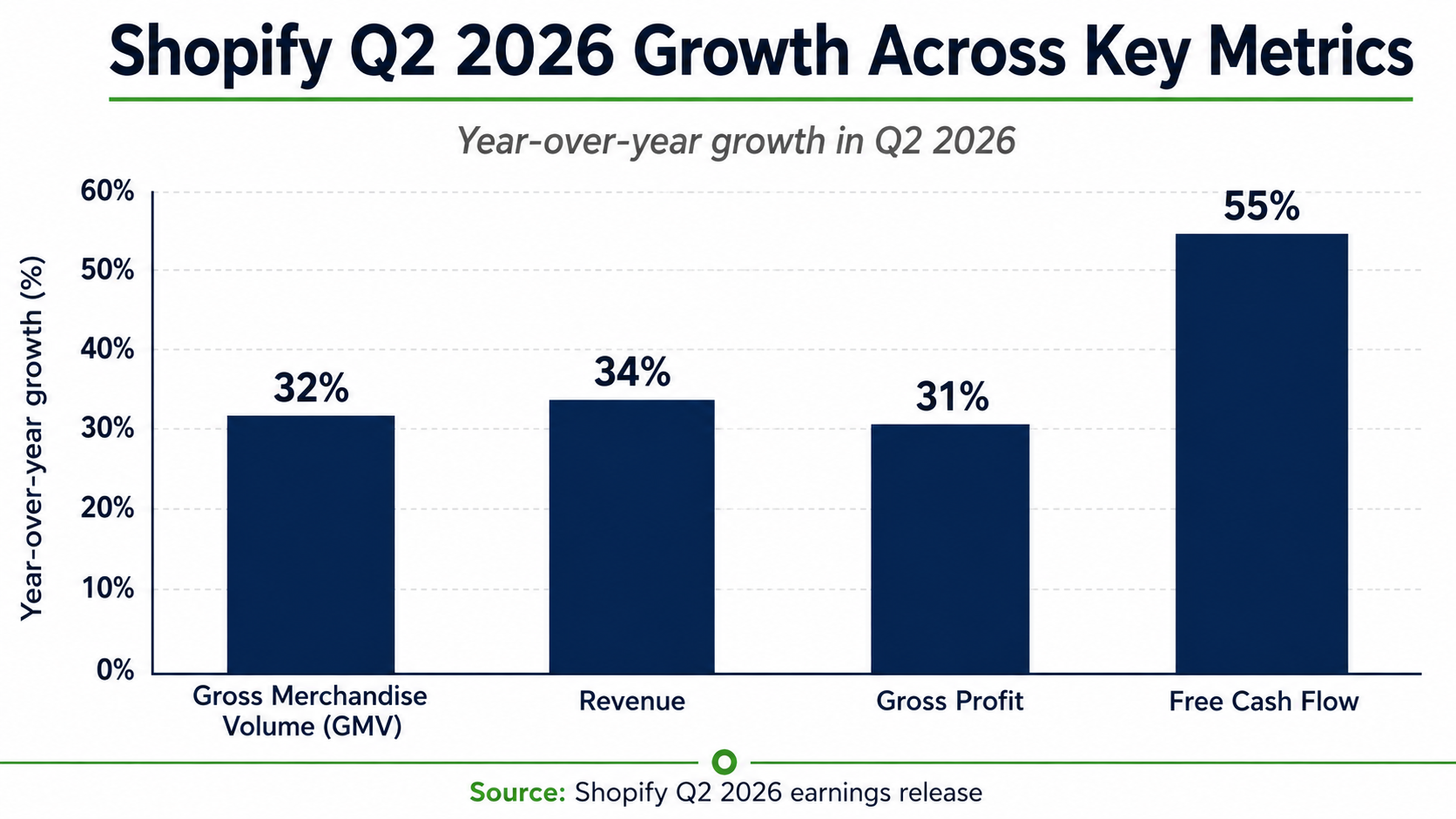
The Q2 2026 earnings release paints a picture of a company operating at an immense scale while maintaining the growth velocity of a startup. Shopify reported a 34% year-over-year increase in revenue, climbing to $3.58 billion. This surge was underpinned by a robust $115.6 billion in Gross Merchandise Volume (GMV), a 32% increase from the $87.8 billion reported in the same period last year.
Perhaps most impressively, the company’s profitability metrics have kept pace with its top-line expansion. Gross profit rose 31% to $1.71 billion, and, significantly, free cash flow (FCF) climbed 55% to $654 million. This indicates that Shopify is not merely buying growth through aggressive spending; it is scaling its operational efficiency. The FCF margin expansion from 16% to 18% is a critical indicator for investors, suggesting that as the company grows, its underlying infrastructure becomes increasingly lucrative.
Chronology: The Trajectory of 2026
To understand the current performance, one must look at the progression of 2026. The year began with a milestone achievement: in Q1 2026, Shopify crossed the $100 billion quarterly GMV threshold for the first time. The momentum from Q1 carried directly into the second quarter, where the company saw another 34% revenue jump.

The consistency of this performance is noteworthy. Throughout the first half of the year, the strategic pivot toward "Merchant Solutions"—which includes payments, capital, and shipping—has consistently outpaced the growth of the legacy "Subscription Solutions" model. By the end of Q2 2026, the company’s Monthly Recurring Revenue (MRR) had reached $221 million, a steady climb from the $185 million reported in Q2 2025. This chronology confirms that Shopify’s transition is not a reactionary measure but a calculated, long-term strategic evolution.
Supporting Data: The Merchant Solutions Dominance
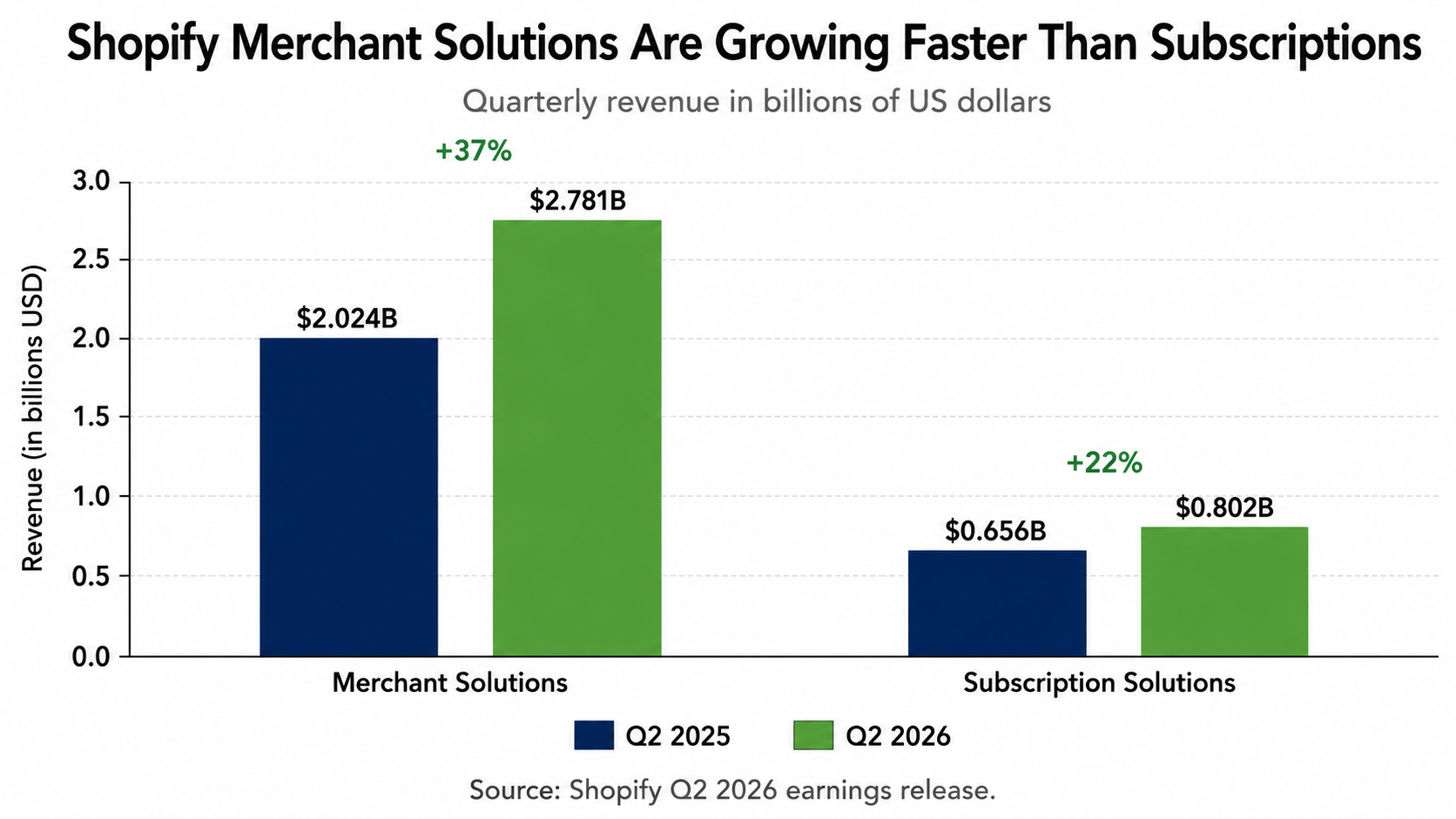
The divide between Shopify’s two primary revenue streams has never been more apparent. Merchant Solutions, the suite of tools that includes payment processing, shipping labels, POS hardware, and financial services like Shopify Capital, generated $2.78 billion in Q2 2026. This represents a 37% year-over-year growth. In contrast, Subscription Solutions—the recurring fees paid for platform access—grew by 22%, totaling $802 million.
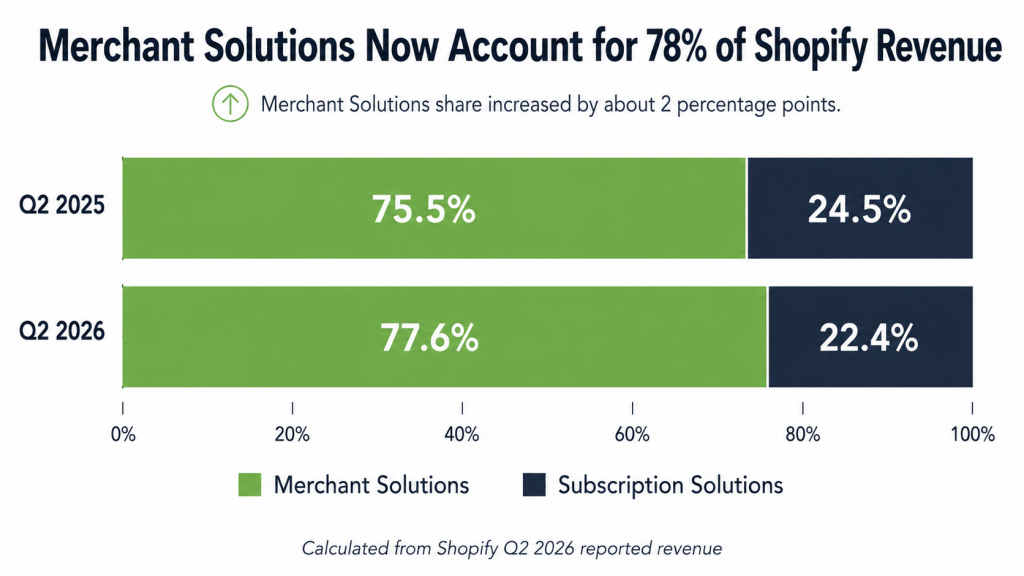
This structural shift means that Merchant Solutions now accounts for approximately 78% of Shopify’s total quarterly revenue, up from 75.5% in the prior-year period.
The Payments Engine
At the heart of this growth is Shopify Payments. The data shows that the "Merchant Solutions" category is heavily reliant on the payment processing volume flowing through the platform. Specifically, Shopify attributed $624 million of the $757 million total increase in Merchant Solutions revenue directly to Shopify Payments.
The penetration rate—the percentage of total GMV processed through Shopify’s native payment tools—hit 68% in Q2 2026, up from 64% in Q2 2025. In absolute terms, the volume processed via Shopify Payments rose from $56.6 billion to $78.1 billion, an increase of 38%. This metric is the "North Star" for the company’s future revenue stability; the more merchants rely on Shopify to handle the financial plumbing of their business, the stickier the platform becomes.
Official Responses and Strategic Directions
Shopify’s management has remained focused on balancing the rapid expansion of its fintech offerings with the complex needs of enterprise-level commerce. The company’s Spring ’26 product release serves as the primary window into these priorities.
The B2B Frontier
A key area of debate has been the role of Business-to-Business (B2B) commerce in Shopify’s future. The Spring ’26 release introduced significant updates, including automated vaulted payments for B2B customers. These tools allow for complex payment terms (Net 30, Net 60, etc.) to be managed directly within the Shopify ecosystem, synced with enterprise accounting software like QuickBooks.
While some analysts have attempted to categorize the company’s commitment to B2B by the number of features announced, Shopify’s official stance emphasizes a broader, integrated approach. With $445 million spent on Research and Development in Q2 alone, the company is investing heavily in AI, checkout, and international commerce alongside B2B. Management maintains that the "feature count" of a release is a poor proxy for R&D allocation, as the platform’s underlying infrastructure—like its checkout engine—supports all segments simultaneously.
Implications: A New Era for E-commerce Platforms
The implications of these results for the broader e-commerce industry are profound.
1. The Death of the "Pure SaaS" Model
Shopify’s transition suggests that the future of e-commerce software is inherently tied to financial services. As platforms reach a certain scale, charging a flat subscription fee becomes an insufficient way to capture the value created on the platform. By "taxing" the transaction through payment processing and related financial services, Shopify aligns its incentives directly with the success of its merchants. If the merchants make more money, Shopify’s take-rate and volume naturally increase.
2. Operational Efficiency
The increase in free cash flow margins to 18% proves that the "scale-at-all-costs" era of the post-pandemic years has been replaced by a focus on sustainable, high-margin operations. By building a robust payments infrastructure, Shopify is creating a moat that is difficult for traditional software competitors to bridge. It is no longer just selling a website builder; it is selling the infrastructure of a modern digital business.
3. Future Guidance and Market Sentiment
Looking ahead, Shopify’s guidance for Q3 2026 remains bullish. The company expects revenue to continue growing at a low-thirties percentage rate, with gross profit dollars growing at a mid-to-high twenties percentage rate. This forward-looking confidence suggests that the company does not anticipate a material slowdown in consumer spending or a saturation of its merchant acquisition pipeline.
4. The "Platform-as-a-Fintech" Paradox
The primary risk for Shopify moving forward is the increasing complexity of its financial services. As the company leans further into B2B payments, capital lending, and global currency conversion, it assumes more credit and operational risk. However, as of Q2 2026, the data suggests that these risks are being managed effectively.
Conclusion
Shopify’s Q2 2026 report is a testament to a company successfully reinventing itself while in motion. By shifting the weight of its business model from subscription fees to transaction-based "Merchant Solutions," Shopify has fundamentally changed its relationship with its customers. It has transformed from a tool that merchants use to a partner that merchants rely on to function. As the company continues to scale toward the latter half of 2026, all eyes will remain on the penetration rates of its payment tools and the success of its B2B enterprise push. If the current trajectory holds, Shopify is on track to cement its status not just as a retail platform, but as the central nervous system of global digital commerce.