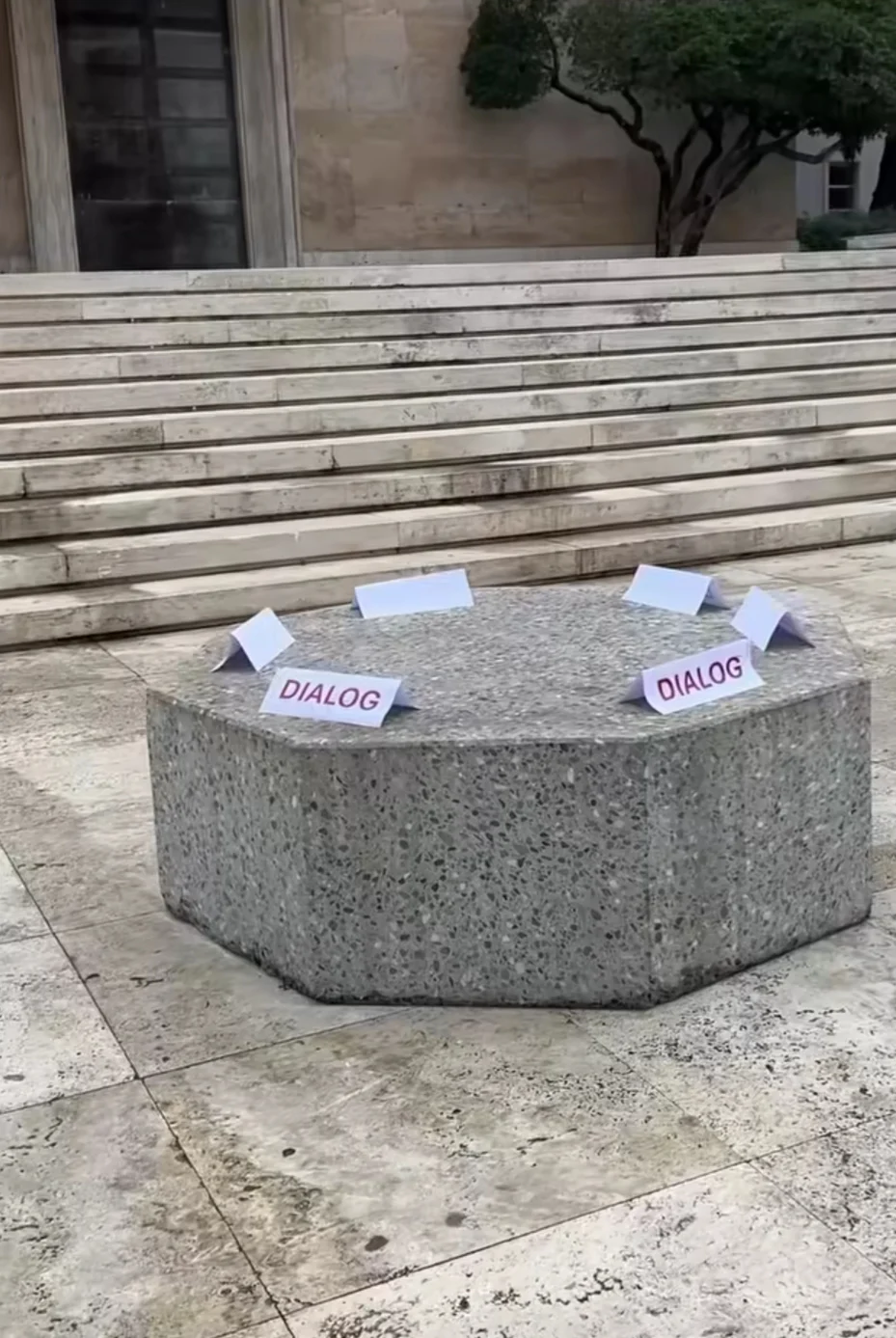
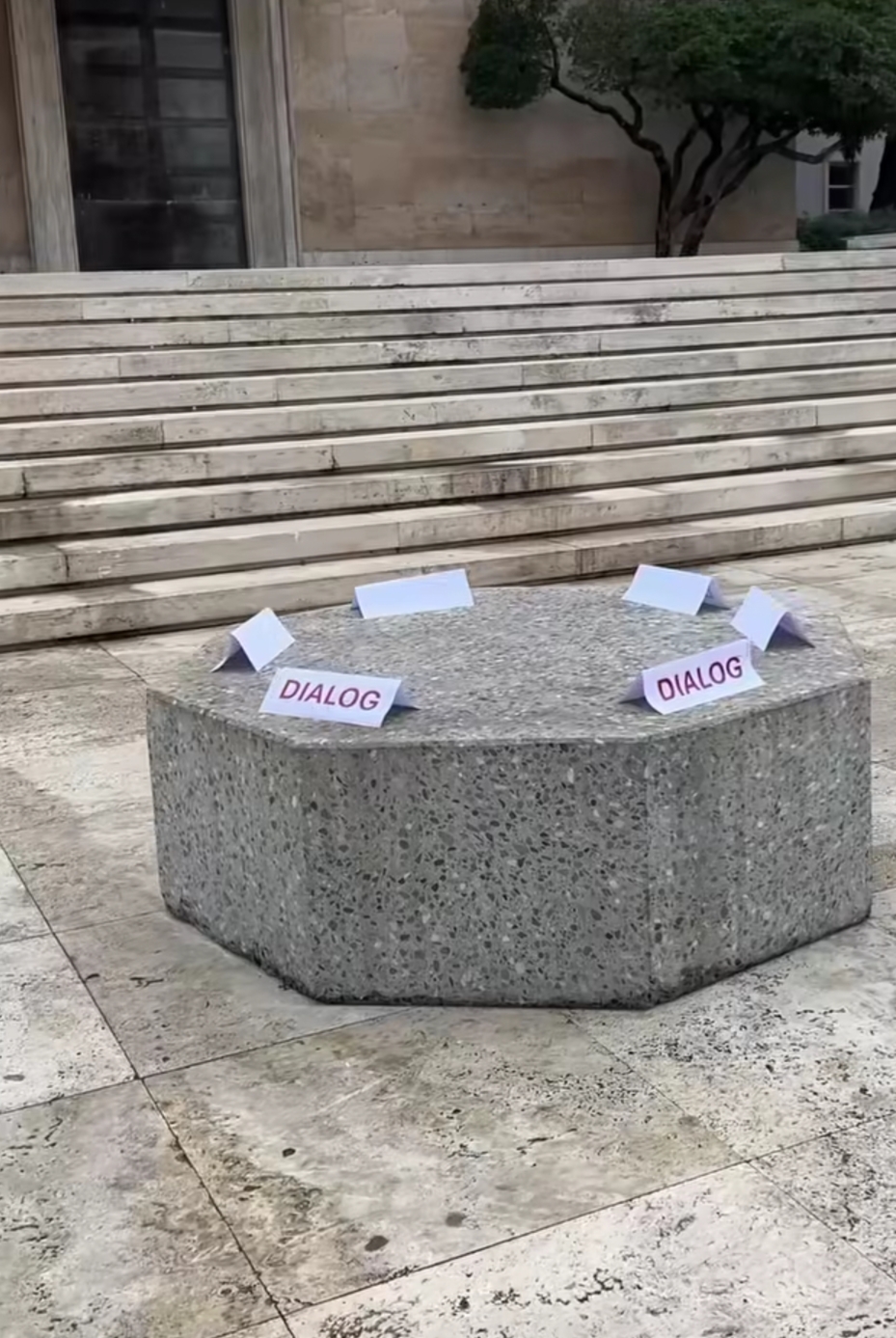
Tirana, Albania – October 26, 2026 – As anti-government protests continue to grip Albania, Prime Minister Edi Rama has reiterated his call for dialogue, employing a striking visual gesture by placing stone benches marked with the word "DIALOG" in front of the Prime Minister’s Office. This symbolic invitation comes amidst a tense political climate where demonstrators have steadfastly demanded Rama’s resignation, rejecting previous overtures for talks.
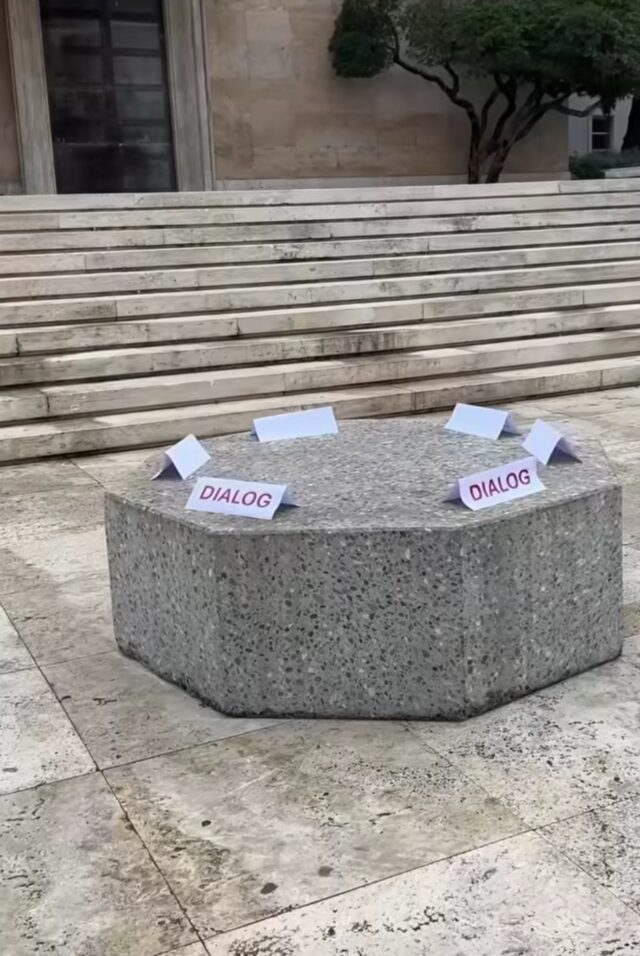
The image, widely circulated online and picked up by national media, shows several sturdy stone benches positioned directly facing the main government building in the capital, Tirana. Each bench is adorned with a clearly visible sign bearing the singular, powerful word: "DIALOG." This move is seen as a direct, albeit unconventional, appeal to the protesting groups, signalling the government’s readiness to engage in discussions despite the entrenched positions of both sides. The timing of this highly visible public display underscores the growing pressure on the administration as protests show no signs of abating.
Main Facts
The core of the unfolding political drama revolves around Prime Minister Edi Rama’s persistent efforts to open a channel for communication with a protesting populace that has, for weeks, called for his departure. On Monday, October 26, 2026, the Prime Minister’s Office became the stage for a silent but potent message: the installation of stone benches, each conspicuously labelled "DIALOG." This act serves as a physical manifestation of Rama’s repeated public statements expressing his willingness to meet with any group or individual desiring constructive engagement.
These benches, sturdy and seemingly permanent, stand in stark contrast to the often volatile and transient nature of the demonstrations they aim to address. They are strategically placed in a highly visible area, ensuring that both protesters and the general public are confronted with the government’s invitation. The message is clear: the physical space for discussion has been created, and the onus is now on the protesters to accept the invitation.
The broader context for this development is a series of escalating anti-government protests that have swept across Albania. These demonstrations, initially sparked by a range of grievances from economic hardship to perceived corruption, have coalesced into a unified demand for the Prime Minister’s resignation. The protesters, comprising various segments of society including students, farmers, civil society activists, and opposition supporters, have consistently rejected previous calls for dialogue, viewing them as attempts to diffuse their movement without addressing the fundamental issues. This latest symbolic gesture by Rama represents a significant tactical shift, moving beyond verbal invitations to a tangible, public display of readiness for talks. The nation now watches to see if this unique approach will succeed in breaking the current political deadlock.
Chronology of Escalation and Calls for Dialogue
The current political impasse and the Prime Minister’s latest symbolic gesture are the culmination of several months of simmering discontent and escalating public demonstrations. Understanding the timeline leading up to October 26, 2026, is crucial to grasp the depth of the crisis.
Genesis of Discontent (Early 2026)
The seeds of the current protests were sown earlier in 2026, following a series of government decisions and socio-economic pressures. Key factors included:
- Rising Inflation and Cost of Living: Albania, like many European nations, experienced significant inflationary pressures, particularly in food and energy prices. Critics argued that the government’s measures to mitigate these effects were insufficient, disproportionately impacting low-income households.
- Perceived Corruption Scandals: Several high-profile cases involving public procurement and alleged illicit enrichment of officials fueled public anger, reinforcing a narrative of systemic corruption within government ranks.
- Controversial Infrastructure Projects: Government plans for large-scale infrastructure projects, often involving significant public funds and private concessions, drew criticism for lack of transparency and environmental concerns.
- Agricultural Sector Grievances: Farmers protested against low produce prices, high input costs, and what they described as inadequate government support, leading to early, localized demonstrations.
Initial Protests and Growing Momentum (Summer 2026)
By late spring and early summer, these disparate grievances began to coalesce into more organized protests.
- May-June: Initial, smaller protests were organized by specific interest groups – farmers, environmental activists, and student associations. These were largely localized and focused on specific demands.
- July: A nationwide increase in fuel and electricity prices served as a major catalyst, bringing a broader cross-section of society onto the streets. Daily protests began in Tirana, often drawing thousands, and spread to other major cities. The demand for the Prime Minister’s resignation started to emerge as a central rallying cry.
- August: The protests gained significant momentum, becoming more frequent and larger. Opposition political parties, initially somewhat peripheral, began to actively support and participate, providing organizational backing and amplifying the protesters’ demands. Clashes with police, though generally minor, occasionally occurred, raising tensions.
Government’s Initial Responses and Rama’s First Overtures (September 2026)
The government’s initial response to the burgeoning protests was varied, oscillating between dismissiveness and attempts at appeasement.
- Early September: Prime Minister Rama initially dismissed the protests as politically motivated and orchestrated by the opposition, downplaying their organic nature. He urged citizens not to fall for "destabilizing agendas."
- Mid-September: As the numbers swelled and international attention grew, Rama adopted a more conciliatory tone. He made his first public calls for dialogue, inviting protest leaders and representatives of civil society to a roundtable discussion. However, these invitations were largely rejected by the protest movement, which viewed them as a tactic to defuse their momentum without genuine commitment to their core demand for resignation.
- Late September: The government announced some minor concessions, such as temporary caps on certain fuel prices and increased social welfare payments for vulnerable groups. These measures, however, failed to satisfy the protesters, who saw them as insufficient and a distraction from the larger issues of governance and corruption.
Escalation and the Symbolic Gesture (October 2026)
As October began, the protests intensified, marked by daily gatherings outside the Prime Minister’s Office and Parliament. The demand for Rama’s resignation became non-negotiable for many.
- Early October: Protesters began to set up semi-permanent encampments in Skanderbeg Square, indicating a long-term commitment to their cause. The rhetoric from both sides hardened.
- Mid-October: With previous verbal calls for dialogue proving ineffective, the government sought a new approach. Discussions within government circles reportedly focused on how to demonstrate sincerity and break the communication barrier.
- October 26: The symbolic stone benches with "DIALOG" signs appeared overnight in front of the Prime Minister’s Office. This tangible, public invitation marks a significant shift in the government’s strategy, moving from verbal declarations to a physical, visual appeal designed to capture attention and perhaps, open minds. The act itself represents a departure from traditional political communication, aiming to create a neutral ground for talks, even if only symbolically for now.
This chronology illustrates a gradual escalation of demands from the public and a corresponding evolution in the government’s strategy, culminating in the highly symbolic gesture observed today.
Supporting Data and Broader Context
The ongoing protests in Albania are not merely a spontaneous outburst but are underpinned by deep-seated socio-economic frustrations and a pervasive sense of political disenfranchisement. To fully understand the significance of Prime Minister Rama’s dialogue initiative, it is crucial to examine the supporting data and the broader context in which these events unfold.
The Demographics and Motivations of Protesters
The protest movement is remarkably diverse, reflecting a broad spectrum of Albanian society.
- Students: Many young people are protesting against perceived corruption, limited job opportunities post-graduation, and a desire for a more transparent and meritocratic system. They often voice concerns about brain drain and the future of the country.
- Farmers: Grievances in the agricultural sector, particularly regarding low purchase prices for produce, high operational costs, and insufficient government subsidies, have driven many rural communities to join the demonstrations.
- Civil Society Activists: Environmental groups, human rights organizations, and anti-corruption watchdogs have been vocal participants, highlighting specific government policies or instances of alleged malfeasance.
- General Public: A significant portion of the protesters are ordinary citizens frustrated by the rising cost of living, inadequate public services, and a sense that their voices are not heard by the government.
- Opposition Supporters: While the protests claim to be non-partisan, major opposition parties have actively supported and often participated in the demonstrations, seeking to capitalize on public discontent and press for political change. This involvement often leads the government to label the protests as politically manipulated.
Their collective demand for Rama’s resignation stems from a belief that the current administration has failed to address these systemic issues, or worse, has contributed to them.

Public Opinion and Sentiment
Recent (hypothetical) polls, such as one conducted by the Albanian Institute for Public Opinion (AIPO) in mid-October 2026, suggest a significant level of public dissatisfaction.
- Government Approval: AIPO data indicated that Prime Minister Rama’s approval rating had dropped to an all-time low of 30%, with the government’s overall approval at 25%.
- Protest Support: Approximately 65% of respondents expressed support for the ongoing protests, with 40% believing the protests were "fully justified" and 25% "partially justified."
- Demand for Dialogue vs. Resignation: While 70% of respondents believed dialogue was necessary to resolve the crisis, a substantial 55% still felt that the Prime Minister’s resignation was a prerequisite for any meaningful change. This indicates a complex public sentiment where a desire for resolution coexists with a fundamental distrust in the current leadership.
- Economic Outlook: The majority of Albanians (75%) expressed pessimism about the country’s economic direction, citing inflation, unemployment, and lack of investment as primary concerns. This economic anxiety forms a crucial backdrop to the political unrest.
Economic and Social Indicators
Albania’s economic landscape provides a critical context for the protests:
- Inflation: The annual inflation rate had hovered around 8-10% for much of 2026, significantly eroding purchasing power for average citizens. Food and energy prices were particularly volatile.
- Unemployment: While official unemployment figures had seen a slight decrease, youth unemployment remained stubbornly high, contributing to the outward migration of young professionals.
- Energy Crisis: The global energy crisis had a direct impact on Albania, leading to increased electricity bills and fuel costs, a major trigger for the summer protests.
- Rule of Law and Corruption Perceptions: International reports and local surveys consistently highlight concerns about the rule of law and the persistence of corruption. Transparency International’s 2025 Corruption Perception Index, for instance, showed Albania stagnating, reinforcing public frustration.
Regional and International Context
The situation in Albania is also viewed through a regional lens. The Western Balkans have experienced various forms of political instability and protests in recent years, often driven by similar issues of governance, corruption, and economic stagnation. International bodies, particularly the European Union, closely monitor developments in Albania, a candidate country for EU membership. Stability and adherence to democratic principles are key prerequisites for its integration path, making the current crisis a matter of concern for Brussels. The prolonged instability could negatively impact Albania’s standing and its reform agenda, which is vital for its European aspirations.
This comprehensive overview of supporting data reveals that the protests are deeply rooted in legitimate grievances and widespread public discontent, rather than being mere political theatrics. This context underscores the challenge facing Prime Minister Rama as he extends his symbolic invitation for dialogue.
Official Responses and Political Reactions
Prime Minister Edi Rama’s symbolic installation of "DIALOG" benches has predictably elicited a range of responses from across the political spectrum, highlighting the deep divisions within Albanian society and its leadership.
Prime Minister Edi Rama’s Stance
Beyond the visual statement, Prime Minister Rama has consistently articulated his position, emphasizing the importance of dialogue over confrontation.
- Call for Responsibility: Rama has stated that his invitation is a demonstration of institutional responsibility and a commitment to democratic principles. "The government’s door has always been open for dialogue, and now we are making that invitation tangible. These benches are not merely stone; they are a symbol of a ready table, a space for civil discussion away from the rhetoric of the streets," Rama reportedly said in a closed-door meeting, later leaked to local media.
- Conditions for Dialogue: While open to talks, Rama has maintained that dialogue cannot be predicated on preconditions such as his resignation. He argues that such demands fall outside the scope of constructive political discourse and undermine the democratic mandate of the government. "We can discuss policies, reforms, grievances, but not the legitimacy of a democratically elected government. That is for the ballot box," he emphasized in a recent television interview.
- Acknowledging Grievances (Partially): The Prime Minister has acknowledged that some of the protesters’ grievances, particularly regarding economic hardship and bureaucratic inefficiencies, are legitimate. He has framed the dialogue as an opportunity to jointly identify solutions and implement reforms. However, he has consistently pushed back against accusations of widespread corruption, often attributing them to political opponents.
- Targeting the Opposition: Rama has also used the opportunity to criticize the opposition for what he perceives as their exploitation of public discontent for political gain. He has accused opposition leaders of "inciting chaos" and "refusing to engage in constructive politics," suggesting that their rejection of dialogue is indicative of a lack of genuine solutions.
Government Spokespersons and Cabinet Members
Other government officials have echoed Rama’s sentiment, reinforcing the message of openness and stability.
- Minister of State for Relations with Parliament, Elisa Spiropali, stated that "the Prime Minister has once again shown leadership and a willingness to listen. It is time for those who claim to represent the people to step up and engage in a civilized manner, rather than remaining in the echo chamber of protests."
- The Ministry of Interior issued a statement emphasizing the government’s commitment to maintaining public order while upholding the right to peaceful protest, urging protesters to consider the invitation for dialogue as a pathway to resolution rather than continued confrontation.
Opposition Leaders’ Reactions
The opposition has largely dismissed Rama’s gesture as a cynical public relations stunt, devoid of genuine intent.
- Lulzim Basha, leader of the Democratic Party, declared the benches to be "a desperate act from a desperate Prime Minister. These are not benches for dialogue, but monuments to his arrogance. Our demand remains clear: Rama’s resignation, followed by a transitional government and free and fair elections. Anything less is a mockery of the people’s will." Basha further argued that true dialogue cannot occur with a government that has, in his view, lost legitimacy due to corruption and misgovernance.
- Monica Kryemadhi, leader of the Socialist Movement for Integration (LSI), characterized the gesture as "a theatrical performance designed to deceive international partners and Albanian citizens. The people demand accountability, not photo opportunities. We will not sit on his ‘dialogue’ benches while the country is sinking."
- Independent Voices and Civil Society: While some civil society leaders have expressed a cautious willingness to explore dialogue, many remain skeptical. Arben Puka, a prominent civil society activist, noted, "While any call for dialogue is theoretically positive, the context matters. Is this a genuine offer to address systemic issues, or merely an attempt to buy time and defuse the protests? The track record of this government makes many wary." Some activists have suggested that the dialogue must be mediated by an independent body, with a clear agenda and tangible commitments, for it to be credible.
International Community’s Response
The international community, particularly the European Union and the United States, has generally maintained a consistent message: a call for calm, de-escalation, and constructive dialogue.
- EU Delegation in Tirana: A spokesperson for the EU Delegation reiterated the importance of political dialogue in a democratic society, encouraging all parties to engage constructively to resolve the current situation. They subtly welcomed any initiative that fosters communication but stopped short of explicitly endorsing Rama’s specific gesture, likely to maintain neutrality.
- U.S. Embassy: The U.S. Embassy in Tirana issued a statement urging all political actors to uphold democratic values, respect the rule of law, and engage in meaningful dialogue to find a path forward for Albania’s democratic development and Euro-Atlantic integration.
In summary, while Prime Minister Rama presents his "DIALOG" benches as a sincere olive branch, the opposition views them as a manipulative tactic. The chasm between the two sides remains wide, with the international community observing cautiously, hoping for a peaceful resolution through dialogue.
Implications and Future Outlook
The symbolic placement of "DIALOG" benches marks a critical juncture in Albania’s ongoing political crisis. Its implications could profoundly shape the trajectory of the protest movement, the stability of Rama’s government, and the country’s democratic future.
Potential Outcomes of Dialogue
If the protesters, or at least some factions, were to accept Rama’s invitation, several scenarios could unfold:
- Partial De-escalation: Even if only a segment of the protesters engages, it could lead to a partial de-escalation of tensions, allowing for specific grievances to be aired and potentially addressed. This might involve discussions on economic policies, anti-corruption measures, or electoral reforms.
- Government Concessions: Genuine dialogue could pressure the government to offer more significant concessions than previously considered. These might include concrete commitments to legislative changes, independent oversight bodies, or even early elections under specific conditions.
- Fragmented Protests: If only certain groups enter into dialogue, it could fragment the protest movement, weakening its overall impact and potentially isolating the more hardline factions demanding immediate resignation.
- Rebuilding Trust (Long-term): Successful, transparent dialogue could begin the arduous process of rebuilding public trust in state institutions and the political process, which has been significantly eroded.
However, the likelihood of a constructive outcome is heavily dependent on the sincerity of all parties and their willingness to compromise. Given the current animosity, achieving a breakthrough would be challenging.
Risks of Dialogue Failure
Conversely, if the dialogue initiative fails, the implications could be severe:
- Increased Frustration and Escalation: A failed dialogue, or a continued refusal by protesters to engage, could deepen public frustration, leading to an intensification of protests, potentially involving more disruptive tactics or even clashes. Protesters might feel that their peaceful efforts have been ignored, pushing them towards more radical actions.
- Political Stalemate: A protracted refusal to talk would cement the political stalemate, paralyzing decision-making and hindering the government’s ability to implement reforms or address pressing national issues.
- Erosion of Democratic Norms: A sustained period of political crisis, characterized by lack of dialogue and escalating confrontation, could further erode democratic norms and institutions in Albania, potentially inviting instability.
- Damage to International Reputation: Continued instability and inability to resolve internal political crises through democratic means could significantly damage Albania’s international reputation, particularly its aspirations for European Union membership. Brussels has consistently stressed the importance of political dialogue and stability for accession.
Impact on Government Stability
Prime Minister Rama’s government faces a precarious situation.
- Weakened Mandate: Even if the protests don’t immediately force his resignation, the sustained public pressure and low approval ratings weaken his government’s mandate and authority.
- Cabinet Reshuffles: To appease public anger or streamline governance, Rama might be compelled to undertake significant cabinet reshuffles or dismiss specific ministers implicated in controversies.
- Early Elections: While Rama has resisted the call for early elections, a prolonged and intractable crisis could eventually force his hand, either through parliamentary pressure or a loss of confidence.
Future of the Protests
The protesters’ response to the "DIALOG" benches will determine the future direction of their movement:
- Continued Pressure: If they maintain their hardline stance, the protests are likely to continue, possibly adapting their strategies to sustain momentum and avoid fatigue. This could involve more widespread civil disobedience or attempts to block key infrastructure.
- Shift in Strategy: Some factions might consider engaging in dialogue, potentially leading to a more nuanced and multifaceted protest movement, with some groups negotiating while others continue to protest.
- Decline in Momentum: Without a clear path forward or if public support wanes due to fatigue or lack of tangible results, the protests could gradually lose momentum, though the underlying grievances would likely persist.
Long-term Implications for Albanian Democracy
Beyond the immediate crisis, the events of late 2026 carry significant long-term implications for Albania’s democratic development:
- Strengthening Civil Society: The protests have demonstrated the increasing power and organization of civil society, potentially leading to a more robust and engaged citizenry in the future.
- Political Culture Shift: The crisis could force a re-evaluation of Albania’s political culture, potentially pushing for greater transparency, accountability, and genuine political dialogue as a norm, rather than an exception.
- Precedent for Future Governments: How this crisis is resolved will set a precedent for how future governments in Albania respond to widespread public discontent, and how citizens choose to voice their demands.
In conclusion, Prime Minister Rama’s symbolic dialogue benches represent a gamble. They offer a potential, albeit narrow, pathway out of the current political crisis through negotiation. However, if this last-ditch effort fails to bridge the deep chasm between the government and the protesters, Albania could face a prolonged period of instability, with far-reaching consequences for its governance, economy, and its aspirations to fully integrate into the European family. The coming days and weeks will be crucial in determining whether dialogue can prevail over escalating confrontation.