By Sarah Lewis | October 26, 2026
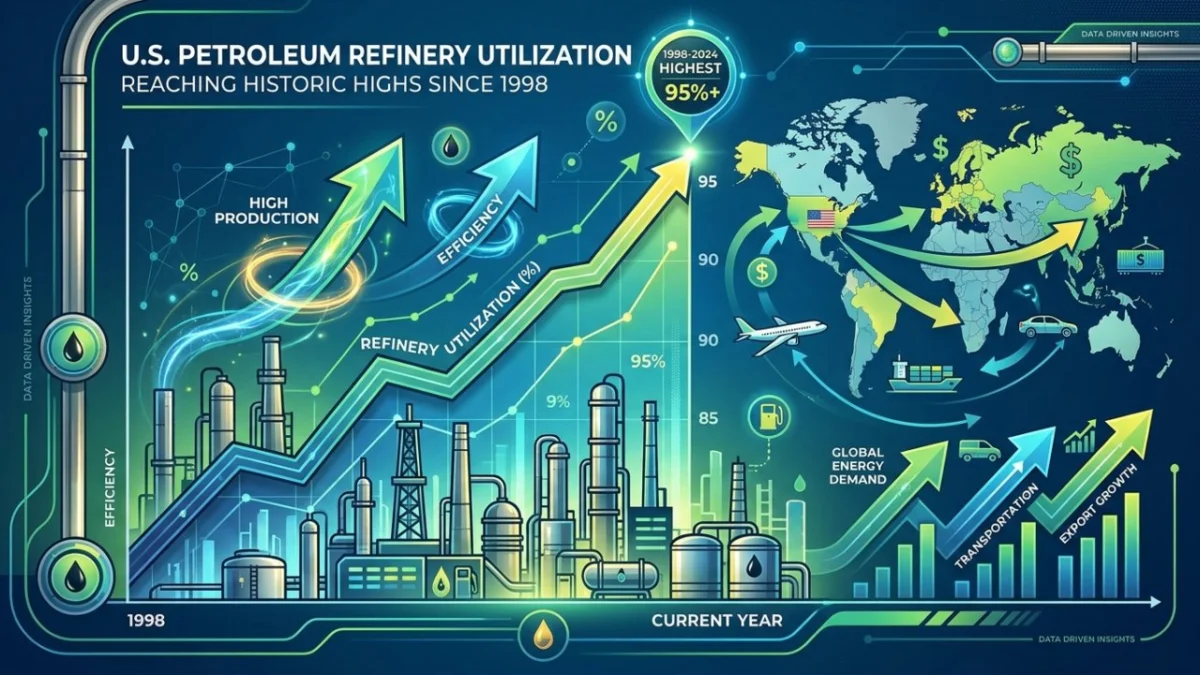
The American energy landscape is currently defined by a remarkable operational milestone. Between May and September 2026, United States refineries achieved an average utilization rate exceeding 95%, marking the highest performance for that specific window since 1998. This surge in productivity, driven largely by robust international demand for refined petroleum products, offers a complex narrative for the U.S. economy—one that presents both significant logistical opportunities and persistent supply-side risks for small business owners and industrial operators alike.
As the global market continues to recalibrate, the data from this year’s peak summer season reveals a structural shift in how U.S. energy is produced, exported, and consumed. While the headlines celebrate record efficiency, a deeper look into the capacity constraints and the changing nature of fuel demand suggests that the road ahead remains volatile for businesses sensitive to energy costs.
Main Facts: A Return to 1998-Era Intensity
The primary driver behind this record-setting performance is the aggressive push to meet global demand for distillate fuels, such as diesel and heating oil. While gasoline production remains a staple of the summer refinery cycle, 2026 has been defined by a pivot toward exports.
For the American small business sector, which relies heavily on the steady flow of diesel for logistics, heavy machinery, and agricultural operations, the 95% utilization rate serves as a double-edged sword. On one hand, the output is sufficient to keep the economy moving; on the other, the system is operating with almost no "slack." When refineries run at or near maximum capacity, any unexpected disruption—be it a regional weather event, a mechanical failure, or a labor dispute—can lead to immediate and sharp price volatility.
A Chronology of the 2026 Surge
To understand how we arrived at these historic highs, one must look at the progression of the year:
- Q1 2026: Refineries began the year with standard winter maintenance cycles. However, international geopolitical tensions began to tighten the supply of distillates, signaling to domestic producers that an export-heavy spring was imminent.
- May–June 2026: As the peak driving season approached, refinery utilization began a steady climb. Unlike previous years, where the focus was strictly on seasonal gasoline demand, U.S. facilities pivoted early to build up stockpiles of diesel to meet projected global shortfalls.
- July–August 2026: The "peak of the peak." Utilization rates consistently hovered above the 95% threshold. Data from the U.S. Energy Information Administration (EIA) confirmed that this was the highest sustained output for these months in nearly three decades.
- September 2026: As the summer ended, high demand remained, keeping utilization rates elevated well past the traditional seasonal cooling-off period.
- October 2026: Entering the fourth quarter, there has been a marginal softening in utilization. However, rates remain firmly above the five-year seasonal average, indicating that the pressure on the system has not yet fully dissipated.
Supporting Data: The Paradox of Capacity
A critical nuance often missed in discussions regarding "record rates" is the distinction between utilization and total capacity. While the utilization rate—the percentage of total capacity currently in use—has reached 1998 levels, the total volume of petroleum products produced has not reached a commensurate historical peak.

The reason for this discrepancy is a 4% decline in overall U.S. refining capacity since 2019. Several refineries were either decommissioned or repurposed for biofuel production during the post-pandemic transition. Consequently, the industry is doing more with less infrastructure.
For the entrepreneur, this means that the margin for error in the supply chain is thinner than it was five years ago. Because the total "ceiling" of production is lower, the economy is more susceptible to price spikes if demand remains high. According to EIA metrics, while current output is the highest since 2019, it remains constrained by the permanent loss of those legacy refining assets.
Official Responses and Expert Analysis
Jimmy Troderman, a principal contributor for the U.S. Energy Information Administration, highlights that the current state of the industry is a direct result of global market pressure. "High international demand for U.S. distillate fuel oil exports has kept refinery outputs elevated," Troderman notes.
This sentiment is echoed by industry analysts who observe that U.S. refineries have become the "swing suppliers" for the global market. When international supply chains are disrupted, the world looks to the U.S. Gulf Coast. For domestic business owners, this means your fuel costs are increasingly tethered to the economic health of markets thousands of miles away, rather than just local demand.
Implications for Small Business Owners
The current energy environment requires a proactive, rather than reactive, approach for small business leaders. The implications of this high-utilization, lower-capacity era are threefold:
1. Strategic Inventory Management
Small businesses involved in logistics, transportation, or construction should move away from "just-in-time" fuel purchasing. Given that refineries are operating at maximum capacity, any supply chain bottleneck could lead to sudden shortages. Strategic purchasing—buying in bulk during lulls in the market—can serve as a hedge against the price volatility that often follows these high-utilization periods.
2. Monitoring the "Distillate Gap"
The shift in production toward distillates means that diesel-dependent industries are at the mercy of global export trends. Business owners should utilize forecasting tools provided by industry watchdogs and the EIA to monitor refinery output data. If you see utilization rates in the U.S. dipping while export demand remains high, it is a leading indicator of a potential price increase in the domestic diesel market.

3. Energy Efficiency as a Competitive Edge
When energy represents a high percentage of your operational costs, efficiency is no longer just an environmental goal—it is a financial imperative. Investing in modern, fuel-efficient vehicles or optimizing delivery routes via GPS-based logistics software can mitigate the impact of price hikes. As the energy market remains tight, those who minimize their consumption will naturally maintain a wider profit margin than those who continue with legacy, energy-heavy workflows.
Navigating the Winter Months
As we transition into the winter, the focus of the market will shift from gasoline to heating oil and winter-grade diesel. Historically, this period brings its own set of challenges, particularly in the Northeast and Midwest.
Business owners should prepare for potential premiums in the coming months. If the current trend of high exports continues, domestic inventories may remain lower than the historical average, leading to a tighter market during the peak winter demand months.
Conclusion: A New Era of Energy Planning
The record-breaking utilization rates of 2026 serve as a reminder that the global energy market is highly integrated and increasingly sensitive to capacity constraints. While the high output of U.S. refineries is a testament to the resilience and productivity of the American energy sector, it also highlights a systemic vulnerability.
For the small business owner, the takeaway is clear: stability is not guaranteed. By staying informed on refinery output, understanding the difference between utilization and capacity, and planning for energy costs with a long-term view, you can protect your enterprise from the ripples of global market volatility. In this environment, knowledge is as valuable as fuel; those who track the data will be the best positioned to thrive as the market continues to evolve.
For further analysis and the latest updates on energy trends, business owners are encouraged to monitor the U.S. Energy Information Administration’s official reports.