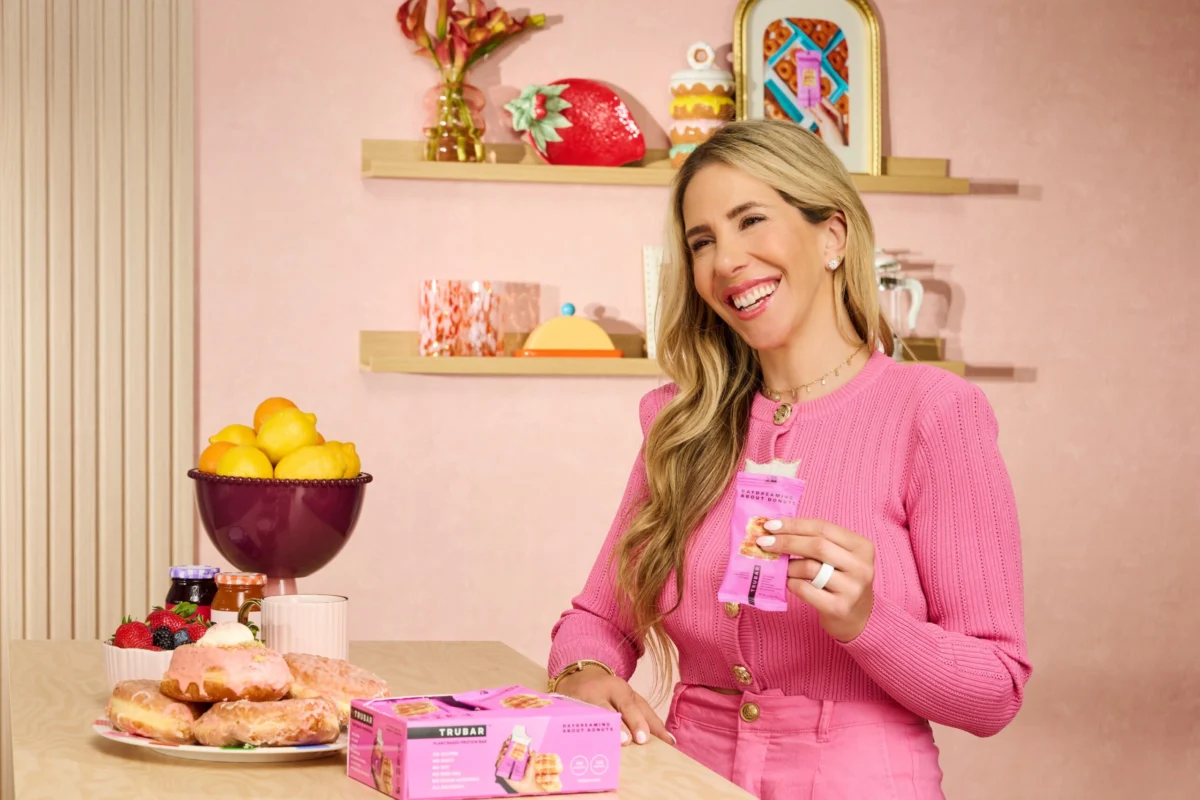
In the competitive landscape of the $20 billion global protein bar market, most startups are swallowed whole by industry giants within their first three years. Yet, Erica Groussman, a former real estate professional and stay-at-home mother, did more than just survive; she built a culinary powerhouse. Today, Trubar stands as a testament to the power of "scrappy" entrepreneurship, having reached a $173 million acquisition by the Turkish snack conglomerate Eti Gida in early 2026. With 32,000 retail locations now carrying her products and nearly 46 million bars shipped in 2026 alone, Groussman has transformed a humble, kitchen-table experiment into a household name.
The Genesis: An Epiphany in the Happiest Place on Earth
The origin story of Trubar is not rooted in a board room or a venture capital pitch deck. It began during a family vacation to Disney World. While attempting to provide healthy snacks for her children, Groussman consumed a popular "better-for-you" protein bar. The result was not the sustained energy she expected, but rather acute digestive discomfort—a common complaint among consumers of high-fiber, processed snacks.
"I remember just feeling very ucky," Groussman recalls. "My belly was very distended and uncomfortable. That was my epiphany. There has to be a better way."
Driven by the need for a snack that bridged the gap between a nutritious profile and the sensory satisfaction of a dessert, Groussman began a journey of iterative product development. She leveraged her personal network to find a food scientist, treating the development process like a laboratory experiment. Every texture, crunch, and aftertaste was scrutinized. She moved away from the chalky, chemically-heavy profiles common in the industry, opting for ingredients that tasted like indulgences—such as "Daydreaming About Donuts" and "Oh Oh Cookie Dough"—without the physical "aftermath."
A Chronology of Growth
The Grassroots Launch (2018–2020)
Groussman officially launched Trubar in 2018. Her initial go-to-market strategy was remarkably low-tech: she used a wooden tray from Bed Bath & Beyond to display her products at local businesses. She approached independent juice shops, delis, and beauty salons with a simple proposition: "Put these on the counter, and see if customers buy them."
The strategy worked. The immediate feedback loop of retail sales validated the product. When shop owners asked for more, she knew she had achieved product-market fit.
The "Costly Mistake" and Near Collapse
Growth, however, brought significant friction. Attempting to scale too quickly, Groussman hired an outside operator to manage the business while she balanced family life. The decision was a turning point for the worse. The operator’s mismanagement led to $7 million in debt, putting the company on the brink of insolvency.
Her husband advised her to cut her losses and move on. Instead, Groussman chose to fight. She stepped back into the driver’s seat, viewing the company not as a failed asset, but as an extension of her own identity.
The Retail Breakthrough (2020–2024)
By 2020, Groussman had refined her strategy, pivoting toward high-stakes retail partners. Through persistent networking—specifically targeting buyers on LinkedIn—she secured a trial in 30 Whole Foods locations. With zero marketing budget, the brand outperformed legacy incumbents. Shortly after, the brand secured a position in Costco, though not without initial struggles. A challenging entry into the Canadian market served as a masterclass in global distribution, teaching Groussman that product quality alone is insufficient; price positioning and regional brand recognition are equally vital.
The Public Transition and Acquisition (2025–2026)
In 2021, Trubar was acquired by a publicly traded holding company. This structure allowed Trubar to access capital for expansion, though it came with the frustration of seeing her revenue diverted to support struggling sister companies within the portfolio. By 2024, after the other assets failed, Groussman was named CEO of the publicly traded entity, effectively rebranding the parent company around the success of Trubar. The cycle culminated in February 2026, when Eti Gida acquired the brand for $173 million.
Supporting Data: By the Numbers
The success of Trubar is supported by impressive financial and operational metrics:
- 2025 Gross Revenue: Approximately $100 million.
- 2026 Volume: Nearly 46 million units shipped.
- Retail Footprint: 32,000 locations across the United States.
- Valuation: $173 million at the point of acquisition by Eti Gida.
- Team Size: A lean, high-performing team of 28 employees.
These figures illustrate a highly efficient operation. By maintaining a lean headcount while achieving mass-market distribution, Groussman maintained high margins and operational agility.
Official Stance: The CEO’s Philosophy
Erica Groussman’s leadership style is characterized by a "hands-on" approach that borders on protective. When asked about her secret to success, she is blunt: "I think that one of the biggest secrets is working your butt off. Really getting it into every hand that you can possibly get it into."
This philosophy extends to her management of the team. During a recent Walmart product launch, a packaging delay threatened a critical deadline. Rather than waiting for external logistics partners, Groussman took the initiative to find an alternative supplier herself, completing the task in two weeks. Her "mama bear" approach—stepping into the fray to solve logistical bottlenecks—has fostered a culture of extreme ownership.
"I will not ask you to do something that I wouldn’t do myself," she says. This extends to error management. When a labeling error occurred—where cashews were incorrectly listed as almonds—she ensured the problem was fixed on-site with stickers before investigating the systemic root cause of the error.
Implications for Future Founders
The Trubar story offers several critical lessons for the next generation of consumer packaged goods (CPG) founders:
1. Solve First, Diagnose Second
Groussman argues that many founders become paralyzed by the need for perfection. Her advice: "Just get 80%, just go." By launching and iterating, she gained the data necessary to improve the product in real-time, rather than losing time on theoretical perfection.
2. Hire for Chemistry, Not Just Resumes
In a fast-paced environment, skills can be taught, but attitude cannot. Groussman emphasizes that she interviews for the resume but hires for chemistry. She looks for individuals capable of independent decision-making and those who thrive in the "chaotic middle" of a scaling business.
3. Resilience in the Face of Debt and Failure
The $7 million debt crisis serves as a reminder that the path to a nine-figure exit is rarely linear. Groussman’s refusal to liquidate the company when faced with significant debt saved the brand. Her experience suggests that founders must be prepared to act as their own crisis managers, even when experts suggest walking away.
4. The Future of the Brand
The acquisition by Eti Gida does not mark a sunset for the founder. With the recent launch of "Trubar Kids" and "Trubar Pro," the brand is actively expanding its demographic reach. For Groussman, the acquisition is merely the beginning of the next chapter. "I’m not done," she asserts. "It’s my baby."
As Trubar continues to scale under its new ownership, the industry will be watching to see if this "scrappy", hands-on management style can sustain its growth on a global scale. By staying true to the original, personal mission of creating a snack that makes people feel good, Erica Groussman has proved that even in the saturated world of protein bars, there is always room for a better, more authentic product.