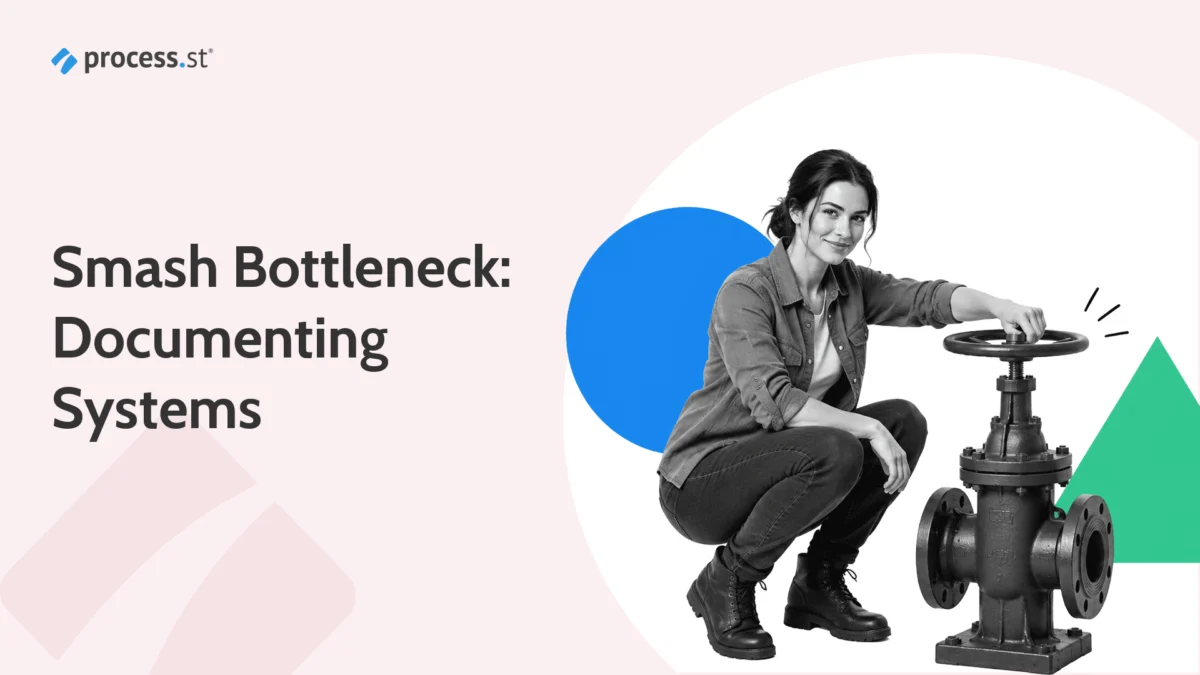
In the lifecycle of a growing company, there exists a silent, invisible barrier that prevents scaling: the founder’s desk. Known as the "business bottleneck," this phenomenon occurs when an organization’s momentum is tethered entirely to the memory, approval, and oversight of a single individual. When every decision—from minor procurement requests to final client sign-offs—must pass through the owner, the business stops being an engine of growth and becomes a hostage to the owner’s availability.
The transition from a hands-on startup to a mature, scalable enterprise requires a fundamental shift in philosophy. It is not about abandoning control; it is about replacing the fragile reliance on individual micro-management with the robust, repeatable architecture of systems. By mastering the triad of documenting, delegating, and trusting, leaders can liberate their time to focus on high-impact strategy rather than day-to-day firefighting.
The Anatomy of a Bottleneck
A bottleneck is rarely a failure of staff; it is a failure of systemization. When work waits for a single person’s review, the business can only move as fast as that person’s capacity. This creates a "founder dependency" that serves as a glass ceiling. If the owner is unavailable, the company grinds to a halt.
For many entrepreneurs, the fear of losing quality prevents them from letting go. However, the data suggests otherwise: companies that rely on clear, documented processes are significantly more resilient to turnover and more capable of rapid scaling. The goal is to build an environment where the business functions as an ecosystem, not a solo performance.
Chronology of Transformation: A Five-Step Roadmap
Breaking the cycle of dependency is not an overnight task. It requires a methodical approach that prioritizes high-value wins over total system overhaul.
Step 1: Identifying the Primary Constraint
The process begins with an audit of the daily friction. Leaders must identify the task that consumes the most "emotional and temporal bandwidth." This is usually a recurring task that is critical to operations but suffers from delays because it requires the owner’s specific input.
To identify your first target, ask: What task ruins my flow? What requires my signature every single day? What becomes risky or costly when someone else tries to do it without my guidance? By selecting one high-frequency, repeatable process, you create a focused "first win" that builds confidence for the rest of the organization.
Step 2: The Art of Process Documentation
Documentation is the foundation of operational freedom. A high-quality process document is not merely a static instruction manual; it is a dynamic, living asset. It must capture the "trigger" (what starts the process), the expected outcomes, the sequential steps, and the decision-making thresholds.
Modern tools have evolved to support this. Platforms like Process Street provide a Compliance Operations Platform that merges documentation with execution, allowing teams to turn static guides into trackable, AI-assisted workflows. By contrast, reliance on static files like Google Docs often leads to "documentation rot," where files are saved but never consulted. The best documentation includes screenshots, clear definitions of "done," and explicit instructions on how to handle exceptions.
Step 3: Delegating with Authority
Delegation is not the act of dumping work; it is the act of transferring ownership. True delegation requires providing the necessary context, access, and, most importantly, the authority to execute.
During the handoff, the leader must resist the urge to dictate every granular movement. Instead, define the "Acceptance Criteria"—the standards by which the work will be judged. Whether it is a project completion time or a specific quality benchmark, these criteria protect the output without stifling the operator’s judgment.
Step 4: Building Controlled Autonomy
Trust is the bridge between delegation and total independence. The common pitfall here is "hovering," where the owner delegates a task but remains physically or digitally present to oversee every micro-decision. This negates the benefits of delegation.
Instead, implement "controlled autonomy." Define clear boundaries: which decisions are the operator’s to make, and which triggers necessitate an escalation to the owner? By scheduling checkpoints rather than continuous oversight, the owner can maintain visibility while the employee gains the confidence to own the outcome.
Step 5: Iteration and Continuous Improvement
A system is never finished. After several cycles, the process will inevitably reveal its flaws. Use these moments to review the "cycle time" and identify where rework occurred. By updating the documentation to reflect these learnings, the organization creates a virtuous cycle of improvement. Once one process is optimized, the leader can move on to the next, systematically dismantling every dependency until the business is no longer reliant on their constant, manual intervention.
Supporting Data: The Cost of Disorganization
Industry research consistently highlights that the primary cause of small-to-medium enterprise (SME) failure is not a lack of market demand, but a lack of operational infrastructure.
- Operational Drag: Studies indicate that employees spend nearly 20% of their work week searching for internal information or tracking down approvals. When processes are documented, this search time drops by up to 60%.
- The Scalability Gap: Businesses that utilize formal process management tools report a 30% faster time-to-market for new products and services compared to those relying on verbal, ad-hoc instructions.
- Quality Variance: In businesses without documented systems, the variance in output quality is often high. Standardizing the workflow reduces the error rate in repetitive tasks by an average of 45% within the first six months of implementation.
Official Perspectives: The Expert View
Operational experts argue that the shift toward process-led business is no longer a luxury; it is a necessity in an AI-integrated economy.
"The bottleneck isn’t just about time," says a senior consultant at a leading operational firm. "It’s about intelligence. When knowledge is trapped in the owner’s head, the business is effectively lobotomized every time the owner takes a vacation or focuses on a new project. Systemization is the act of externalizing the business’s collective intelligence into a format that the entire team can leverage."
Furthermore, as AI tools become more integrated into workflow management, the importance of "clean" processes has grown. AI cannot optimize a broken, undocumented process. Only by defining the steps clearly can a business begin to automate the repetitive elements, effectively allowing the business to run itself while the leadership focuses on high-level strategy.
Implications: A New Era of Leadership
The implications of successfully smashing these bottlenecks are profound. For the owner, it represents a transition from "technician" to "strategist." When routine tasks are handled with consistency and precision by a empowered team, the owner is suddenly free to explore new markets, cultivate high-level partnerships, and focus on the long-term vision of the enterprise.
For the employees, the benefits are equally significant. Documented processes provide clarity, reduce the anxiety of "doing it wrong," and offer a clear path for professional development. When an employee knows exactly what is expected of them and has the tools to achieve it, their engagement increases.
However, the path to this state requires a high degree of vulnerability. Leaders must be willing to admit that their current method of management is unsustainable. They must accept that someone else may eventually perform a task better than they do—and, most importantly, they must be willing to celebrate that success rather than feel threatened by it.
In conclusion, the goal of a business owner should not be to make themselves indispensable, but to make themselves redundant in the day-to-day operations. By replacing personal oversight with institutional systems, leaders create a business that can scale indefinitely, adapt to market shifts, and ultimately provide the freedom that they likely started the business to achieve in the first place. The bottleneck is not a permanent fixture of business life; it is a design flaw that can be fixed, one process at a time.