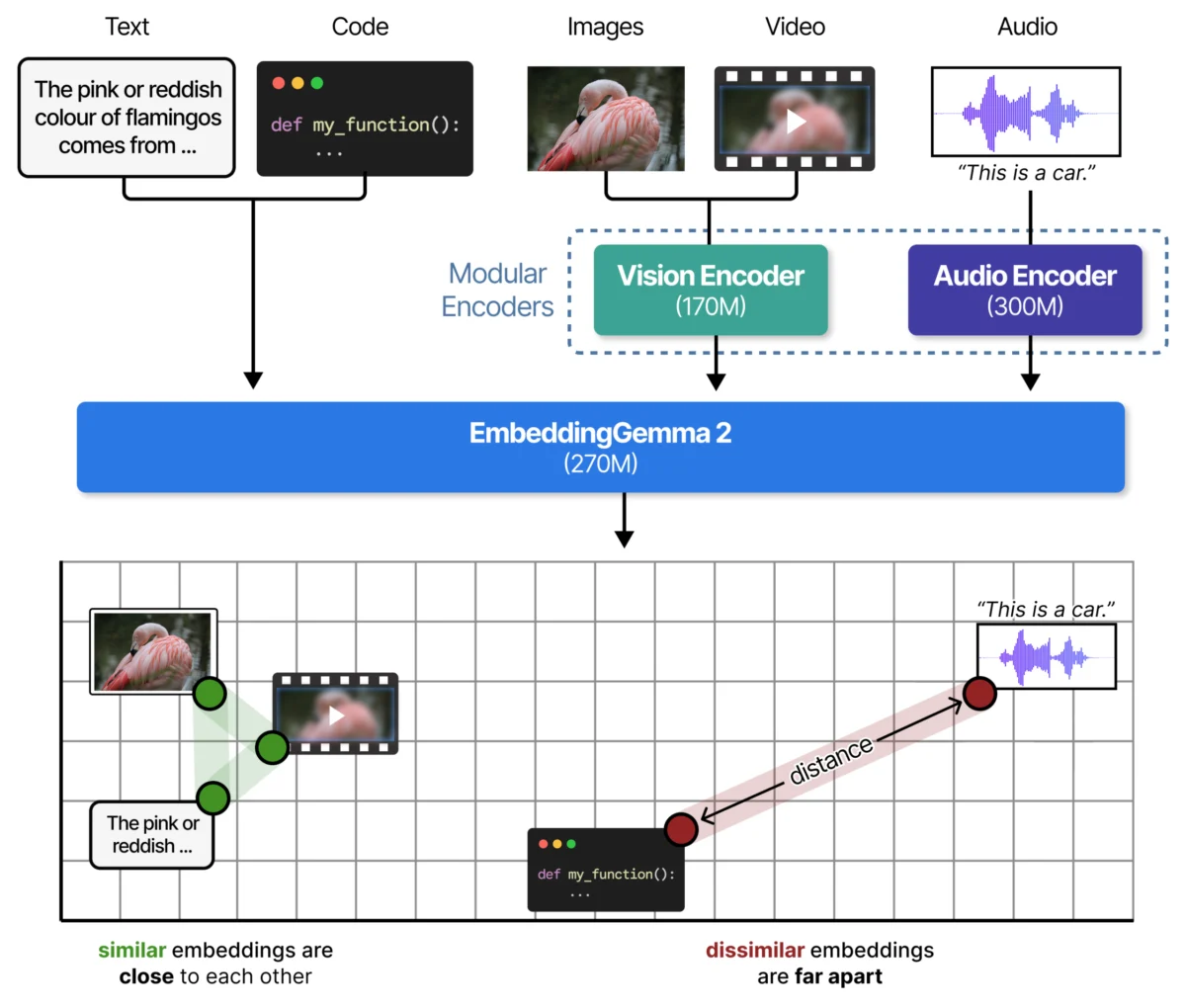
In the rapidly evolving landscape of artificial intelligence, the ability to search, index, and retrieve information across disparate data types—text, code, imagery, audio, and video—has long been a fragmented challenge. Traditionally, developers have relied on a "patchwork" architecture, stitching together multiple models to handle different modalities. This approach resulted in siloed indexes, inconsistent scoring, and an inability to truly compare a photograph with a paragraph of text.
On October 6, 2026, Google fundamentally shifted this paradigm with the release of EmbeddingGemma 2. Built upon the robust foundation of the Gemma 4 architecture, this sub-1B parameter model introduces a unified vector space, enabling a single backbone to process and map diverse content types into a shared 768-dimensional coordinate system. Released under the permissive Apache 2.0 license, EmbeddingGemma 2 is poised to become a cornerstone for developers building next-generation Retrieval-Augmented Generation (RAG) pipelines and multimodal search applications.
The Chronology of Development: From Silos to Synthesis
The development of EmbeddingGemma 2 represents a significant leap from its predecessor. While EmbeddingGemma 1 was a capable text-based retrieval engine, it lacked the native capacity to bridge the gap between media types.
- Foundation (Early 2026): Google’s research team focused on the scalability of the Gemma 4 architecture, emphasizing the need for an efficient, modular model that could reside on edge devices without sacrificing performance.
- Architectural Breakthrough (Mid-2026): Engineers developed a modular encoding system where the base text and code encoder remains constant, while vision and audio modules act as "plug-and-play" extensions. This allowed the model to maintain a consistent output dimension regardless of input type.
- Launch (October 6, 2026): The official release provided the developer community with a single set of weights, allowing users to load only the specific encoders required for their application—drastically reducing the footprint of the model on disk and in RAM.
Technical Specifications: Powering the Multimodal Backbone
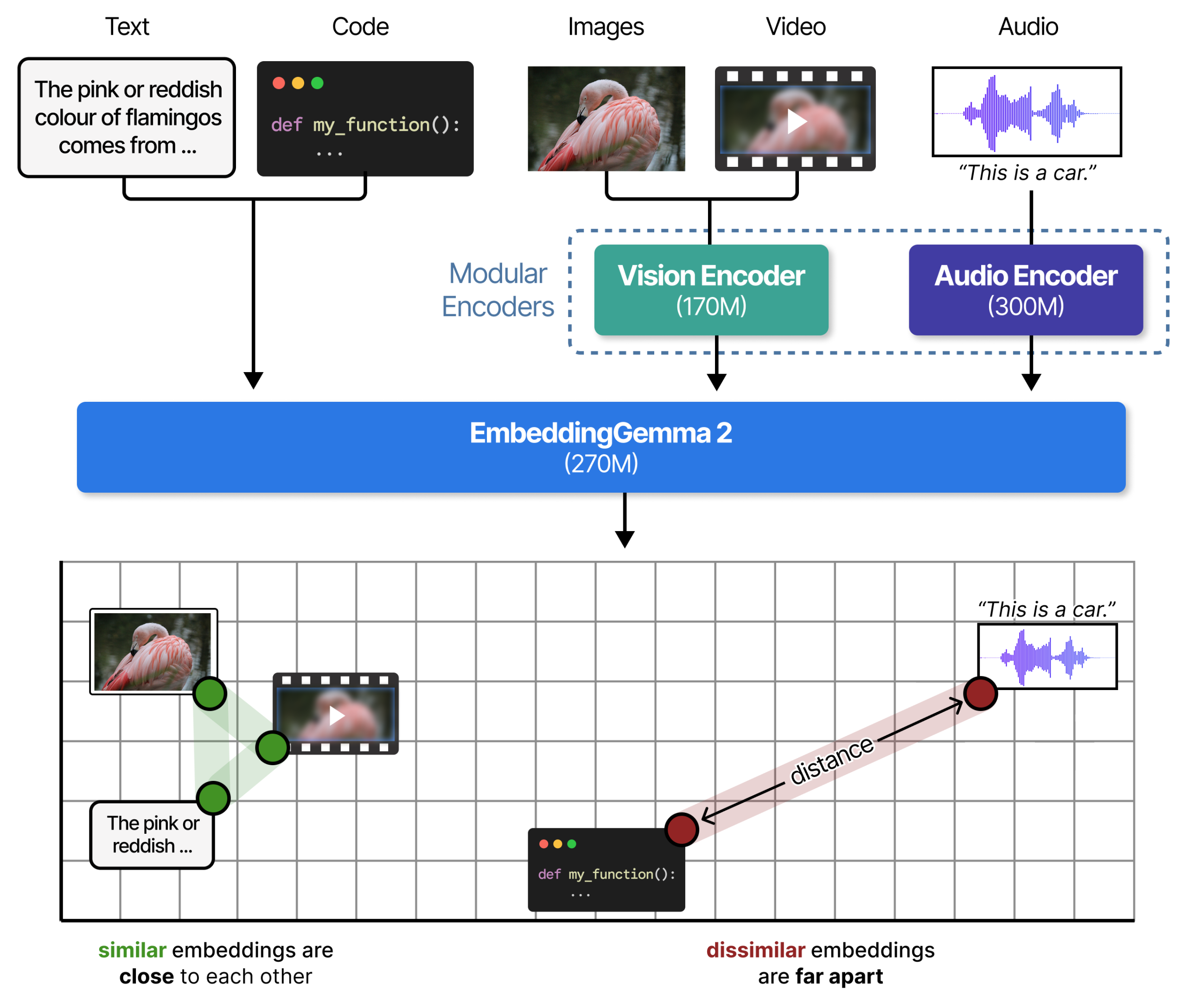
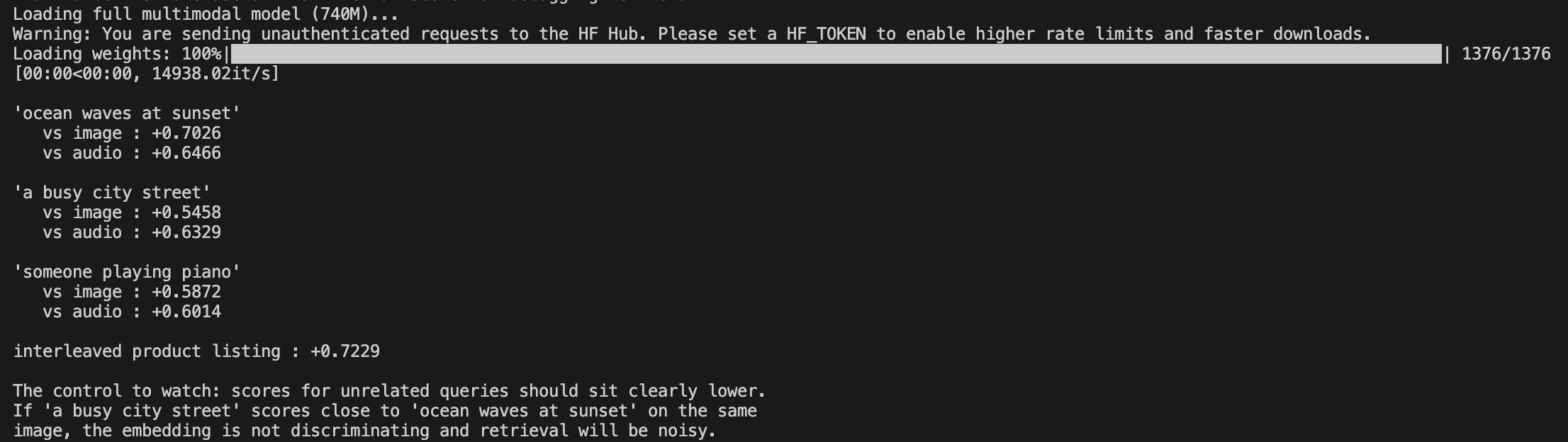
EmbeddingGemma 2 is defined by its extreme flexibility. By sharing a single, 768-dimensional output space, the model allows for "cross-modal" similarity queries, where a text prompt can be accurately matched against images, audio clips, or video frames without the need for complex metadata mapping.
Core Technical Pillars
| Specification | Details |
|---|---|
| Base Model | Gemma 4 |
| Parameters | 270M (Text/Code) to 740M (Full Multimodal) |
| Output Dimension | 768, truncatable to 512, 256, 128 |
| Context Window | 8,192 tokens (shared across modalities) |
| License | Apache 2.0 |
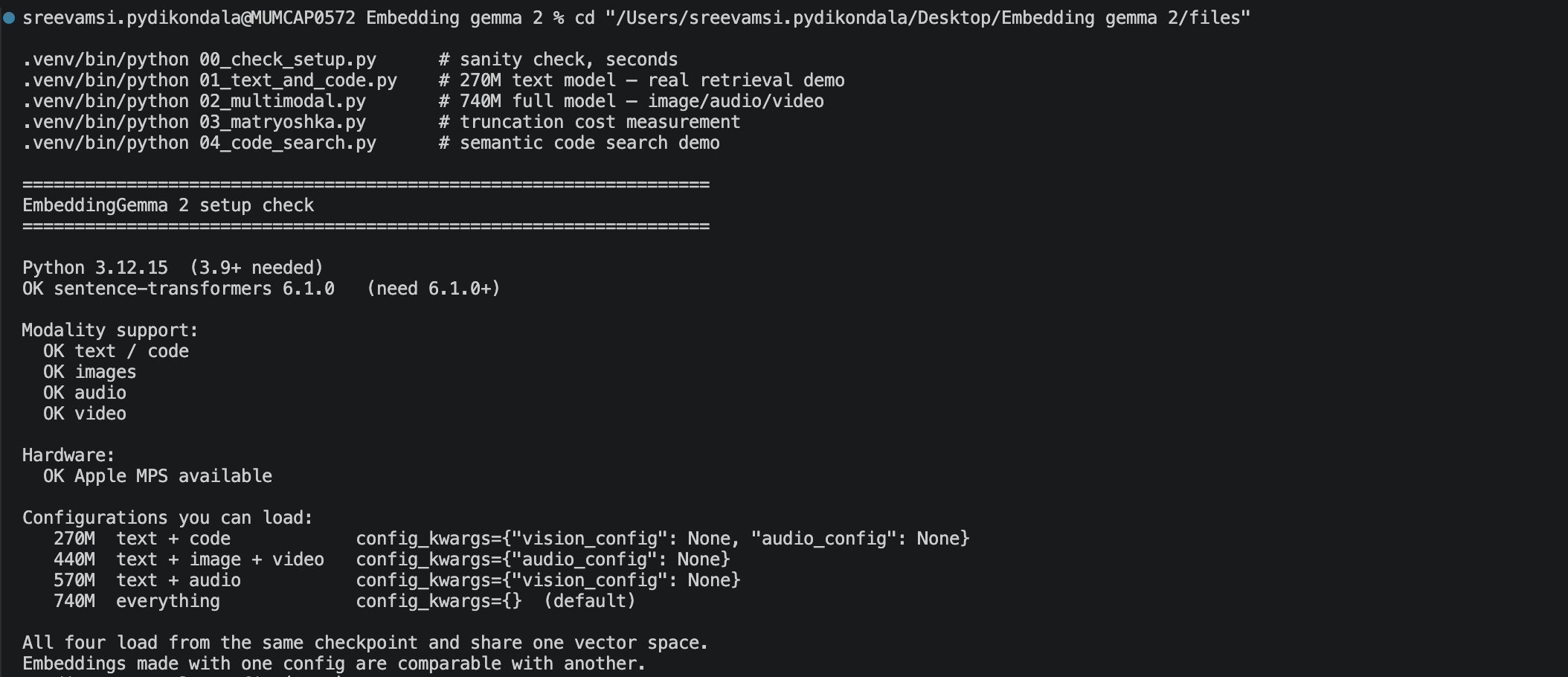
The model’s efficiency is derived from its modular loading capability. A developer building a text-only retrieval system does not need to load the vision or audio encoders, keeping the memory overhead at a lean 270M parameters. Conversely, for a full-stack media retrieval application, the 740M configuration provides the comprehensive encoding power necessary to understand complex, multi-layered data.
How It Works: The Three-Encoder Engine
The architecture relies on a central "backbone"—a highly adapted Gemma 4 decoder—which acts as the semantic engine. The modality-specific front-end encoders (Text/Code, Vision, and Audio) process raw input before passing it into this unified space.
- The Text and Code Encoder (Base): This is the core of the model. It handles plain text and source code with high semantic precision, supporting up to 8,192 tokens. It is always active, ensuring that even in multimodal tasks, the model’s linguistic understanding remains grounded in the Gemma 4 framework.
- The Vision Encoder (+170M params): This module processes photos, charts, slides, PDF pages, and individual video frames. It maps visual features directly into the 768-dimensional space, effectively "describing" images in a mathematical language that the text encoder can understand.
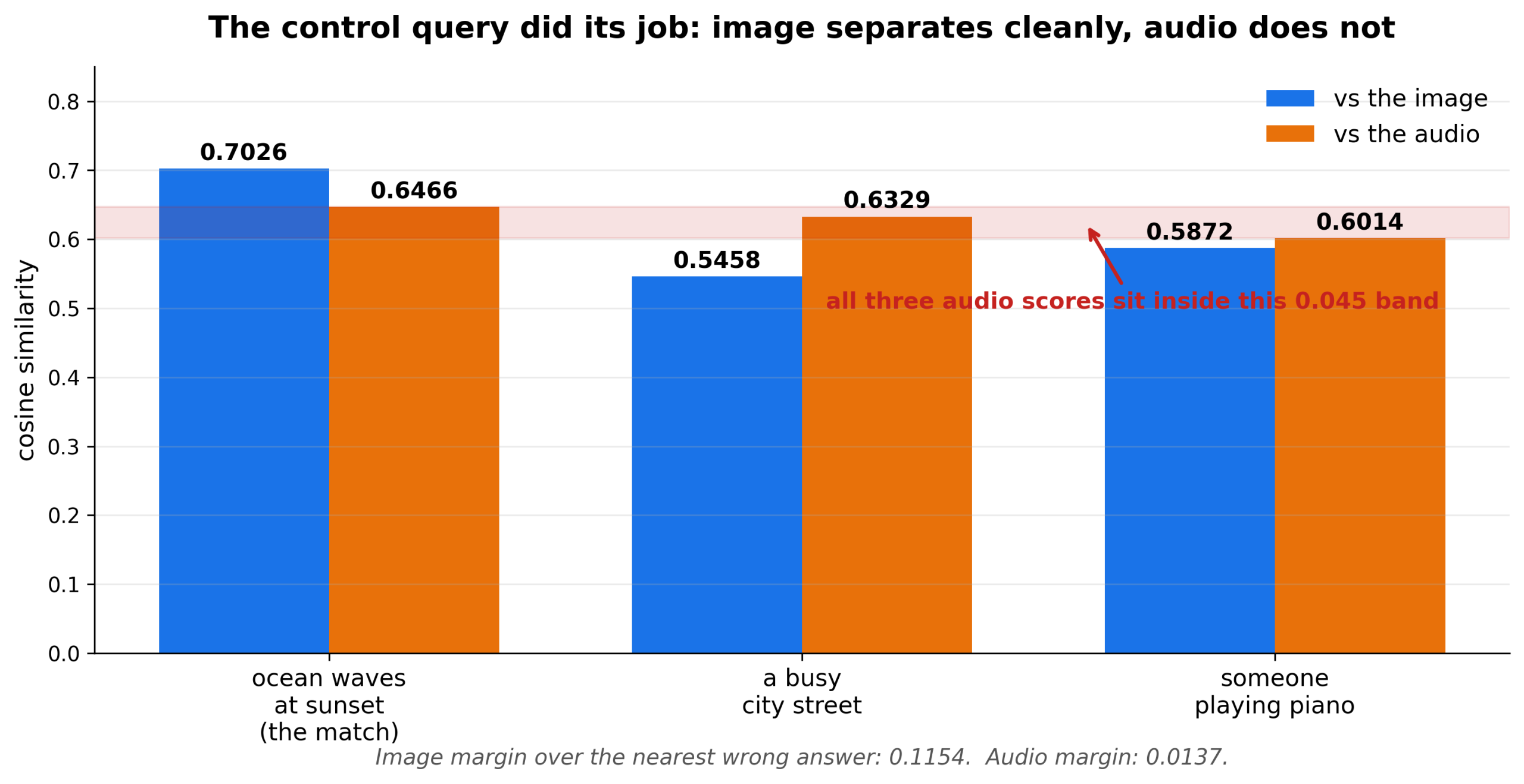
- The Audio Encoder (+300M params): Perhaps the most impressive addition, this encoder processes raw audio, including speech and ambient sound. By converting acoustic patterns into the same shared embedding space, it enables users to search for "ocean waves" and find an audio file containing that specific sound.
Supporting Data: Benchmarks and Truncation Efficiency
Google has emphasized that EmbeddingGemma 2 is not just a research project, but a production-ready tool. Performance data indicates a 14% improvement in MTEB (Massive Text Embedding Benchmark) scores for code retrieval compared to the previous version, while multilingual text accuracy remains rock-solid.
The Matryoshka Advantage
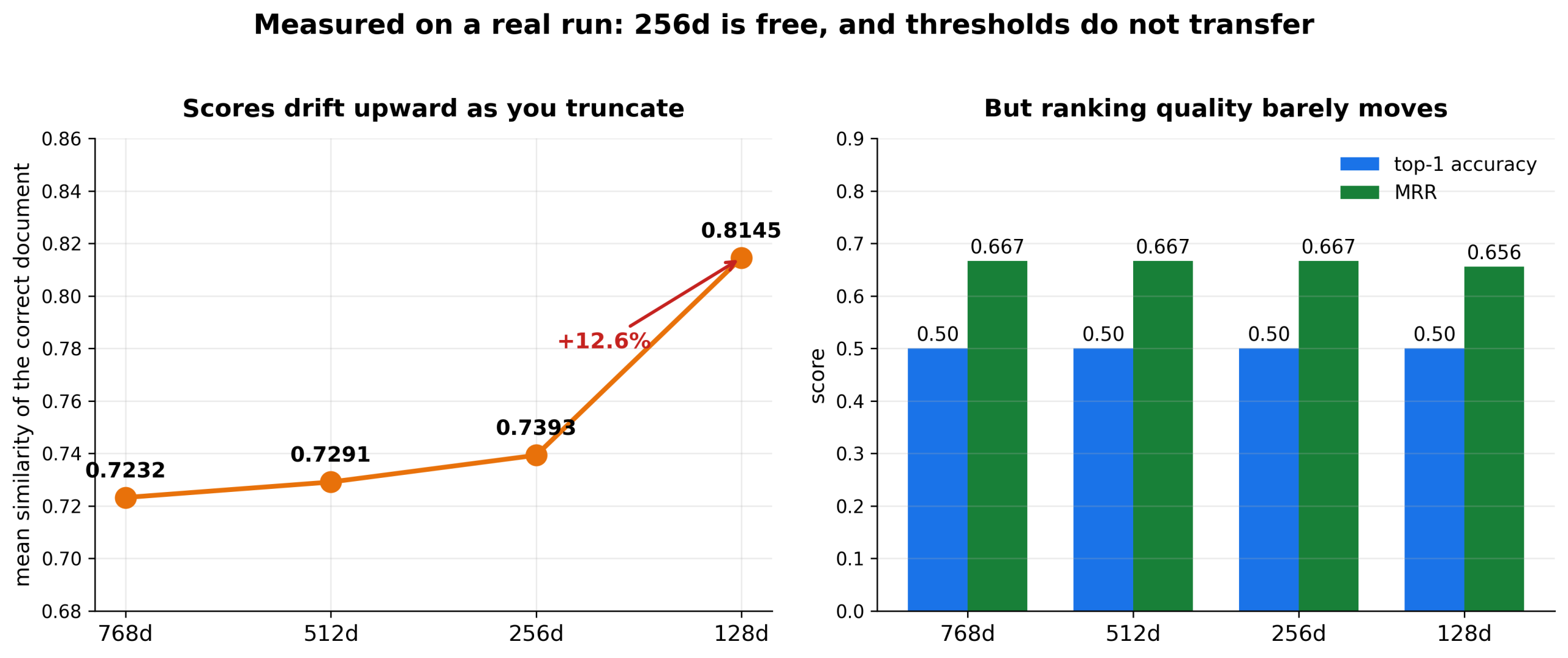
One of the most compelling features of EmbeddingGemma 2 is its support for Matryoshka Representation Learning. This allows developers to truncate the 768-dimensional embeddings to 512, 256, or even 128 dimensions without a catastrophic loss of semantic quality.
For developers managing large-scale vector databases, this is a game-changer. Truncating to 128 dimensions reduces storage requirements by 83% compared to the baseline, enabling massive efficiency gains in index size and retrieval latency. Measurements confirm that while 128d might see a slight dip in precision (roughly 75-90% retention depending on the modality), 256d is often indistinguishable from 768d for many common enterprise use cases.
Implications for the Industry: RAG and Beyond
The introduction of EmbeddingGemma 2 has immediate, far-reaching implications for the AI industry, particularly in the realm of Retrieval-Augmented Generation (RAG).
1. Unified RAG Stacks
Until now, building a RAG pipeline that could "read" a manual, "view" a diagram, and "listen" to a recorded meeting required complex orchestration of disparate models. With EmbeddingGemma 2, these diverse inputs share a common language. A chatbot can now retrieve information from a PDF diagram using a text query, and the embedding space will treat the diagram and the text as neighbors.
2. On-Device AI
Because EmbeddingGemma 2 shares a text tokenizer and audio encoder design with the core Gemma 4 generator, the model is highly optimized for resource-constrained environments. By loading only the necessary encoders, mobile applications and edge devices can now perform sophisticated multimodal retrieval without relying on cloud-based API calls. This significantly improves privacy, latency, and operational costs.
3. Code-Centric Search
The 14% gain in code retrieval accuracy positions EmbeddingGemma 2 as a vital tool for developers. By indexing entire repositories into a 256d space, development environments can provide "semantic code search," allowing developers to query for concepts—such as "how do I implement exponential backoff"—rather than searching for exact keyword matches.
Implementation Guidance: Best Practices
For those looking to integrate EmbeddingGemma 2, the process begins with proper setup. Using the sentence-transformers library (version 6.1.0 or later), developers can initialize the model with specific config_kwargs to load only the required modules.

Deployment Strategy:
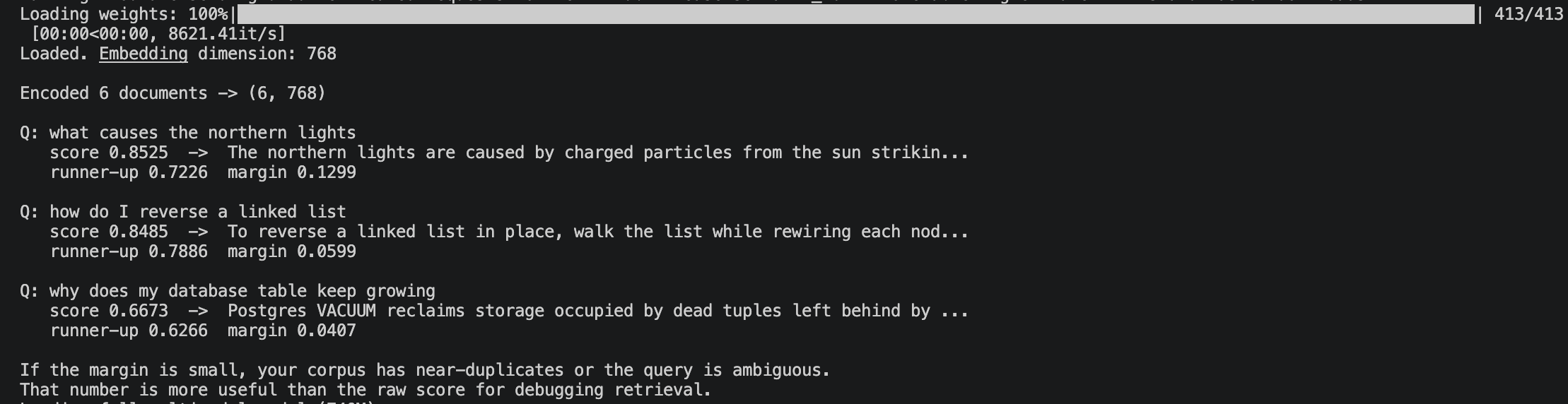
- Step 1: Calibration. Always run a benchmark on your own corpus. While public metrics provide a baseline, the "margin" (the difference in similarity scores between the top result and the runner-up) is the most critical metric for debugging retrieval quality.
- Step 2: Dimensionality Choice. Start at 256d. Given the high retention of ranking performance observed in tests, this is the "sweet spot" for most production applications. Only scale up to 768d if specific cross-modal precision requirements necessitate it.
- Step 3: Modality Optimization. For audio-heavy applications, ensure you have
librosaandsoundfileinstalled to handle the raw audio decoding, as the performance of the audio encoder is highly sensitive to the quality of the input pre-processing.
Conclusion: A New Standard for Multimodal AI
EmbeddingGemma 2 is more than just an update; it is a consolidation of the multimodal frontier. By providing a single, Apache 2.0-licensed checkpoint that bridges the divide between text, code, images, video, and audio, Google has effectively lowered the barrier to entry for developers building sophisticated, multi-modal systems.
The model’s modular design ensures that it is as at home on a low-power edge device as it is in a high-performance server rack. As organizations continue to move away from text-exclusive data strategies and toward richer, media-heavy content repositories, the ability to store and search that data in a unified, efficient vector space will become an essential competitive advantage.
For developers, the mandate is clear: start with your own data. The tools are now available to measure the trade-offs between memory, storage, and retrieval quality, empowering teams to build leaner, faster, and more intelligent AI applications. EmbeddingGemma 2 isn’t just about search—it’s about understanding the entirety of the digital information we interact with every day.