
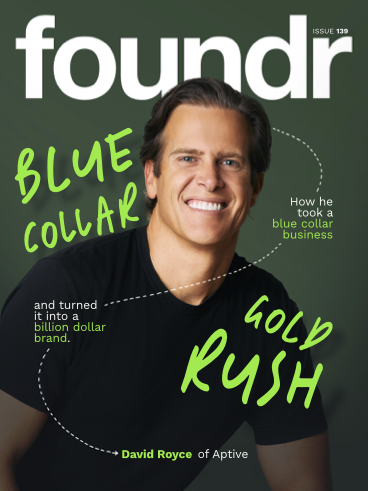
In the polished, high-stakes world of venture capital and tech-centric entrepreneurship, the path to a billion-dollar valuation is usually paved with proprietary algorithms, disruptive software, or massive scalability. David Royce, the founder and chairman of Aptive Environmental, chose a different route. He built his fortune in an industry his finance-degree peers wouldn’t touch with a ten-foot pole: residential pest control.
Today, Aptive stands as the third-largest residential pest control service in North America, a testament to a philosophy that defies conventional business wisdom. For Royce, success is not found in the prestige of the sector, but in the willingness to perform the work others deem beneath them—and doing it for long enough to become the absolute best.
The Foundation: From "Not Smart" to Top Salesman
The narrative of David Royce’s professional life is a study in reframing perceived liabilities as competitive advantages. As a child, Royce struggled in the classroom, often feeling he wasn’t "smart" because he could only focus on subjects that deeply engaged him. It wasn’t until his adult years that he understood this as a manifestation of ADHD.
In his youth, this internal struggle was mitigated by a single, influential sixth-grade teacher, Mrs. Luft. Her belief in him catalyzed a shift in his work ethic. "She believed in me before I believed in myself," Royce recalls. That external validation allowed him to cultivate the discipline he would later require to navigate the grueling world of door-to-door sales.

His entry into the pest control industry was serendipitous. While in college, a friend mentioned making $25,000 in a single summer selling pest control services door-to-door. Royce, intrigued by the potential, headed to Sacramento. The reality, however, was humbling. He spent his first week in a commission-only role without a single sale. While his peers were closing deals, Royce was effectively performing free cardio.
Rather than quitting, he retreated to a bookstore, studied sales psychology for 90 minutes daily, and refused to go home until he mastered the craft. By the end of the summer, he was the company’s top rookie out of 200 representatives. This period solidified his mantra: "Persistence is genius in disguise."
Chronology of a Business Empire
Royce’s ascent was not a singular stroke of luck but a systematic process of learning, applying, and scaling.
- The Early Lessons (Age 15): A stint at McDonald’s after being let go from a pizza parlor taught him the foundational value of "best practices"—a lesson he claims contributed significantly to his later wealth.
- The Sales Crucible (College): Four summers of door-to-door sales generated $300,000 in savings, which became the seed capital for his first venture.
- The First Exit: Following the template provided by his mentor—who had sold a startup to Terminix for $10 million—Royce launched his first venture. He didn’t invent a new product; he optimized the service model, identifying 30 specific pain points in the existing market.
- The Scaling Strategy: Royce sold three separate companies to the same strategic buyer, yet kept his leadership team intact. By selling only the customer base and technicians, he retained his "golden goose"—the human capital—and used the liquidity to start the next iteration with more capital and greater efficiency.
- The Aptive Era: With Aptive, Royce scaled to over $500 million in annual revenue, building a machine of over 3,000 sales representatives.
Data-Driven Growth and Efficiency
What allowed Royce to grow seven to ten times faster than the average of the 20,000+ competitors in the North American market? The answer lies in three pillars of operational excellence.

First, the Sales Machine. Royce codified a rigorous training program that lifted the productivity of new hires by 70% compared to their performance at previous firms. Second, Service Innovation. By knocking on over 60,000 doors, he developed an intimate, data-backed understanding of homeowner pain points, allowing him to offer features that incumbents ignored. Third, Technological Integration. Seventeen years ago, he implemented a sales app that gamified performance, boosting productivity by 30% on tournament days.
Financial Sanity vs. Vanity
Royce’s early days were not without peril. In Los Angeles, his company almost went bankrupt due to a cash-flow mismatch: he was paying commissions before the revenue from those contracts had been realized. He learned a hard, expensive lesson: "Revenues are vanity. Profits are sanity. But cash flow is reality." This forced him to restructure his financial model, ensuring that the company could sustain rapid growth without collapsing under its own weight.
Corporate Culture as an Economic Driver
Royce’s approach to culture is highly intentional. Rejecting the idea that culture is merely "vibes," he views it as a design challenge. While perks like skydiving, golf simulators, and international retreats are often highlighted, Royce is quick to point out that these are "sugar, not protein."
The true driver of his culture is ownership. Royce distributed 25% of the company to his employees, ensuring that the financial success of the business translated directly into life-changing outcomes for his team—mortgages paid, student loans cleared, and parents’ retirement funds bolstered. "Ownership is a far better retention tool than ping-pong tables," he notes.

Lessons from the C-Suite: Letting Go
Perhaps the most difficult transition for a founder is the shift from being the "hero" to being the "architect." After ten years, Royce replaced himself as CEO with his long-time protégé. This period taught him the difference between building a company and building a dependency.
However, the path was not without stumbling blocks. Royce once hired an experienced CFO from a billion-dollar tech firm, hoping to streamline operations. The result was a catastrophic misalignment. The executive failed to understand the granular reality of the business, and the resulting missed forecasts during a sales process caused potential buyers to walk away. Royce cites this as a vital lesson: "Never miss your forecast while running a sale process."
Implications for the Modern Entrepreneur
The rise of AI has led many to believe that blue-collar industries are at risk, but Royce disagrees. While AI can handle code and legal analysis, it cannot physically service a home or solve tactile, real-world problems. The "unsexy" industries remain a bastion of wealth for those willing to do the work.
Furthermore, with millions of baby-boomer business owners preparing for retirement, the window for consolidation in these essential, recession-proof sectors is wider than ever.
Final Reflections
For David Royce, the goal of entrepreneurship transcends the "big exit." He echoes the sentiment that success is a moving target—when you reach a goal, you simply double it. The true reward, he argues, is not the valuation on a balance sheet, but the expertise, discipline, and character cultivated during the climb.
As he looks back on his journey from a student who struggled to focus to the architect of a billion-dollar empire, his legacy remains clear. It is not found in the boardrooms or the headlines, but in the leaders he developed along the way. "If there’s a legacy I care about," Royce says, "it’s the leaders we helped build."
In an era where many entrepreneurs are obsessed with the image of success—the suit, the skyline, the tech-disruptor label—Royce serves as a reminder that the most durable empires are often built in the spaces where others fear to tread, driven by the simple, stubborn refusal to quit.