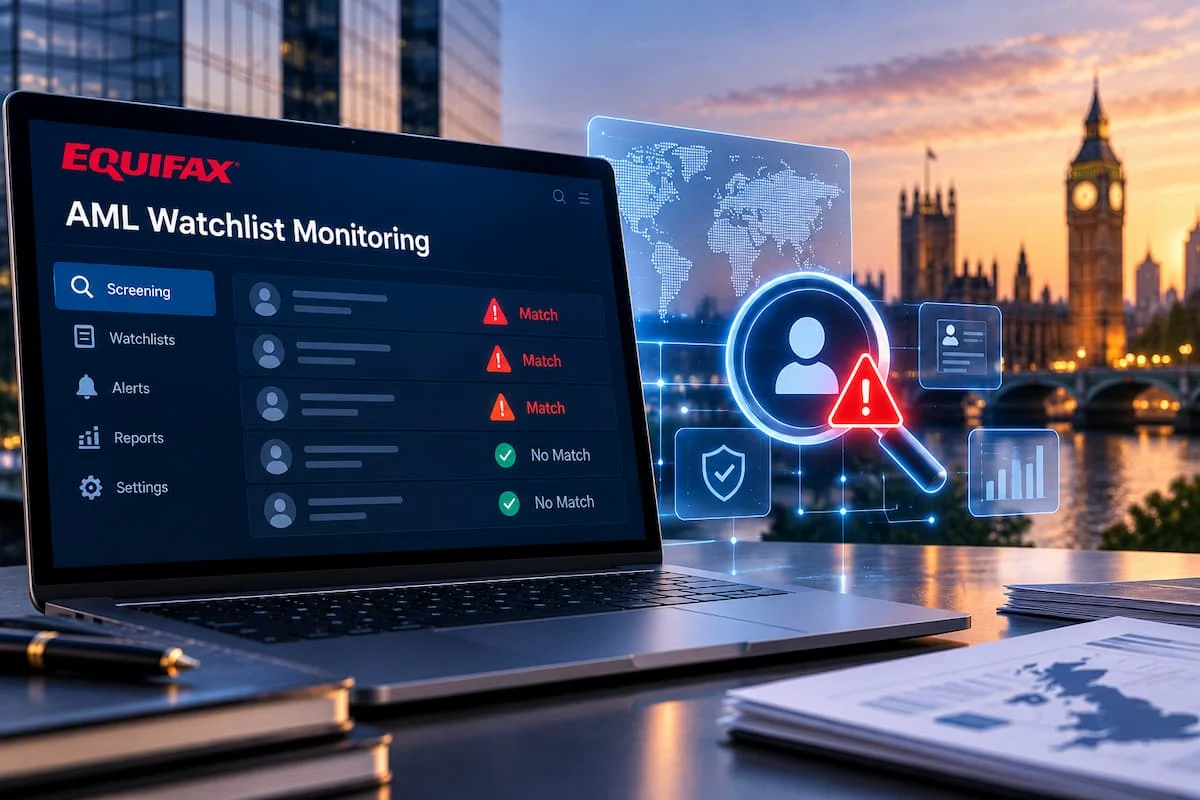
In a strategic move to modernize the UK’s financial regulatory landscape, Equifax UK has unveiled its latest innovation: Automatic Watchlist Monitoring (AWM). This sophisticated product is designed to transition regulated businesses away from the labor-intensive, periodic manual checks that have historically defined anti-money laundering (AML) compliance, replacing them with a dynamic, real-time screening engine.
Developed in collaboration with data intelligence provider NOTO, the AWM solution offers a streamlined approach to fulfilling the stringent ongoing customer due diligence (CDD) obligations required by the UK’s evolving regulatory framework. By integrating global sanctions lists, politically exposed persons (PEP) registers, databases of relatives and close associates (RCAs), and comprehensive adverse media sources, Equifax aims to provide a robust defense against financial crime.
Core Functionality and Strategic Capabilities
At its heart, AWM is engineered to solve the persistent "false-positive" dilemma that plagues compliance teams. In traditional screening models, firms are often forced to choose between high-sensitivity settings—which catch more potential threats but generate a flood of false alarms—and lower sensitivity, which risks missing genuine bad actors.
Equifax’s AWM addresses this friction by allowing clients to configure bespoke match thresholds. This level of granular control enables compliance officers to calibrate the system according to their specific risk appetite and the risk profile of their customer base.
The Technological Edge
Delivered via a single, lightweight API, the solution feeds into a centralized case management dashboard. This architecture serves two primary functions:
- Operational Efficiency: It removes the need for manual batch processing, allowing for continuous, "always-on" monitoring.
- Audit Readiness: Every screening event is recorded, creating a comprehensive audit trail that is critical for satisfying the rigorous scrutiny of supervisory bodies like the Financial Conduct Authority (FCA).
Stephen Adams, Principal Consultant for Identity and Fraud Risk at Equifax UK, notes that the product is a response to the growing operational burdens faced by firms today. "By replacing time-consuming manual checks with an intelligent, automated, real-time solution," Adams explains, "we are enabling our clients to onboard customers faster while maintaining the highest standards of regulatory compliance in an increasingly complex environment."
Chronology of Regulatory Pressure
The launch of AWM arrives at a juncture of heightened scrutiny for the UK financial sector. The evolution of the regulatory environment has been marked by several key milestones that have effectively forced the industry to adopt automation:

- Pre-2023: Regulatory focus centered on basic KYC (Know Your Customer) and periodic reviews, which often relied on legacy systems and manual intervention.
- 2023: The enactment of the Economic Crime and Corporate Transparency Act 2023 significantly shifted the goalposts. The legislation broadened the scope of corporate criminal liability, making it easier to hold firms accountable for failing to prevent fraud.
- 2024: The EU’s Anti-Money Laundering Regulation came into force, setting the stage for a standardized European framework. While the UK operates under its own jurisdiction, the cross-border nature of financial services means that the UK’s alignment with international best practices has become a competitive necessity.
- Mid-2027 (Anticipated): Full application of the new EU AML Authority’s mandate, which will directly supervise the highest-risk entities. This creates a dual-compliance burden for UK firms with EU operations, reinforcing the need for flexible, centralized screening layers.
Supporting Data and Market Context
While Equifax has not yet published specific accuracy metrics or false-positive reduction rates, the industry standard for such tools is increasingly high. The market for automated AML screening is already populated by formidable incumbents, including LexisNexis Risk Solutions, Refinitiv (World-Check), and ComplyAdvantage.
The Competitive Landscape
Equifax’s entry into this space is not merely about launching a new product; it is about leveraging its existing ecosystem. Unlike standalone screening providers, Equifax integrates AWM into its broader identity and fraud-prevention stack.
For firms in financial services, insurance, and gaming, the decision to choose a provider often comes down to the "supervisory perimeter." As an FCA-authorized entity, Equifax presents itself as a partner that understands the specific regulatory pressure points of the UK market. The partnership with NOTO adds a layer of high-fidelity data, drawing from "millions of detailed and up-to-date risk profiles" using anonymized, secure data sets.
Official Perspectives and Industry Implications
The implications of the AWM launch are broad, affecting everything from operational overhead to the speed of customer onboarding.
The Regulatory View
The Financial Conduct Authority (FCA) has made no secret of its dissatisfaction with current ongoing monitoring practices. In various enforcement actions, the regulator has pointed to "weaknesses in ongoing customer monitoring" as a primary failure point. For regulated firms, the message is clear: if you are not using real-time, automated tools, you are falling behind the standard of "reasonable care."
The Gaming and Insurance Sectors
The Gambling Commission, in particular, has ramped up pressure regarding source-of-funds and customer interaction requirements. Gaming operators are under intense scrutiny to ensure they are not inadvertently facilitating money laundering. AWM offers these firms a way to monitor their customer portfolios continuously, ensuring that a user who was "clean" at the point of onboarding does not become a liability months later due to a change in their status on a global sanctions list.
Future-Proofing Compliance
The integration of AI and machine learning into AML screening is no longer a luxury; it is a fundamental requirement. As financial criminals become more sophisticated—using complex corporate shells and rapid-transfer mechanisms—compliance teams cannot rely on static, historical data.

Equifax’s AWM represents a strategic shift toward proactive compliance. By providing a system that can be tuned to specific risk profiles, Equifax allows firms to move from a "defensive" compliance posture—where the goal is merely to avoid fines—to a "proactive" posture, where the goal is to integrate risk management seamlessly into the user experience.
Challenges Ahead
Despite the promise of AWM, challenges remain. The primary hurdle for any new entrant in the AML space is proving "material performance advantage." Established incumbents have years of data refinement and deeply embedded workflows within major banks. For Equifax to succeed, it must demonstrate that its configurable rules and the NOTO-powered data engine can outperform legacy tools in terms of both accuracy and ease of integration.
Furthermore, the lack of published accuracy metrics in the initial announcement leaves a gap that the market will inevitably seek to fill. As the product gains traction and is deployed by Tier-1 financial institutions, the transparency of its "match logic" will become a focal point for compliance auditors.
Conclusion
The launch of Automatic Watchlist Monitoring by Equifax UK marks a significant milestone in the digital transformation of the UK’s financial sector. By bridging the gap between high-level regulatory expectations and the practical, daily realities of compliance teams, Equifax is positioning itself as an essential partner for firms operating in high-risk environments.
As the regulatory perimeter continues to expand—driven by both domestic legislation like the 2023 Economic Crime Act and international mandates—the ability to automate, audit, and configure AML screening will become the defining characteristic of a resilient financial institution. Whether Equifax can successfully disrupt the established hierarchy of AML providers remains to be seen, but the introduction of AWM certainly raises the bar for what businesses should expect from their compliance partners in the years ahead.
This article was produced by Darlyn Ho, with editorial oversight and structural guidance from Mark Walker, Editorial Director at The Fintech Times.