In boardrooms across the globe, the ritual is familiar. Executives gather annually to pore over talent matrices, identifying "high-potential" individuals, discussing career trajectories, and allocating millions to leadership development programs. Yet, when a critical role suddenly falls vacant—due to a resignation, a strategic pivot, or a retirement—the atmosphere in the room shifts from confident planning to frantic triage. The question moves from the strategic "Who is next?" to the desperate "Who is actually ready?"
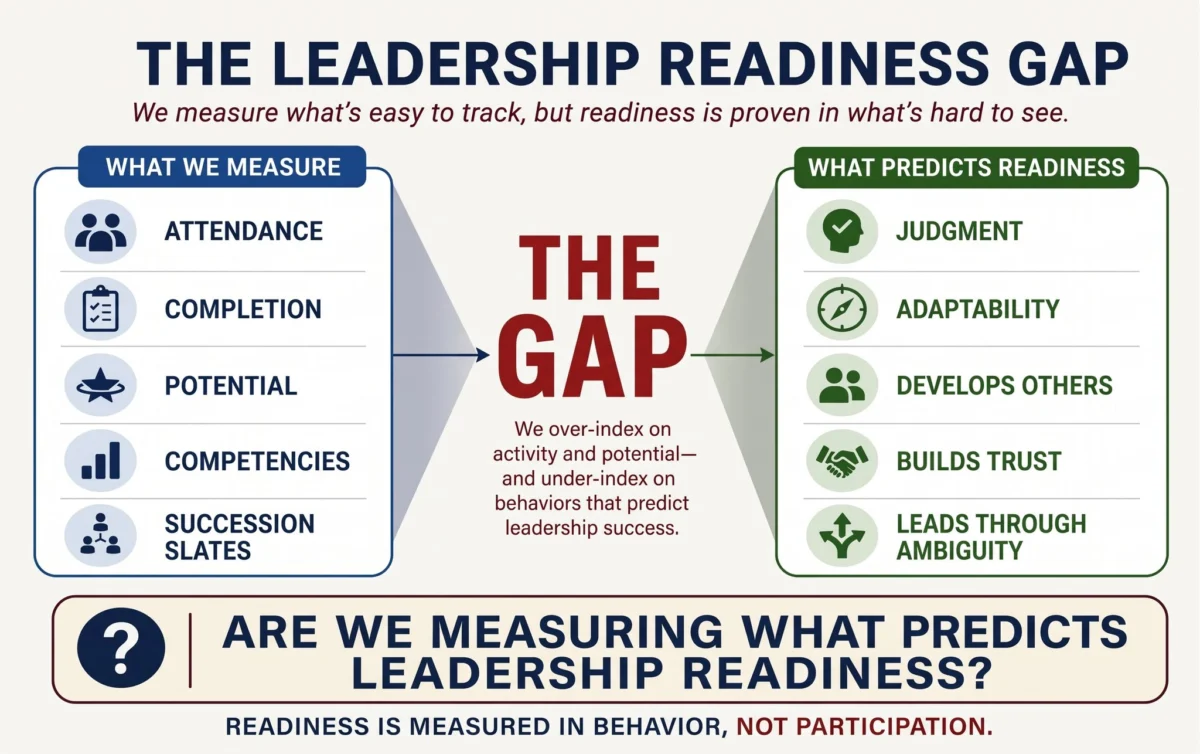
According to experts and industry data, this is not merely a communication breakdown; it is a systemic failure. While organizations have become masters at identifying potential, they have lagged significantly in cultivating readiness. As the corporate landscape becomes increasingly volatile, the gap between a "high-potential" label and the ability to execute in a crisis is widening, creating a "leadership readiness gap" that threatens the stability of major institutions.
The State of the Pipeline: Data-Driven Disconnect
The disconnect between corporate investment and leadership confidence is documented in the Global Leadership Forecast 2025 by DDI. The report reveals a staggering reality: 80 percent of organizations lack confidence in their current leadership pipelines.
If companies are investing record amounts in leadership development, why is the return on investment in the form of "bench strength" so abysmal? The answer lies in a misunderstanding of what it means to be "ready."
Leadership readiness is not a binary switch that turns on when an employee completes a management course. It is highly contextual. A leader may possess the technical brilliance to manage an established, stable division, yet find themselves completely ill-equipped to lead a radical digital transformation or a complex corporate turnaround. The modern organization requires a shift in perspective: from viewing readiness as a static achievement to viewing it as a dynamic, evolving capability that must be tested against the specific, future challenges of the business.
The Anatomy of the Readiness Gap
To understand why the gap exists, we must analyze the evolution of the modern leadership crisis. Historically, succession planning focused on mapping talent to roles. Today, that is insufficient. The complexity of modern business—defined by ambiguity, rapid technological disruption, and shifting global markets—demands that we differentiate between potential and readiness.
The Danger of Confusing Potential with Readiness
"Potential" is an indicator of what an individual might achieve with the right guidance and time. "Readiness," by contrast, is a measure of what an individual can demonstrate with consistency today.
Consider the case of the "star performer." Many organizations make the mistake of promoting high-performing individual contributors into leadership roles based solely on their past success in a functional task. However, the skills that make a person an excellent individual contributor—deep subject matter expertise, personal accountability, and hyper-focus—are often the very skills that hinder them when they are promoted to lead through others.
When a company promotes an individual based on "potential" without verifying their "readiness" to influence, delegate, and manage ambiguity, the result is often a double failure: the new leader struggles, loses confidence, and becomes demoralized, while the team they manage suffers from a lack of effective direction. In such instances, the organization often blames the individual’s lack of "leadership fit," when the real culprit is a broken system that failed to test that individual’s capacity for leadership before the promotion occurred.
Three Structural Shifts for Modern Succession
Closing the readiness gap requires a fundamental shift in how human capital functions operate. Organizations must transition away from passive, program-heavy models toward active, system-based approaches.
1. From Potential-Based Promotion to Evidence-Based Readiness
The first shift involves changing the inquiry process. Instead of asking, "Does this person have the potential for this role?" stakeholders must ask, "What evidence do we have that they are ready to handle the specific stressors of this role?"

This requires a move toward "lived performance" assessments. If a future leader needs to manage through ambiguity, the organization should not wait until they are in the seat to see if they can do it. They should be placed in low-risk, high-complexity scenarios—a cross-functional task force, a small-scale pilot project, or a challenging stakeholder management assignment—that provides the organization with empirical evidence of their capability.
2. From Leadership Programs to Leadership Systems
Leadership development is often treated as a "course" that employees attend. However, a classroom seminar is a poor substitute for a systemic development cycle. An effective leadership system functions as a continuous loop:
- Succession Decisions: Identifying the critical roles and the required skills.
- Gap Identification: Using diagnostic tools to determine where the talent falls short.
- Development Experiences: Assigning "stretch" work that directly targets those specific gaps.
- Observation and Feedback: Creating a culture of real-time coaching.
- Reassessment: Evaluating progress and adjusting the plan.
This system ensures that development is not an extracurricular activity, but a core component of the business operations.
3. From Measuring Activity to Measuring Value
For years, HR and Learning & Development departments have measured success through activity metrics: "How many hours of training were delivered?" or "What was the attendance rate?" These metrics are vanity indicators. They measure effort, not outcome.
Adopting the mindset of asking, "What value are we adding?" forces a shift in focus. At organizations like BDO Canada, for instance, the focus on leadership development shifted from activity to a progression of Capability, Behavior, and Impact.
The question should never be "Who attended the workshop?" but rather "What is this leader doing differently on Monday morning as a result of their training?" If a leader is not having more difficult, high-quality conversations with their team, or if their team is not showing increased engagement and output, the program has failed—regardless of how many hours were spent in the classroom.
Implications for the C-Suite
The implications for leadership are profound. When an organization treats succession planning as a bureaucratic exercise rather than a strategic imperative, it risks losing its best talent to competitors who are more adept at identifying and grooming leaders.
The "readiness" problem is, at its heart, a failure of accountability. If the system fails to prepare a leader, the system must be redesigned. We must move away from the blame-the-leader mentality when a promotion goes wrong. Instead, we must interrogate the assessment protocols that labeled that leader as "ready" in the first place.
Conclusion: Building for the Next Horizon
The era of the "static" succession plan is over. The organizations that will thrive in the coming decade are those that view leadership readiness as a daily, observable, and measurable discipline.
We must stop treating leadership as a destination one reaches after checking enough boxes in a development program. We must treat it as an active practice, tested by experience and refined through feedback.
If we want to build a resilient, future-ready organization, we must abandon the comfortable question, "Who’s next?" and lean into the harder, more uncomfortable work of answering, "Who is actually ready—and how do we know?" The evidence lies in the day-to-day operations of the business. By creating a culture where potential is verified through performance and readiness is forged through systemic challenge, organizations can finally bridge the gap between their ambitions and their reality.